
Iqlab Rule in Tajweed: Meaning, Letter and Examples

The Iqlab rule in Tajweed is one of the four main rules for Noon Sakinah (نْ) and Tanween (ً ٍ ٌ). Iqlab means conversion or changing. It happens when Noon Sakinah or Tanween is followed by the letter Ba (ب). Instead of reading a clear Noon sound, the sound changes toward a hidden Meem with Ghunnah, then moves smoothly into Ba. Unlike Idgham and Ikhfa, Iqlab is easy to identify because it has only one trigger letter. In many printed Mushafs, a small Meem sign may appear near the Noon Sakinah or Tanween to remind the reader that the sound changes. Beginners should focus on four things: identify Ba, avoid a clear “n,” keep the hidden Meem quality with controlled Ghunnah, and pronounce Ba cleanly from its own articulation point.
What is the Iqlab rule in Tajweed?
Iqlab happens when Noon Sakinah or Tanween is followed by Ba (ب). The Noon or Tanween “n” sound changes toward a hidden Meem sound with Ghunnah before the Ba is pronounced. The learner should not say a full Noon and should not completely drop the nasal sound. In common beginner teaching, the Ghunnah is held for about two counts. Iqlab can occur inside one word with Noon Sakinah or across two words with Noon Sakinah or Tanween. The easiest memory rule is simple: see Ba after Noon Sakinah or Tanween → change the sound toward a hidden Meem with Ghunnah.
What does Iqlab mean in Tajweed?
The Arabic word Iqlab means changing, converting, or turning one thing into another. In this Tajweed rule, the sound of Noon Sakinah or Tanween is changed toward a Meem sound because Ba comes next.
The change is not a normal fully pronounced Meem followed by a pause. It is a concealed Meem-like sound carried with Ghunnah and connected directly into Ba.
The Noon/Tanween sound does not vanish. Its quality changes toward a hidden Meem because the next letter is Ba.
What is the Iqlab letter?
There is only one Iqlab letter:
That makes Iqlab one of the easiest Noon Sakinah and Tanween rules to identify. If Noon Sakinah or Tanween is followed by Ba, the rule is Iqlab.
Noon Sakinah
If Ba comes next, change the Noon sound toward hidden Meem.
Fathatain
If the next word begins with Ba, apply Iqlab.
Kasratain
The final “n” quality changes toward hidden Meem before Ba.
Dammatain
Read with hidden Meem quality and Ghunnah before Ba.
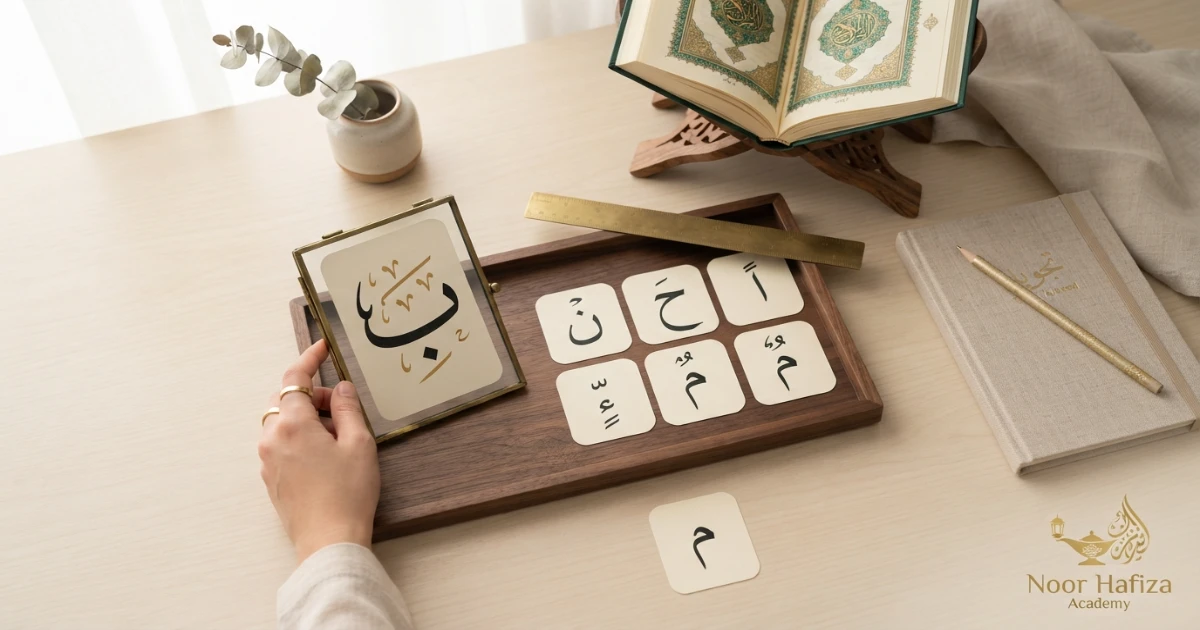
Iqlab with Noon Sakinah
When Noon Sakinah comes before Ba, the Noon sound changes toward a hidden Meem. This can happen inside one word or across two words.
The Noon Sakinah and Ba appear within the same word, so the Noon changes toward hidden Meem with Ghunnah.
The first word ends in Noon Sakinah and the next begins with Ba.
Avoid a clear Noon; keep nasal resonance before the Ba.
A well-known pattern is seen in expressions such as مِنْ بَعْدِ. The Noon Sakinah before Ba is not read as a separate clear Noon. It changes toward a concealed Meem sound with Ghunnah, then the reader moves into Ba.
Another same-word pattern appears when Noon Sakinah is immediately followed by Ba inside the word. The learner should still apply Iqlab; the rule is triggered by the letter relationship, not by a mandatory word boundary.

Iqlab with Tanween
Tanween carries an “n” sound at the end of a word. If the next word begins with Ba, that “n” quality changes toward a hidden Meem with Ghunnah.
Convert the Tanween “n” quality toward hidden Meem before Ba.
Keep a controlled nasal sound while moving into Ba.
Do not pronounce a separate Noon between the two words.
A commonly cited pattern is سَمِيعٌ بَصِيرٌ. Because the first word ends with Tanween and the next begins with Ba, the Tanween “n” sound is converted toward a hidden Meem with Ghunnah before Ba.
The written Tanween sign remains visually attached to the first word, but the reading decision depends on what follows. This is why beginners should train their eyes to look one letter ahead rather than reading each word in isolation.
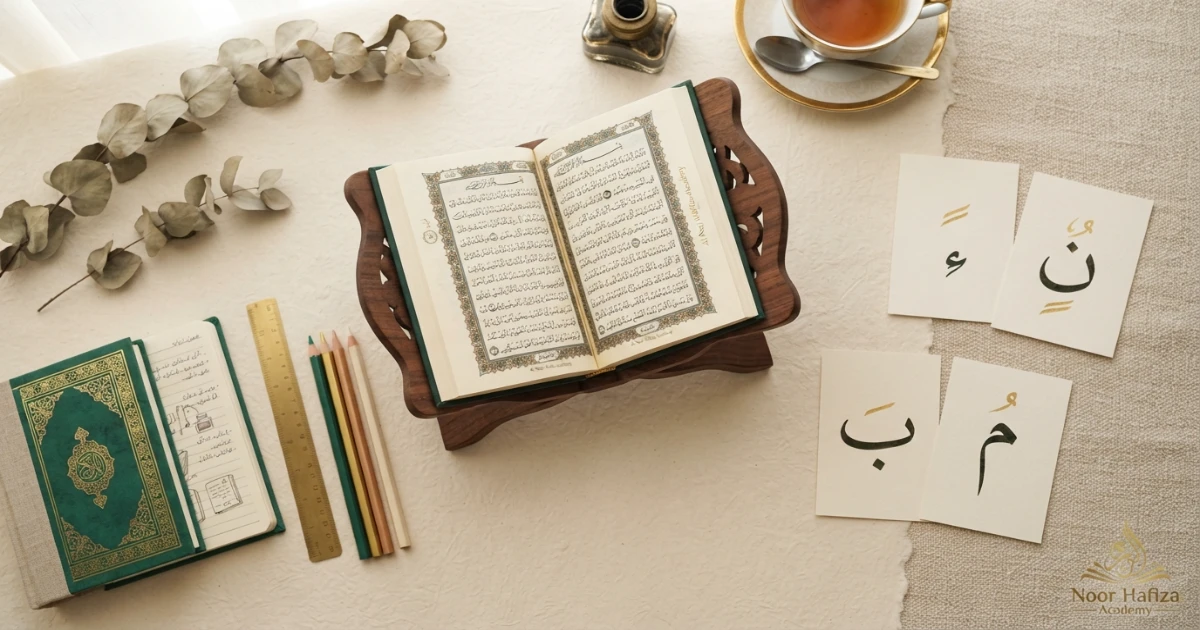
How do you pronounce Iqlab correctly?
A useful beginner description is: do not complete a clear Noon, shift the sound toward Meem, keep Ghunnah, then move into Ba. The lips prepare for the labial sound because both Meem and Ba involve the lips, but the transition should remain smooth rather than becoming a heavy pause.
Do not pronounce the normal “n” sound fully.
Keep the nasal Ghunnah while the lips prepare for Ba.
Finish by articulating Ba clearly without inserting an extra vowel.
Different teachers may describe the exact lip closure in slightly different beginner language. The key practical point is that the learner should not produce a clear Noon and should not turn the hidden Meem into an exaggerated separate syllable. The transition must remain connected.

How long is the Ghunnah in Iqlab?
In common beginner Tajweed teaching, the Ghunnah in Iqlab is held for about two counts. These counts are relative recitation units rather than measured seconds.
The important goal is consistency. If the Ghunnah is too short, the conversion may disappear. If it is held too long, the recitation can become exaggerated. A learner should also avoid turning the two-count Ghunnah into a separate humming sound detached from Ba.
A teacher can help you distinguish the correct hidden Meem from an over-pronounced Meem.
What does the small Meem sign mean in the Mushaf?
In many printed Mushafs, you may see a small م near a Noon Sakinah or Tanween when Iqlab applies. This is a visual reminder that the Noon/Tanween sound changes toward Meem before Ba.
The exact typography can vary between Mushaf editions, so beginners should not depend on the sign alone. The safest skill is to recognize the actual rule: Noon Sakinah or Tanween followed by Ba.
Do not rely only on the small Meem
Learn the underlying rule so you can recognize Iqlab even in a different Mushaf layout.
Do not confuse it with a normal Meem
The small sign is a Tajweed reading cue, not an extra independent word letter.
Can Iqlab happen inside one word?
Yes. Iqlab can happen when Noon Sakinah is followed by Ba inside the same word. It can also happen across two words when one word ends in Noon Sakinah or Tanween and the next word begins with Ba.
| Situation | Trigger | Rule | What changes |
|---|---|---|---|
| Same word | نْ before ب | Iqlab | Noon → hidden Meem sound |
| Across two words | Word ends نْ, next begins ب | Iqlab | Noon → hidden Meem sound |
| Tanween | ً ٍ ٌ before next-word ب | Iqlab | Tanween “n” → hidden Meem sound |
This flexibility makes Iqlab different from the common Noon Sakinah/Tanween Idgham rule, which beginners usually encounter across a word boundary. With Iqlab, the deciding factor is simply the presence of Ba after the Noon sound.
Simple Iqlab examples for beginners
Before reading full verses, practise the pattern itself. The goal is to hear the sound change clearly and consistently.
Noon Sakinah + Ba
Change the Noon sound toward hidden Meem with Ghunnah.
Dammatain + Ba
Convert the final “n” quality before moving into Ba.
Kasratain + Ba
Use the same hidden Meem quality and controlled Ghunnah.
Fathatain + Ba
Avoid a clear Noon and connect smoothly into Ba.
When the pattern feels comfortable, move into complete words and short phrases. Then practise in a fresh Quran page where you must identify Iqlab without being told where it appears. That step helps transfer the rule from exercise mode into real recitation.
How to practise Iqlab step by step
Mark the trigger in a short Quran passage.
If the next letter is ب, the rule is Iqlab.
Do not pronounce a full “n” sound.
Keep controlled Ghunnah while preparing for Ba.
Move into Ba without adding an extra vowel.
Practise until you recognize the rule automatically.
A useful practice routine is to read five Iqlab examples slowly, then repeat them at a natural pace, then open a different page and search for the rule. This trains recognition, sound, and transfer together.
Iqlab vs Izhar, Idgham, and Ikhfa
Iqlab becomes easier when you compare it directly with the other Noon Sakinah and Tanween rules.
| Rule | Core idea | Trigger | What happens |
|---|---|---|---|
| Izhar | Clarity | Izhar letters | Noon/Tanween is clear |
| Idgham | Merging | يرملون | Noon/Tanween merges |
| Iqlab | Conversion | ب only | Changes toward hidden Meem with Ghunnah |
| Ikhfa | Concealment | 15 letters | Noon/Tanween is hidden with Ghunnah |
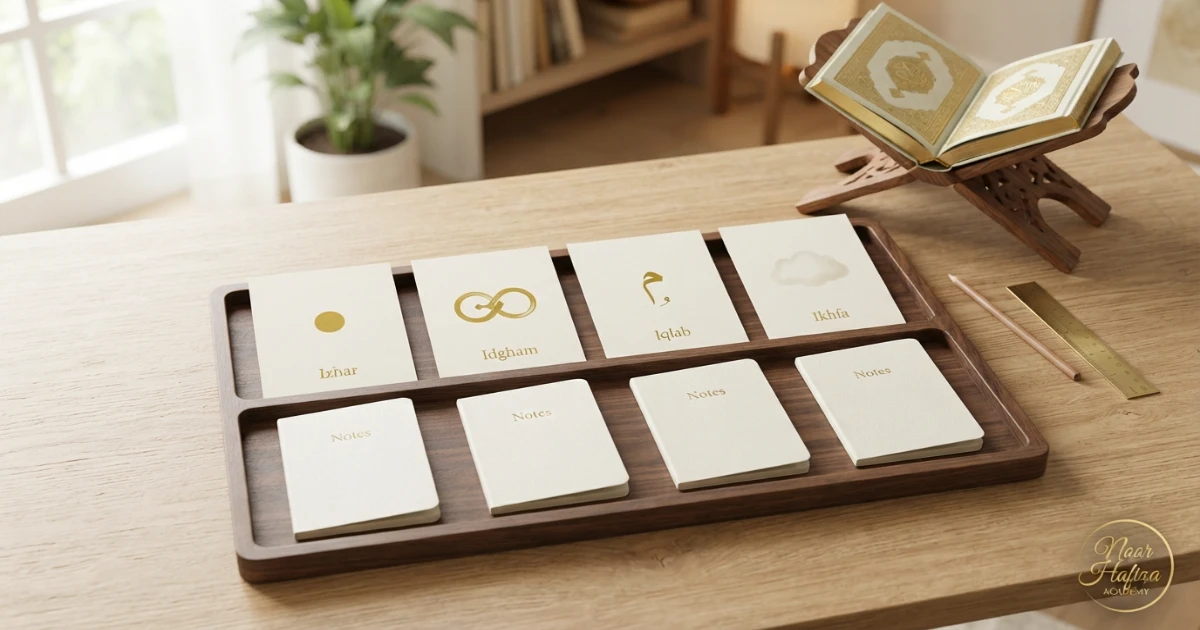
A beginner can often solve any Noon Sakinah/Tanween example by looking at the next letter and asking four questions: is it an Izhar letter, one of the six Idgham letters, Ba, or one of the 15 Ikhfa letters?
Common Iqlab mistakes beginners make
Pronouncing a clear Noon
The learner says a full “n” before Ba instead of converting the sound.
Making a full separate Meem
The hidden Meem becomes too strong and sounds like an extra syllable.
Dropping Ghunnah
The conversion loses its nasal quality.
Holding Ghunnah too long
The sound becomes exaggerated and breaks the flow.
Adding a vowel before Ba
The learner accidentally inserts an “a,” “i,” or “u” sound.
Forgetting same-word Iqlab
The student assumes the rule only works between two words.
Looking only for the small Meem sign
The learner cannot recognize Iqlab in a different Mushaf style.
Confusing Iqlab with Ikhfa Shafawi
Both involve a Meem-like nasal quality near Ba, but the triggers are different.
Is Iqlab the same as Ikhfa Shafawi?
No. The two can sound related because both involve nasal resonance before Ba, but the starting letter is different. Iqlab starts with Noon Sakinah or Tanween. Ikhfa Shafawi starts with Meem Sakinah.
| Rule | Starting letter | Next letter | Main action |
|---|---|---|---|
| Iqlab | Noon Sakinah / Tanween | ب | Convert toward hidden Meem + Ghunnah |
| Ikhfa Shafawi | Meem Sakinah | ب | Hide Meem with Ghunnah |
This distinction is useful because beginners sometimes hear “Meem-like sound before Ba” and assume both rules are identical. The source letter determines the rule name.
Why teacher feedback matters for Iqlab
Iqlab is easy to identify but can still be difficult to pronounce accurately. A learner may produce a clear Noon, close the lips too heavily, add an extra vowel, or over-hold the Ghunnah.
A teacher can listen to the transition and correct the balance between the hidden Meem quality and the following Ba. This is especially useful because written explanations cannot fully represent nasal resonance or exact articulation. Once the basic sound is stable, the teacher can test Iqlab inside full verses so the learner does not slow down unnaturally whenever Ba appears.
12-point Iqlab practice checklist
Use this while reading fresh Quran text
- Can I identify Noon Sakinah correctly?
- Can I identify all three Tanween signs?
- Is the next letter Ba (ب)?
- Do I recognize that Ba is the only Iqlab letter?
- Am I avoiding a fully clear Noon?
- Am I shifting the sound toward hidden Meem?
- Is the Ghunnah controlled rather than exaggerated?
- Am I moving smoothly into Ba?
- Am I avoiding an extra vowel before Ba?
- Can I recognize Iqlab inside one word?
- Can I recognize Iqlab across two words with Tanween?
- Can I apply the rule without relying only on a small Meem sign?

Learn Iqlab and beginner Tajweed online
Noor Hafiza Academy offers live online Quran learning for children, girls, women, adults, beginners, returning readers, teenagers, siblings, and homeschool families with female Quran teachers. Learners can ask about Noorani Qaida, Quran reading, Tajweed, Makharij, Hifz, and pronunciation correction according to their current level.
A beginner Tajweed plan may include Noon Sakinah and Tanween rules, Meem Sakinah, Ghunnah, Qalqalah, Madd, Waqf, Makharij, and guided recitation practice. Current teacher qualifications, female-teacher availability, class length, trial arrangements, fees, schedules, privacy practices, safeguarding policies, and enrollment terms should be confirmed directly.
Share the learner’s age, Quran reading level, Tajweed background, main pronunciation difficulty, preferred schedule, and whether a female teacher is requested.
FAQs about the Iqlab rule in Tajweed
What is Iqlab in Tajweed?
How many Iqlab letters are there?
Does Iqlab apply to both Noon Sakinah and Tanween?
Does Iqlab use Ghunnah?
Can Iqlab happen inside one word?
What happens to the Noon sound in Iqlab?
What does the small Meem sign mean in the Mushaf?
How long should the Ghunnah be in Iqlab?
What is the difference between Iqlab and Ikhfa?
Is Iqlab the same as Ikhfa Shafawi?
What is the most common Iqlab mistake?
How should beginners practise Iqlab?
Master Iqlab by recognizing Ba, controlling Ghunnah, and changing the Noon sound toward a hidden Meem in real Quran recitation
Share the learner’s age, Quran level, Tajweed background, main pronunciation difficulty, and preferred class schedule.