
Tajweed Rules for Beginners: A Practical Starting Guide

Tajweed rules for beginners become manageable when they are learned as practical reading skills. Start with accurate Arabic letter sounds and short vowels. Then build control of madd, ghunnah, qalqalah, noon sakinah and tanween, meem sakinah, and safe stopping. The goal is not to memorize every technical term in one week. The goal is to hear the difference, produce it with guidance, recognize the pattern in the Mushaf, and apply it consistently while reading short Quran passages.
Which Tajweed rules should a beginner learn first?
A beginner should normally start with correct letter articulation, short vowels, sukoon, shaddah, and basic madd. After that, the learner can study the most frequent rule families: noon sakinah and tanween, meem sakinah, ghunnah, qalqalah, heavy and light sounds, and practical stopping. This order works because every later rule depends on the learner being able to recognize letters, signs, and sound length accurately. The rules should be learned through listening and corrected recitation, not definitions alone. A useful beginner target is to apply one or two rules accurately in short verses before adding another group.
What are Tajweed rules for beginners?
Tajweed is the disciplined way of reciting the Quran by giving letters their correct points of articulation, sound qualities, timing, and relationships to nearby letters. For a beginner, a “rule” is not merely a name such as ikhfa or qalqalah. It is an instruction that changes what the reader should do with a sound.
For example, a beginner may see a noon sakinah before a particular letter. The rule explains whether the noon should be pronounced clearly, merged, changed, or partially concealed with nasal resonance. The terminology helps organize learning, but the practical skill is hearing and producing the correct result.
This distinction matters because many beginners can repeat definitions yet remain unsure when the rule appears in a real verse. Strong teaching connects four stages: identify the sign, name the pattern when useful, hear the model, and apply it in Quran reading. The learner should then meet the same rule in a different word so the teacher can check whether the skill transferred.
Ask instead: Can I recognize the pattern, produce the sound correctly, and keep it accurate when the word changes?

Foundation 1: letters, makharij, and sound qualities
The first Tajweed foundation is makharij: the points from which Arabic letters are produced. Some sounds are formed at the lips, some with parts of the tongue, and others in the throat. The purpose is not to turn the lesson into an anatomy lecture. The purpose is to help the learner stop substituting one letter for another.
A teacher may ask the learner to compare two letters that sound similar to an untrained ear. The student listens, watches the teacher’s mouth position when appropriate, repeats slowly, and then reads the letter inside a short word. This process is more effective than repeating a mistaken sound quickly.
Sifat are the characteristics of letters. They describe qualities such as strength, airflow, heaviness, softness, or echo. Beginners do not need every advanced classification immediately, but they do need the qualities that prevent common substitutions. A letter may be correctly located yet still sound wrong if its characteristic is missing.
Listen for contrast
Compare two commonly confused letters and identify what changes in place, airflow, or heaviness.
Repeat slowly
Produce the letter alone, then with a short vowel, and finally inside a simple word.
Transfer the correction
Apply the improved sound to a different word instead of repeating only the teacher’s example.

Foundation 2: short vowels, sukoon, shaddah, and madd
Before studying complex combinations, beginners need reliable control of the signs that shape every word. Fathah, kasrah, and dammah are short vowels. They should be read briefly rather than stretched into long vowels. A sukoon shows that the letter does not carry a vowel, while shaddah strengthens or doubles the consonant sound.
Many early recitation errors come from timing. A learner may stretch every vowel because melodic recitation sounds beautiful, or shorten a required long sound because the reader is rushing. Tajweed teaches that short and long sounds have different values. The learner should hear and feel the difference before memorizing several categories of madd.
The practical two-count madd
A beginner usually starts with the natural or basic lengthening that is held for approximately two counts. The counts should be even and calm. They are not tied to a stopwatch; they are a consistent recitation pulse. The teacher can clap, tap, or use a simple vocal count until the learner can maintain the same duration in different words.
Why shaddah needs attention
A shaddah is not merely a visual mark. It indicates that the consonant receives a doubled or strengthened treatment. Beginners sometimes pass over it as though the letter were ordinary, which changes the word’s sound. Slow practice helps the learner give the first part its proper closure and then release the second part with its vowel.
| Sign or skill | What the beginner should do | Common error | Practical correction |
|---|---|---|---|
| Short vowel | Read briefly and clearly | Stretching it into a long sound | Compare short and two-count versions |
| Sukoon | Stop the vowel while preserving the letter | Adding an extra vowel | Close the sound without inserting “a,” “i,” or “u” |
| Shaddah | Give the doubled consonant its complete value | Reading it as a single light letter | Separate the held portion from the following vowel |
| Basic madd | Maintain an even two-count length | Randomly shortening or over-stretching | Use a steady count and repeat in new examples |
Noon sakinah and tanween: izhar, idgham, iqlab, and ikhfa
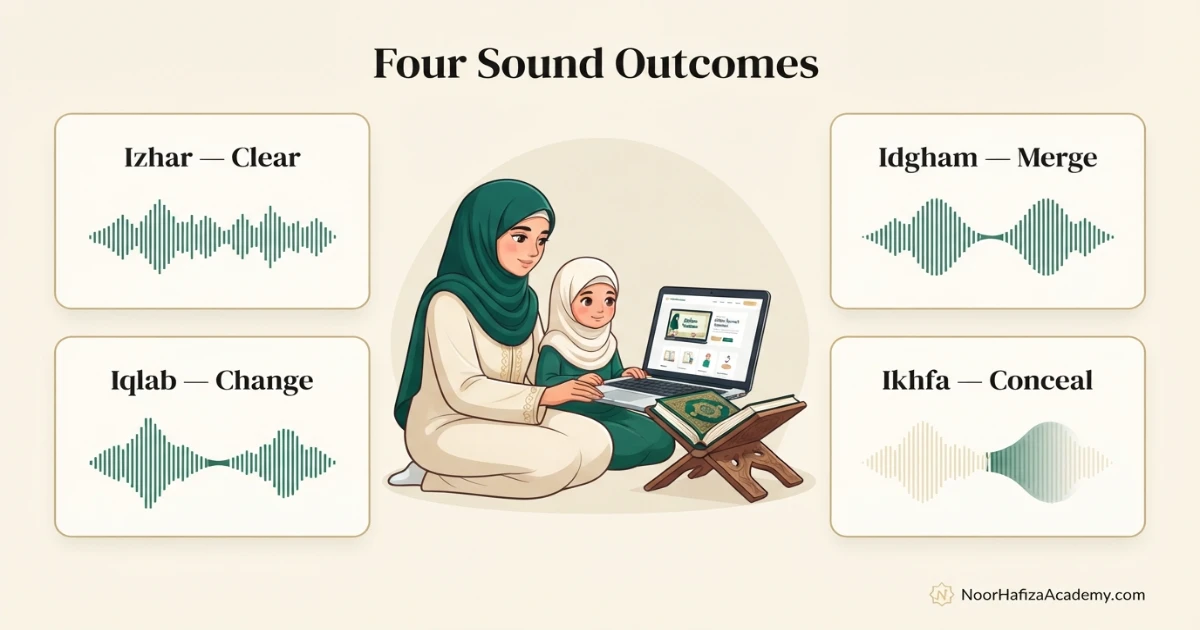
Noon sakinah and tanween rules are among the most frequently taught Tajweed rules for beginners. They describe what happens when a noon without a vowel, or a tanween ending, meets the next letter. The four major outcomes are clear pronunciation, merging, conversion, and concealment.
Izhar: pronounce clearly
The noon sound remains clear before the izhar letters. The beginner should avoid adding excessive nasalization or merging the noon into the next letter.
Idgham: merge into the next letter
The noon or tanween enters the following letter. Some idgham cases include ghunnah and some do not, so the learner should hear the difference rather than treating every merge identically.
Iqlab: change the sound toward meem
Before the letter ba, the noon sound changes toward a concealed meem with ghunnah. Beginners should not produce a fully open noon or an exaggerated separate meem.
Ikhfa: conceal between clarity and merging
The noon sound is neither fully clear nor completely merged. It is concealed with nasal resonance while the mouth prepares for the next letter.
Beginners often try to memorize letter lists without hearing the four outcomes. A more practical method is to use one contrasting example from each group. Once the ear recognizes the difference, the letter groups become easier to remember. The teacher should then mix examples so the learner must choose the rule independently.
Meem sakinah, ghunnah, and nasal control
Meem sakinah has three practical beginner outcomes. Before ba, it is concealed with a lip-based ikhfa and ghunnah. Before another meem, it merges into the next meem with ghunnah. Before the remaining letters, it is pronounced clearly, while the lips still close naturally for meem.
Ghunnah is a nasal sound associated strongly with noon and meem. Beginners may produce too little ghunnah, making a rule disappear, or too much, turning every noon and meem into a long nasal tone. The goal is controlled resonance with the correct duration and context.
Ikhfa shafawi
Before ba, conceal the meem lightly with closed lips and measured ghunnah.
Idgham shafawi
When meem sakinah meets meem, merge them and maintain the ghunnah.
Izhar shafawi
Before other letters, pronounce the meem clearly without hiding or over-stretching it.
Qalqalah: controlled echo without adding a vowel
Qalqalah is a controlled bounce or echo heard when one of its letters carries sukoon. The purpose is to preserve the consonant clearly without adding a full vowel. Beginners sometimes turn qalqalah into “qa,” “qi,” or “qu,” depending on habit. That extra vowel should be avoided.
The sound is produced by releasing the articulation point after closure. It may be more noticeable when stopping on the letter, but it should still remain a consonant release rather than a new syllable. A teacher can help the learner compare an accurate qalqalah with an example containing an inserted vowel.

Heavy letters, light letters, lam, and ra
Arabic includes letters that naturally carry a heavier quality and letters that remain light. A beginner should first learn the clearly heavy letters and avoid making every nearby vowel heavy. The heaviness belongs to the letter and influences the surrounding sound in a controlled way.
The letters lam and ra require special attention because their heaviness can depend on context. Beginners do not need every rare condition in the first stage. They need common patterns taught through real Quran examples. The teacher can mark one recurring situation, demonstrate the contrast, and ask the learner to find the same pattern elsewhere.
A common mistake is to force heaviness by changing the mouth too dramatically. This can distort the vowel. Correct heaviness should sound full but natural. Likewise, a light sound should not become weak or unclear.
Beginner rules for stopping and starting
Tajweed is not only about individual sounds. A learner also needs to know where to stop, what changes when stopping, and how to restart safely. Stopping in the wrong place can interrupt meaning, while stopping without adjusting the final sound can create a reading error.
At beginner level, the teacher can start with three practical habits. First, observe common pause signs and verse endings. Second, when stopping, apply the appropriate ending form rather than continuing the final vowel automatically. Third, restart from a place that produces a complete and understandable phrase.
Breath is part of the decision. A learner should not rush through a long phrase simply to avoid stopping. It is better to plan a safe pause, take a calm breath, and restart correctly. With practice, stopping and breath control become more natural.
A calm, meaningful stop is better than reaching the end of a line with rushed letters, shortened madd, and lost articulation.

A step-by-step Tajweed roadmap for beginners
The order below keeps the learner focused on high-value foundations. A teacher may adjust it according to the student’s reading level and recurring mistakes.
Assess Quran-reading ability
Check letter recognition, joined reading, short vowels, fluency, common sound substitutions, and the learner’s ability to read without copying every word.
Repair the most important makharij errors
Prioritize letter substitutions and unclear contrasts that affect many words. Practise slowly and transfer each correction to a new example.
Control vowels, sukoon, shaddah, and basic madd
Build reliable timing before introducing several advanced lengthening categories.
Learn noon sakinah and tanween outcomes
Hear and apply izhar, idgham, iqlab, and ikhfa through contrasting examples.
Add meem sakinah, ghunnah, and qalqalah
Control lip closure, nasal resonance, and consonant release without exaggeration.
Practise heaviness, lam, ra, and stopping
Use common patterns first and connect them to meaningful Quran phrases.
Apply rules in continuous recitation
Read short passages, identify recurring mistakes, retain corrections, and gradually reduce teacher prompting.
A weekly practice plan for beginner Tajweed
A beginner does not need a long technical session every day. Ten to twenty focused minutes on most days can be useful when the practice is connected to the teacher’s current target. The learner should not practise an uncertain sound dozens of times without a correct reference.
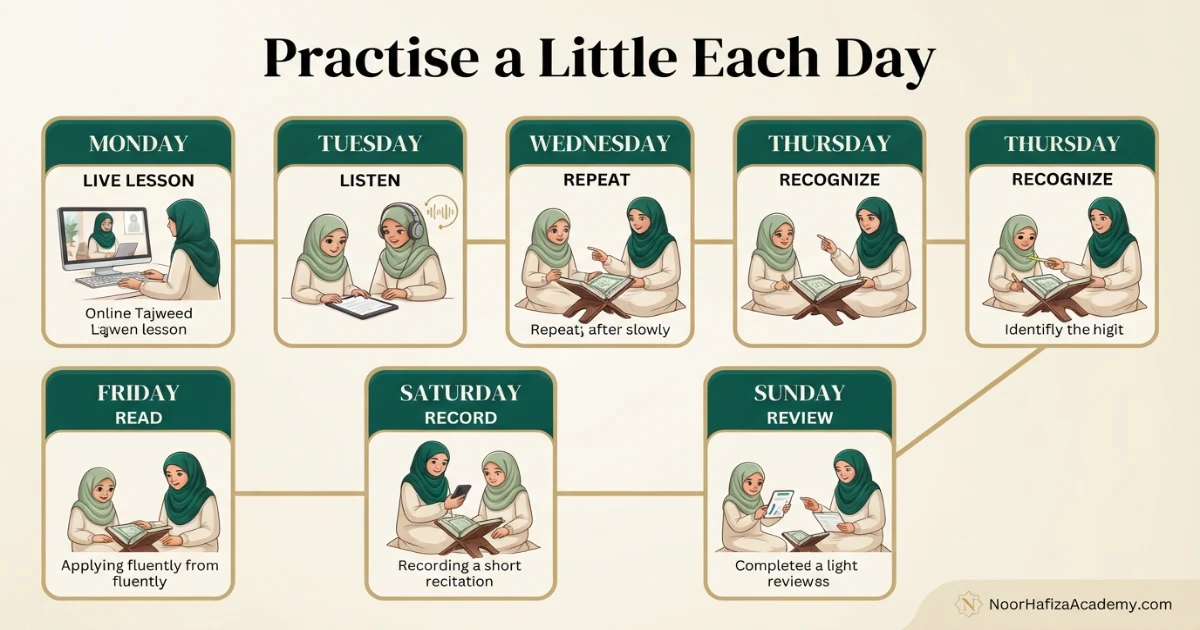
Live correction lesson
Learn one main sound or rule, hear accurate examples, and record the teacher’s specific correction.
Listening and slow repetition
Listen to the assigned model, repeat short examples, and stop before fatigue reduces accuracy.
Recognition practice
Find the rule in several Quran words and explain what should happen before reading aloud.
Second live lesson or review
Read the assigned passage, correct the recurring issue, and test the correction in a new verse.
Short continuous recitation
Read a manageable passage without stopping after every word, then review the teacher’s priority mistake.
Self-recording check
Record a short recitation, compare it with the model, and note one difference rather than trying to diagnose everything.
Light revision and rest
Review rule cards or listen attentively. Avoid adding new material before the previous target is stable.
Measure transfer
Check whether the learner applies the rule in an unfamiliar word with less prompting than before.
Common mistakes beginners make when learning Tajweed
Memorizing terminology without sound
The learner can define ikhfa or madd but cannot recognize or apply it during recitation.
Learning too many rules at once
Several rule lists are introduced before the learner can apply the first group independently.
Practising mistakes repeatedly
Uncertain pronunciation is repeated at home without a reliable teacher model or recording.
Overdoing ghunnah and qalqalah
Nasal sounds and echoes become theatrical rather than controlled and measured.
Chasing melody before accuracy
The learner copies tune and speed while letters, vowels, and madd remain unstable.
Ignoring stopping and breath
The reader rushes through long phrases, shortens sounds, or stops where the phrase becomes incomplete.
How Tajweed teaching should change by learner
Children and adults can learn the same Tajweed principles, but the lesson method should reflect attention, language, confidence, and previous reading experience. A young child may need shorter activities, more listening, and one correction at a time. An adult may appreciate concise explanation and written notes but may need careful work on pronunciation habits established over many years.
| Learner | Useful lesson approach | Common challenge | Progress sign |
|---|---|---|---|
| Young child | Short modeling, repetition, visual pointing, parent-supported routine | Attention and speech control | Clearer sounds with less prompting |
| Older child or teen | Private correction, clear goals, Quran application | Embarrassment about mistakes | Independent retry and self-correction |
| Adult beginner | Mature explanations, flexible schedule, focused practice | Work, family duties, fear of error | Consistent short practice and rule recognition |
| Returning reader | Targeted assessment and selective repair | Established habits and memorized reading | Corrections transfer to unfamiliar passages |
What to look for in a beginner Tajweed teacher
A good beginner teacher should be able to hear the difference between a reading problem and a rule problem. Some learners need basic Quran decoding before a full Tajweed course. Others read fluently but need targeted makharij and rule application. Placement should follow a live assessment rather than age or a previous certificate alone.
Accurate recitation model
The teacher demonstrates sounds and timing clearly without asking the learner to imitate an unclear or rushed example.
Specific correction
The learner is told which letter, articulation point, duration, or rule needs repair.
Independent retry
The teacher gives the student time to attempt again rather than reading every answer first.
Transfer checks
The corrected skill is tested in another word or verse to confirm real understanding.
Level-based pacing
The teacher does not overload a beginner with advanced terminology before the foundation is usable.
Clear progress feedback
The learner or parent understands what improved, what remains weak, and what to practise next.
Learning Tajweed online with Noor Hafiza Academy
Noor Hafiza Academy offers live online Quran and Tajweed learning for children, girls, women, sisters, beginners, and returning readers with female Quran teachers. A learner’s Quran-reading ability, pronunciation, previous study, goals, preferred schedule, and time zone can be discussed before regular classes begin.
A complete beginner may first need Noorani Qaida or foundational Quran reading. A learner who already decodes Arabic may begin with a focused Tajweed assessment. Lessons can then prioritize the most important makharij errors, basic timing, common rule families, and gradual application in short Quran passages. Current teacher availability, schedules, fees, materials, and enrollment terms should be confirmed directly with the academy.
A short live assessment can show whether the learner needs Quran-reading foundations, beginner Tajweed rules, pronunciation repair, or more advanced recitation practice.
How to know beginner Tajweed is improving
Clearer letter contrast
Commonly confused letters sound more distinct in new words, not only in isolated drills.
Stable short and long sounds
Short vowels remain brief and basic madd is held with more consistent timing.
Rule recognition
The learner notices common noon, meem, ghunnah, and qalqalah patterns before reading.
Correction retention
A corrected sound remains improved in the next example and a later lesson.
Safer stopping
The reader plans breath, stops calmly, and restarts from a more suitable place.
Growing self-correction
The learner hears some mistakes independently and retries before the teacher gives the full answer.
Tajweed rules for beginners FAQs
What are the basic Tajweed rules for beginners?
Which Tajweed rule should I learn first?
Can I learn Tajweed rules without reading Arabic?
How many Tajweed rules should a beginner study at once?
What is the easiest way to remember noon sakinah rules?
What is ghunnah in simple words?
What is qalqalah for beginners?
How should a beginner practise madd?
Should beginners learn all stopping signs?
Can children learn Tajweed rules online?
Can adults learn Tajweed from scratch?
Can I request a female Tajweed teacher?
Learn Tajweed rules through listening, correction, and Quran application
Share the learner’s age, Quran-reading level, pronunciation concerns, time zone, and preferred schedule. A live assessment can help identify whether to begin with reading foundations, makharij repair, or a structured beginner Tajweed plan.