
Daily Hifz Schedule for Kids: School-Friendly Quran Memorization

A realistic daily Hifz schedule for kids should support Quran memorization without turning every school day into a race. Most children do better with one short focused session for new memorization, one lighter revision period, regular teacher testing, and a predictable bedtime. The exact timetable depends on school hours, age, reading level, travel, homework, family routines, and how much Quran the child already carries in revision. This guide gives practical weekday, weekend, and exam-season models that parents can adjust without sacrificing retention, confidence, or rest.
What is a good daily Hifz schedule for kids?
A practical school-day schedule often uses 10–20 minutes for a small new portion when the child is mentally fresh, 10–15 minutes for recent revision later in the day, and a short older-revision or listening session. Many children benefit from three to five live Hifz lessons each week, but the timetable should be adjusted to school load and energy. The child should revise more Quran than she memorizes, recite yesterday’s lesson before adding new work, and receive at least one weekly test that includes older passages. During exams, illness, travel, or poor sleep, reduce or pause new memorization and protect revision.
What a school-friendly Hifz schedule should actually achieve
A Hifz timetable is not successful merely because every available minute has been filled. It is successful when a child can attend school, complete normal responsibilities, sleep adequately, learn a manageable new portion, revise older work, accept correction, and return the next day without dread. The schedule should make memorization repeatable. A plan that works for four intense days and then collapses is weaker than a modest routine that continues through the term.
Parents sometimes focus on the number of lines memorized each day because it is easy to measure. Retention is harder to see. A child may recite a fresh passage beautifully in the evening and struggle the next morning. That does not always mean she lacks ability. It may mean the new portion was too large, revision was delayed, sleep was short, or the passage was repeated while looking without enough closed-book recall.
The child should be able to recite yesterday’s work, connect the verses, preserve word order, apply major pronunciation corrections, and return to older surahs on schedule. New memorization is only one part of that system.
The timetable also needs emotional space. Children learn differently on school days, weekends, examination weeks, and holidays. A responsible plan can become lighter without becoming careless. Reducing the new lesson during a demanding week may protect long-term progress better than forcing the original target and creating repeated failure.
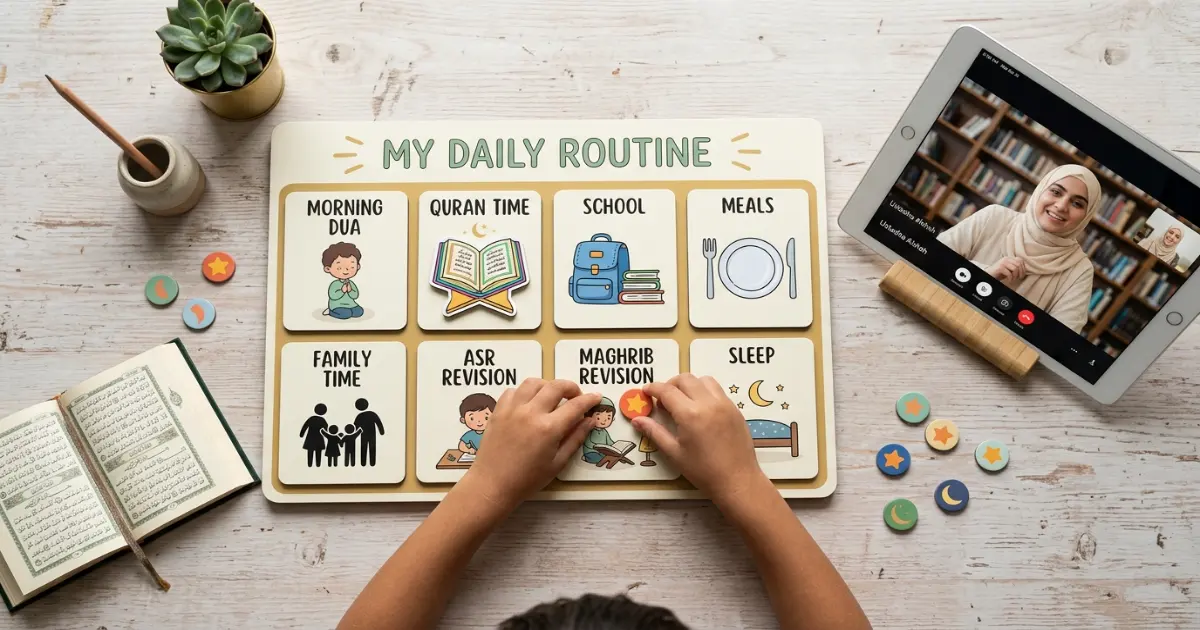
Before setting the timetable, check the child’s real starting point
Two children of the same age may need very different schedules. One may read fluently and memorize a short passage quickly but require more older revision. Another may have strong memory but weak decoding and need time to read accurately before memorizing. A third may travel a long distance to school and arrive home exhausted. The first timetable should therefore be based on observed performance rather than a generic chart.
Reading level
Can the child read the assigned passage with manageable support, or must every word be copied from the teacher?
Current revision load
How many surahs, pages, or lessons already need regular circulation?
School hours
Include travel, homework, tuition, sports, meals, and bedtime—not only classroom hours.
Best energy window
Some children focus before school; others work better after a snack and short rest.
Pronunciation needs
Difficult letters, similar words, and Tajweed corrections may require a smaller daily portion.
Parent support
A parent may manage time and listening, but should not supply every first word.
A live assessment can help the teacher select a starting portion and identify whether the first goal should be memorization, reading repair, pronunciation correction, or revision recovery. Parents can review the broader guide on how to memorize the Quran with a realistic beginner plan for the full memorization method.
How much should a school child memorize each day?
The correct amount is the portion the child can read accurately, memorize with attention, recite without looking, retain the next day, and carry alongside revision. It may be part of a verse, one short verse, two or three lines, or more for an experienced learner. The amount should not be selected only by age or by what another child is doing.
Use the next-day test. Before new work begins, ask the child to recite yesterday’s portion without looking and without receiving every opening word. If the passage needs many prompts, repair it first. If yesterday’s work is stable for several weeks, recent revision is complete, and older revision is also strong, a teacher may increase the portion slightly.
| Child profile | Possible starting amount | New-work session | Main caution |
|---|---|---|---|
| Young beginner | Part of a verse or one short phrase | 8–12 focused minutes | End before attention turns into guessing |
| Primary-school learner | One short verse or one to three lines | 10–20 minutes | Keep revision larger than new work |
| Older child with stable fluency | Several lines based on retention | 15–25 minutes | School workload may change weekly |
| Child returning after a break | Pause or reduce new work | Revision first | Do not hide weak old work with fresh pages |
| Exam-season learner | Very small portion or none | Optional 5–10 minutes | Protect sleep and minimum revision |
A child who memorizes quickly may still need a small portion if the existing revision load is large. A child who memorizes slowly may make excellent progress when each passage remains strong. The goal is not to create an impressive daily number; it is to build a growing body of Quran that the learner can continue to access.
Balance new memorization, recent revision, and older revision
Every school-friendly Hifz schedule should separate three types of work. New memorization is today’s fresh portion. Recent revision includes yesterday’s lesson and the passages learned during the current week or recent weeks. Older revision includes material that has moved into long-term circulation. When all three are mixed without a plan, parents may feel busy while important passages quietly weaken.
New lesson
A small fresh portion read accurately, divided into phrases, connected, recalled without looking, and tested.
Recent revision
Yesterday’s and this week’s work, reviewed frequently because it is not yet secure.
Older revision
Earlier surahs or pages rotated across the week to protect long-term recall.

A simple beginner pattern is one short new portion, several recent passages, and a small older-revision set. As the memorized amount grows, the older-revision cycle must become more organized. When revision time becomes too long for a school day, reduce new memorization instead of squeezing revision into an unrealistic window.
Before school or after school: when should kids memorize Quran?
There is no single best time for every family. The most useful time is a quiet, repeatable window when the child is alert and not rushing. Before-school memorization can work well for children who wake easily, sleep on time, and have calm mornings. After-school memorization can work better when mornings are rushed or when the child needs to hear a live teacher in another time zone.
Before-school option
- Use after adequate sleep and a calm wake-up
- Keep the new portion short
- Prepare books and school items the night before
- Avoid turning breakfast and transport into a rush
- Move revision to later if the morning is brief
After-school option
- Allow a snack, prayer, and short decompression
- Do Hifz before the child becomes exhausted
- Separate memorization from heavy homework when possible
- Use a live female teacher for focused correction
- Finish well before bedtime
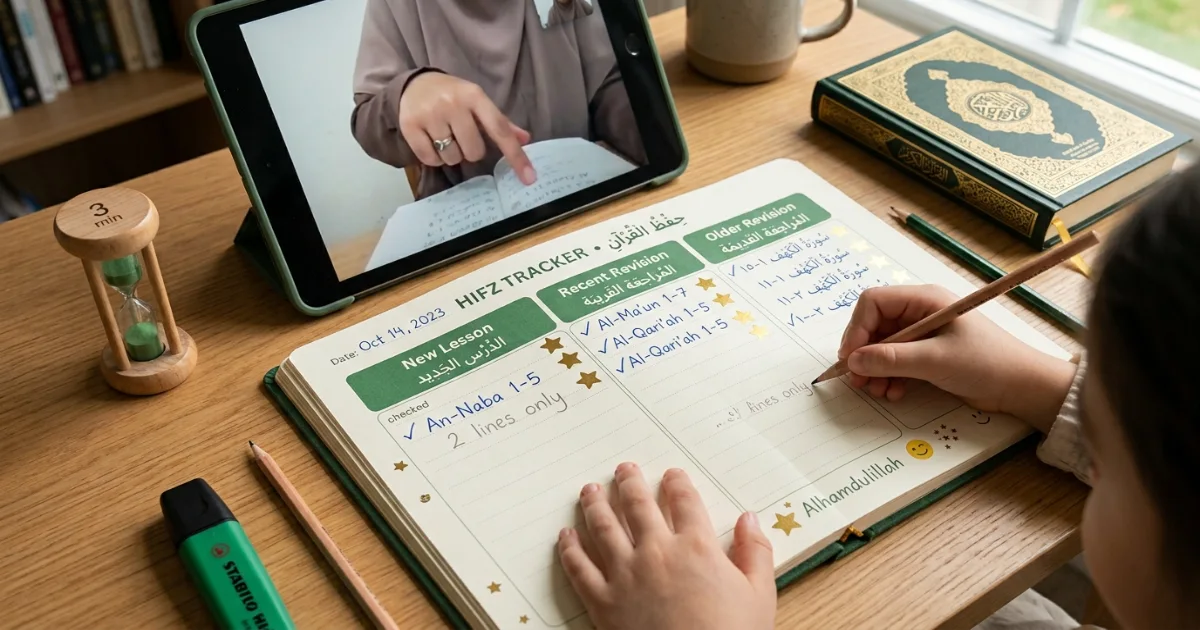
Some children benefit from a split schedule: new memorization in the morning and revision in the afternoon or evening. This often reduces fatigue because no single session is long. Other families prefer one after-school live class followed by a five-minute independent recall check later. The timetable should be tested for two or three weeks and adjusted according to retention and mood.
Three realistic daily Hifz schedules for school days
The examples below are planning models, not fixed rules. Parents should change the clock times according to school start, travel, prayer times, family meals, and the teacher’s availability. The order matters more than the exact hour: fresh mind for new work, a separate revision check, homework protected, and bedtime kept stable.
| Schedule model | Before school | After school | Evening |
|---|---|---|---|
| Morning-focused | 10–15 min new portion after waking and prayer | 10–15 min recent revision after snack and rest | 5–10 min older revision or listening |
| After-school live lesson | 5 min yesterday’s lesson | 20–30 min live class: test, correction, small new portion | 5 min closed-book recall |
| Homework-heavy day | 10 min revision only | Homework and normal responsibilities | 5–10 min light new work or no new work |
| Very young child | Optional listening | 10–15 min teacher-guided Hifz | 5 min parent-supported review |
When Hifz repeatedly pushes bedtime later, concentration, school performance, behavior, and next-day retention may all suffer. Reduce the portion, move a session, or revise only.
A 20–40 minute daily Hifz routine for school children
The total time can be divided into two or three short sessions. A younger learner may need less. An older or more experienced child may use more time, particularly when revision has grown. The following sequence keeps accuracy and recall at the center.
Test yesterday’s lesson
Ask for closed-book recitation before giving the new portion. Note weak beginnings, joins, word changes, and pronunciation corrections.
Read the new passage accurately
Use the Mushaf and teacher guidance. Correct letters, vowels, shaddah, madd, and word order before high repetition.
Divide it into short phrases
Use manageable units, repeat attentively, and connect one phrase to the next instead of restarting the entire passage every time.
Recall without looking
Cover the text, allow thinking time, repair only the exact weak point, and retest the complete portion.
Complete recent revision
Recite the current week’s work, especially verse joins and passages corrected in the previous class.
Rotate older revision
Follow a recorded weekly cycle so earlier surahs do not depend on occasional memory.
End with one clear note
Record the new portion, revision set, one correction, and what must be tested next time. Avoid sending the child away with a long vague list.
Repetition counts can help some children, but they should not replace attention. The child should know what she is checking. Is the weak point the first word, a similar ending, the join between two verses, a heavy letter, or a long vowel? Purposeful repetition is easier to retain than mechanical recitation.
A school-friendly weekly Hifz schedule for kids
A weekly plan prevents every day from becoming identical. Some days can include a live new lesson, while others focus on strengthening. One lighter day can protect recovery and family flexibility without abandoning Quran contact. The exact number of live lessons should match the child’s level, attention, and family schedule.
| Day | Main Hifz task | Revision task | Parent or teacher check |
|---|---|---|---|
| Monday | Small new lesson | Weekend material | Confirm the week’s target |
| Tuesday | Strengthen Monday’s passage | Recent revision | Check verse joins |
| Wednesday | New lesson if retention is strong | Older rotation set A | Live correction |
| Thursday | Repair weak points | Current week combined | Random beginnings |
| Friday | Light new work or no new work | Older rotation set B | Short confidence-building recitation |
| Saturday | Longer teacher lesson or weekly test | Full weekly review | Adjust next week’s portion |
| Sunday | Recovery, listening, or light review | One familiar set | Prepare school-week materials |
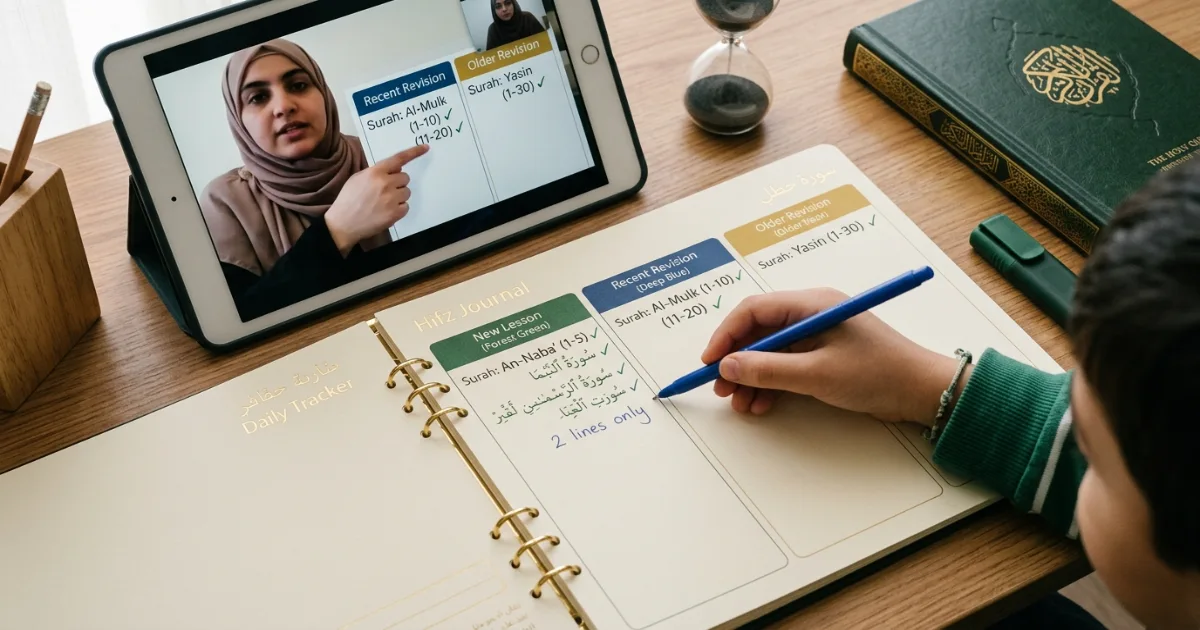
The lighter day should not become an automatic backlog day. It can be used for listening, a familiar surah, family recitation, or rest when the child is genuinely tired. The purpose is to preserve positive continuity, not to hide unfinished work.
How to use weekends without overloading the child
Weekends offer more time, but they should not be used to double or triple the new portion automatically. A longer session is most useful for weekly testing, repairing weak joins, revising older material, and preparing the next passage accurately. When the child has slept well and retention is strong, the teacher may introduce a slightly larger portion, but revision should still come first.
Useful weekend priorities
- Full test of the week’s new work
- Random starting points from recent lessons
- One older-revision set
- Correction of similar verses
- Preparation of the next school week
Avoid on weekends
- Using extra hours only for new pages
- Punishing missed weekdays with a marathon
- Skipping outdoor time, sleep, and family plans
- Repeating mistakes without teacher correction
- Making Sunday night stressful before school
During longer school holidays, families can increase class frequency gradually. The increase should be tested against next-day recall and the child’s mood. When school resumes, reduce the plan before the first week rather than waiting for the child to become overwhelmed.
How to adjust Hifz during exams, illness, travel, and heavy homework
A realistic Hifz schedule has a maintenance mode. During examinations, illness, travel, family events, or periods of poor sleep, the child may not have capacity for the usual new portion. The responsible response is not to abandon Quran completely or to insist on the full target. Reduce new work, maintain a small recent-revision set, and keep one familiar older passage active.
New work plus full revision
Use the normal small portion, recent review, older rotation, and scheduled teacher testing.
Reduce new work and protect recent revision
Shorten the new lesson, keep yesterday’s work active, and use a smaller older-revision set.
Pause new memorization temporarily
Use short listening and revision sessions until sleep, health, school pressure, or travel becomes manageable.
After the busy period, do not immediately restore the largest target. Test recent passages first, repair gaps, and return to a smaller new portion for several days. Continuity should be rebuilt before speed.
What parents should do—and what they should avoid doing
Parents play an important role in protecting the timetable, preparing the environment, communicating with the teacher, and encouraging consistency. Their role is not to become a constant prompt. When a parent supplies every first word, the child may sound fluent without learning how to retrieve the passage independently.
Protect the routine
Set a realistic time, reduce interruptions, prepare the Mushaf and device, and begin without repeated negotiation.
Allow thinking time
Pause before helping. Let the child search memory, then note the exact weak point if help is needed.
Track the right evidence
Record retention, prompts, verse connections, and recurring mistakes—not only the number of lines.
Communicate school pressure
Tell the teacher about exams, travel, illness, or changing sleep before the timetable begins to fail.
Avoid comparison
Compare the child with her previous retention and independence, not with siblings or classmates.
End calmly
When concentration is gone, record the stopping point and adjust. Repeated conflict can damage the routine.
How a female Hifz teacher supports a school-friendly plan
A qualified female Quran teacher can shorten wasted effort by selecting the correct portion, correcting the passage before deep repetition, testing without predictable prompts, and deciding when new work should be reduced. She should understand that a child’s school timetable changes and communicate a clear priority rather than assigning an unclear list.
Strong teacher practices
- Tests old work before new work
- Corrects reading and Tajweed before repetition
- Uses random beginnings and verse connections
- Records recurring weak passages
- Adjusts the portion during exams and illness
- Gives the parent one clear revision task
Warning signs
- New pages added despite weak revision
- Every mistake solved with instant prompting
- No older-revision cycle
- Long lessons beyond the child’s attention
- Shaming or comparison
- No explanation of progress
Families can use the separate guide on choosing a female Quran teacher online to review qualifications, teaching method, privacy, communication, and trial-class fit.
Common Hifz schedule mistakes that slow school children
Too much new memorization
The child completes today’s target but repeatedly loses yesterday’s lesson.
Revision treated as optional
Old passages are reviewed only when a problem becomes obvious.
Late-night memorization
Hifz pushes bedtime later, reducing next-day concentration and recall.
One long daily session
Attention fades while the child continues repeating without processing.
No school-season adjustment
The holiday timetable is forced into normal school weeks.
Parent supplies every answer
The child becomes prompt-dependent instead of strengthening retrieval.
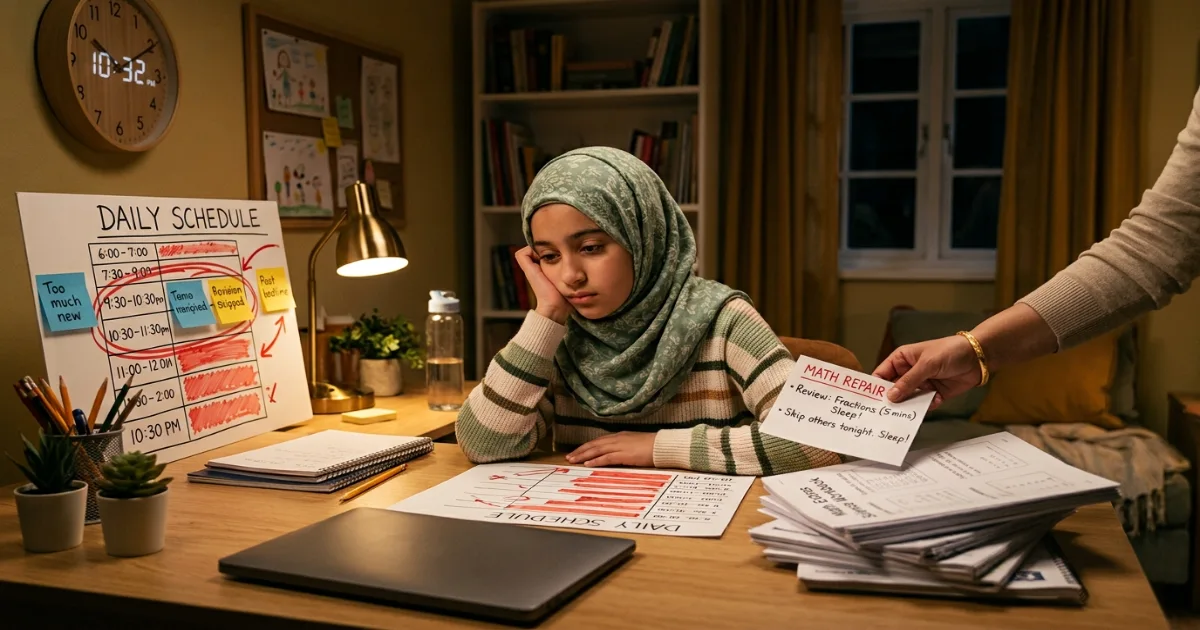
How to know whether the daily Hifz schedule is working
Progress should be reviewed every two to four weeks. The question is not simply whether the child has moved forward in the Mushaf. A good schedule produces stronger recall, fewer prompts, more stable verse connections, accurate recitation, and less daily conflict. The child should be able to carry both new and older work without the timetable repeatedly collapsing.
Next-day retention
Yesterday’s lesson can be recited with limited correction before new work begins.
Independent beginnings
The child starts passages without receiving every first word.
Verse connections
The joins remain stable instead of each verse existing as a separate island.
Older recall
Earlier surahs remain accessible through the planned rotation.
Accurate correction
Major word, vowel, and pronunciation errors decrease rather than becoming memorized habits.
Sustainable mood
The child can begin, work, and finish with manageable resistance through normal weeks.

Can children follow a daily Hifz schedule through online classes?
Yes. Online Hifz can work well for school children when audio is clear, lessons are appropriately short, the teacher listens to both new and old work, and the family protects a consistent learning environment. Online lessons can reduce travel time and make it easier to place classes before or after school, but convenience should not lead to long or poorly supervised sessions.
A child should use a stable device, headphones when suitable, a correctly placed Mushaf, and a quiet desk. A parent may remain nearby for younger children without answering the lesson. The teacher should provide a written or clearly stated assignment: the new portion, recent revision, older revision, and one correction target.
Noor Hafiza Academy offers live online Quran learning with female Quran teachers for children, girls, women, sisters, beginners, and returning learners. A school-friendly Hifz plan can be discussed after checking the child’s age, reading level, existing memorization, school hours, time zone, attention, pronunciation, and family routine. Current programs, schedules, teacher availability, fees, trial arrangements, and enrollment terms are confirmed directly.
Share the child’s age, school timing, current surahs, reading level, preferred lesson days, time zone, and the point where revision usually becomes difficult. A live assessment can help determine the correct starting portion and weekly structure.
Daily Hifz schedule for kids: parent checklist
Sleep first
The timetable does not repeatedly push bedtime later.
Small new portion
The amount survives next-day recall before it is increased.
Revision recorded
Recent and older work follow a visible weekly cycle.
Short sessions
Work ends before attention turns into careless repetition.
Teacher testing
The child receives live correction and independent recall checks.
Busy-week mode
Exams, illness, and travel trigger a lighter maintenance plan.
FAQs about a daily Hifz schedule for kids
What is a good daily Hifz schedule for kids?
How many minutes should a child memorize Quran each day?
Is it better to memorize Quran before school or after school?
How much Quran should a school child memorize daily?
Should revision come before new memorization?
How many days a week should a child take Hifz classes?
What should we do during school exams?
What should a child do after missing several Hifz days?
How can parents help without making the child dependent?
How do I know whether the Hifz schedule is working?
Can a child memorize Quran online while attending school?
What is the most important rule in a school-friendly Hifz plan?
Build a Hifz routine that works with school—not against it
Share the child’s age, school hours, current reading level, memorized surahs, revision challenges, time zone, and preferred lesson days. Noor Hafiza Academy can discuss a live assessment and a realistic school-friendly schedule with a suitable female Quran teacher.