30-Day Quran Reading Improvement Plan for Beginners

A 30-day Quran reading improvement plan can help a beginner become more accurate, confident, and independent when it focuses on the right sequence. The goal is not to “finish the Quran in one month” or promise fluency in exactly thirty days. Instead, the learner spends Week 1 strengthening letter recognition, Harkaat, Sukoon, Shaddah, and slow decoding; Week 2 improves joined-letter reading, Makharij, and word accuracy; Week 3 adds practical Tajweed such as Ghunnah, Qalqalah, and Madd; and Week 4 builds longer reading, Waqf, fluency, and independent correction. Daily sessions can be short—often 10–20 focused minutes—when they are consistent and connected to a qualified teacher’s feedback.
How can a beginner improve Quran reading in 30 days?
Use a four-week progression. In Week 1, strengthen Arabic letters, joined forms, Harkaat, Sukoon, and Shaddah. In Week 2, focus on Makharij, blending, unfamiliar words, and accurate short passages. In Week 3, add beginner Tajweed targets such as Ghunnah, Qalqalah, Madd, and simple Noon or Meem rules. In Week 4, read longer passages, practise Waqf and Ibtida, reduce teacher prompts, and track fluency without sacrificing accuracy. Aim for 10–20 focused minutes on most days, with one lighter review day each week. Use familiar passages for confidence but also include unfamiliar examples so memorization does not hide weak reading.
Start with a quick Quran reading assessment
A good 30-day plan begins with a baseline. The learner should know what actually needs improvement before choosing daily exercises. Some beginners need Arabic letter recognition; others can already read but struggle with joined forms, pronunciation, Tajweed, speed, or stopping.
Letter recognition
Can you identify Arabic letters in isolated and joined forms without relying on alphabet order?
Reading symbols
Can you read Fathah, Kasrah, Dammah, Tanween, Sukoon, and Shaddah correctly?
Word decoding
Can you blend unfamiliar Quran words without waiting for a teacher to give the first sound?
Recitation quality
How are your Makharij, basic Tajweed, Waqf, fluency, and confidence?
Do not judge progress only by page number. A learner who reads fewer lines accurately may be building a stronger foundation than someone who moves quickly while repeating the same errors.
A simple 15-minute Quran reading routine
Review the week’s difficult letters, signs, or Tajweed target.
Read a small passage slowly and prioritize accuracy over speed.
Mark one or two errors, correct them, and reread the same lines.
Adults who can sustain more attention may use 20 minutes, while young children may benefit from 5–10 minutes. The plan works because the practice is frequent and focused, not because every learner follows exactly the same duration.
Days 1–7: Build the reading foundation
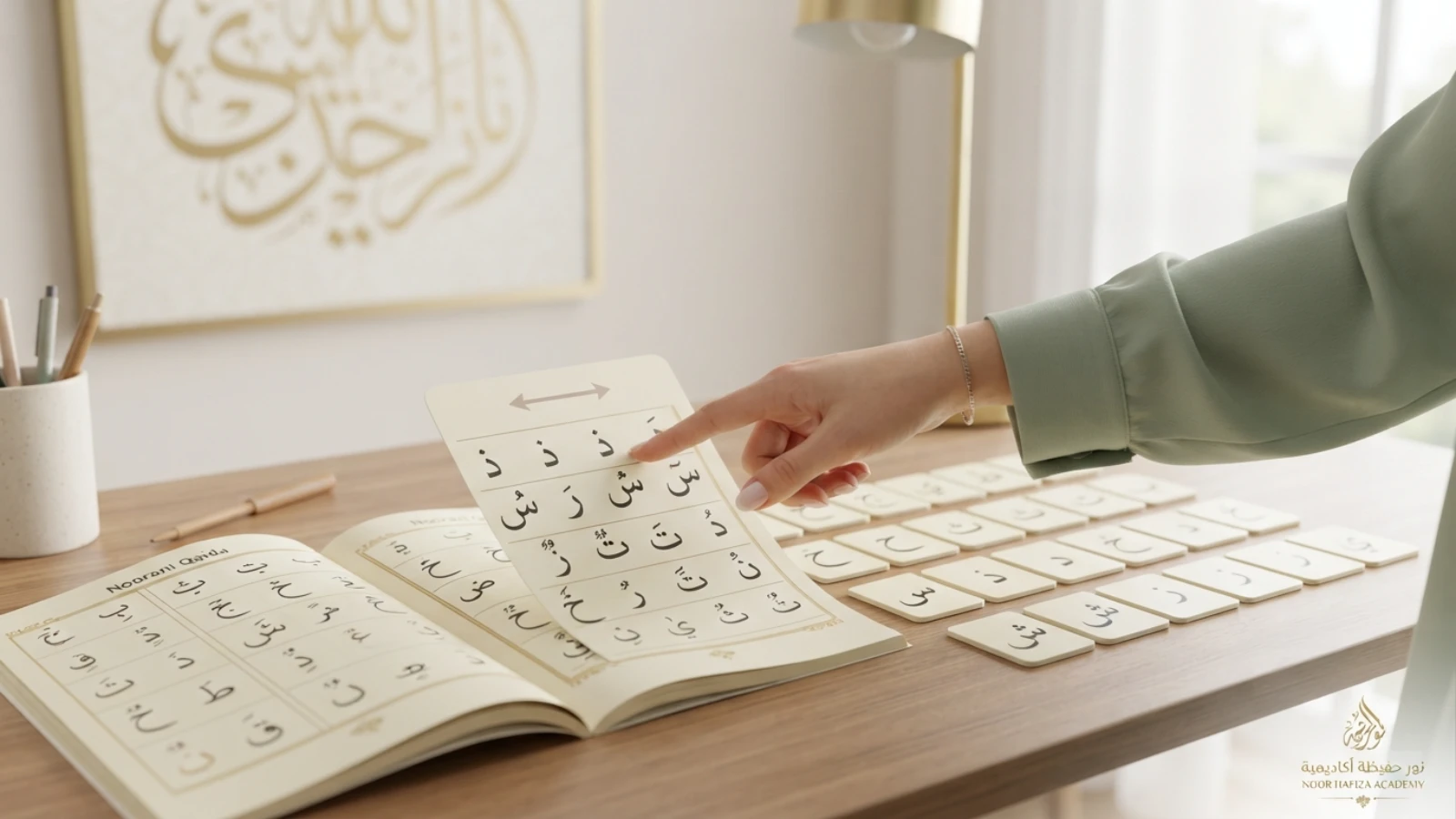
Week 1 is about decoding accuracy. Even if you already read Quran, use the first week to expose weaknesses in letter recognition, Harkaat, Sukoon, Shaddah, and joined forms. Strong readers can move faster through these checks, while complete beginners may spend most of the month here.
| Day | Main focus | Practice | Success check |
|---|---|---|---|
| Day 1 | Baseline | Read familiar and unfamiliar short examples | Identify top 3 weaknesses |
| Day 2 | Arabic letters | Mixed isolated and joined letter recognition | Less guessing from shape families |
| Day 3 | Harkaat | Fathah, Kasrah, Dammah drills | Short vowels stay short |
| Day 4 | Sukoon | Blend closed syllables | No extra vowel added |
| Day 5 | Shaddah | Compare single and doubled consonants | Clear doubled action |
| Day 6 | Joined words | Two- and three-part Quran words | Fewer pauses after each letter |
| Day 7 | Review | Fresh mixed examples | Skills transfer beyond memorized page |
Days 8–14: Improve accuracy and Makharij
Once basic decoding is more stable, Week 2 focuses on pronunciation and word-level accuracy. Do not try to fix every Makharij issue at the same time. Choose one or two recurring letter problems and practise them in isolation, then in words, then in Quran context.
Target two recurring Makharij problems with teacher-approved drills.
Practise contrasts such as ق/ك or ص/س where needed.
Read new Quran words slowly without first hearing the model.
Record a short passage and compare repeated errors with Day 1.
The important question is not “Do I sound fast?” but “Do I produce the same letters correctly when the word changes?” Real improvement appears when a corrected sound transfers into new vocabulary.
Days 15–21: Add Tajweed without losing fluency
Week 3 adds a small number of high-value Tajweed rules. The goal is not to memorize a full Tajweed textbook. Choose the rules that actually appear in your assigned reading and that your teacher has already introduced.
| Days | Tajweed target | Home practice | Watch for |
|---|---|---|---|
| 15–16 | Ghunnah | Noon/Meem with Shaddah and selected connected examples | Overholding or weak nasal sound |
| 17–18 | Qalqalah | Sakin ق ط ب ج د examples | Extra vowel or missing rebound |
| 19–20 | Madd | Stable two-count natural Madd | Random stretching |
| 21 | Mixed review | One short passage with all three | Rule accuracy without stopping flow |
If the learner is not yet ready for Tajweed details, keep Week 3 focused on pronunciation and decoding instead. Progress should follow readiness, not the calendar.

Days 22–30: Build fluency, Waqf, and independence
The final phase is about reading longer sections with fewer prompts. Accuracy still comes first, but the learner should begin connecting words more naturally, planning breath, recognizing Waqf signs, and recovering from mistakes without waiting for the teacher.
| Days | Focus | Practice | Progress sign |
|---|---|---|---|
| 22–23 | Phrase reading | Read complete short phrases rather than single words | Fewer unnecessary pauses |
| 24–25 | Waqf | Mark م, لا, ج and safe stopping points | Better breath planning |
| 26–27 | Independent correction | Record and identify your own two most common errors | Less external prompting |
| 28 | Fresh passage | Read an unfamiliar short section | Skills transfer beyond memory |
| 29 | Review weak areas | Return to the top two remaining problems | More stable correction |
| 30 | Final assessment | Compare with Day 1 reading | Fewer errors, smoother reading, more confidence |
How to track Quran reading improvement
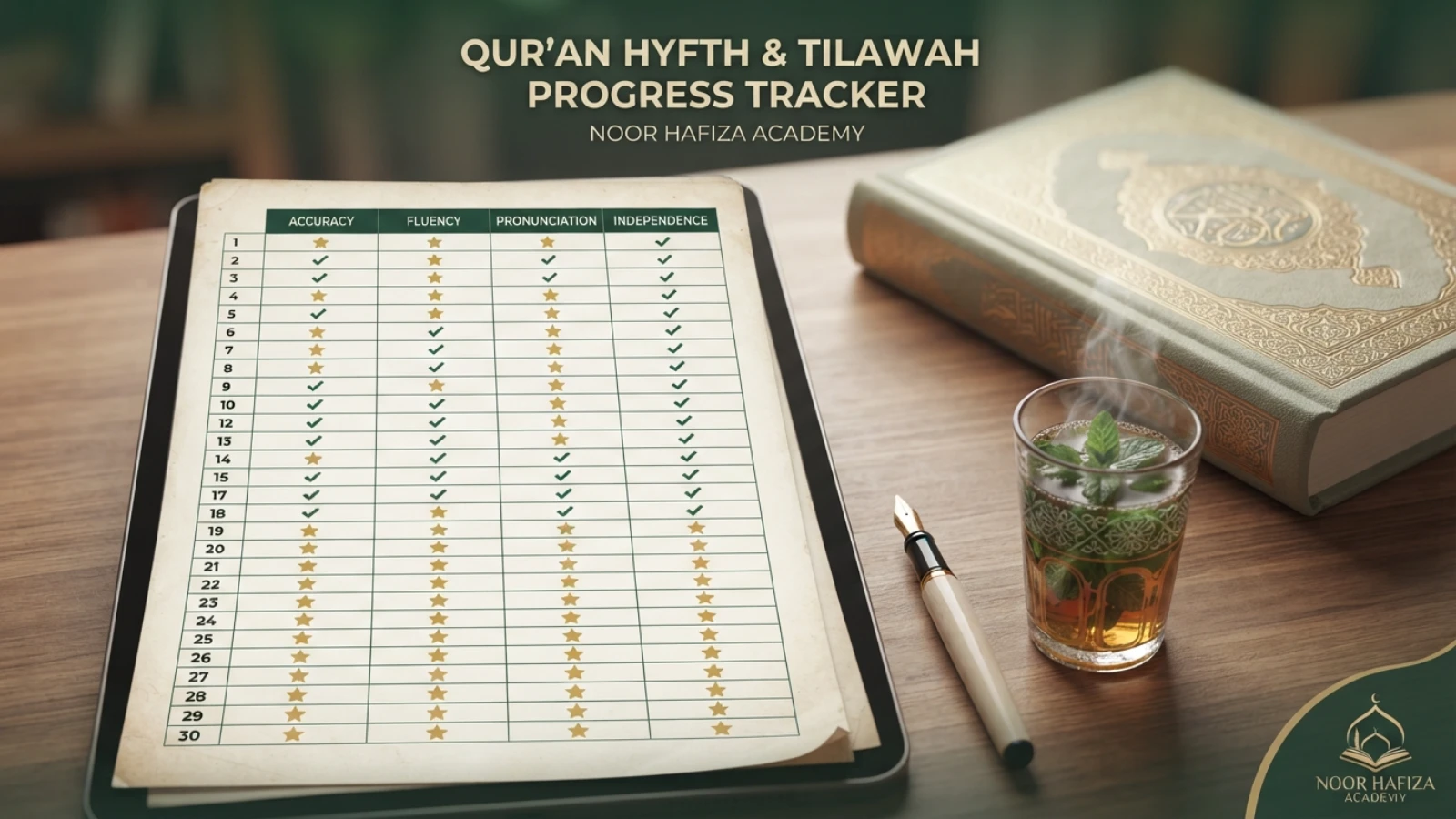
A useful progress tracker measures skill, not just time spent. Record the same categories on Day 1, Day 15, and Day 30.
Accuracy
How many repeated letter, vowel, or Tajweed errors occur in a short passage?
Fluency
Are there fewer unnecessary pauses between letters and words?
Pronunciation
Are your main Makharij problems becoming more stable?
Independence
Can you read unfamiliar examples with fewer teacher prompts?

Mistakes that can weaken a 30-day Quran reading plan
Trying to improve everything at once
The learner changes letters, Tajweed, speed, memorization, and voice style in one session.
Reading only familiar Surahs
Memory hides decoding weaknesses and makes progress look stronger than it is.
Speed before accuracy
Words become faster but repeated pronunciation and symbol errors remain.
Skipping review days
New content keeps replacing unstable foundations.
Using too many teachers or videos
Different terminology and correction methods create unnecessary confusion.
No baseline recording
The learner cannot compare Day 30 with the starting point.
Ignoring difficult letters
The learner keeps choosing easy passages and avoids the actual weakness.
Expecting fluency in exactly 30 days
The learner treats the month as a guarantee rather than a structured improvement phase.
How should complete beginners adapt this plan?
If you cannot yet recognize Arabic letters confidently, do not rush into Tajweed rules in Week 3 just because the calendar says so. Spend longer on Arabic alphabet recognition, joined forms, Harkaat, Sukoon, Shaddah, and blending. A strong month may simply mean moving from isolated letters to short accurate words.
For complete beginners, Noorani Qaida can provide a structured sequence. The important point is to test whether the learner can apply the skill in fresh examples rather than only recite a memorized Qaida page.
How should slow Quran readers adapt the plan?
If you already recognize letters and symbols but read slowly, use Week 1 as a quick check and put more time into joined-word recognition, phrase reading, and unfamiliar passages. Your goal is not to force speed. It is to reduce hesitation caused by decoding each letter separately.
Read short phrases multiple times: first slowly for accuracy, then once more with smoother connection. The second reading should not be faster if accuracy drops.
How parents can support a child’s 30-day Quran reading plan
Helpful parent actions
- Choose a regular practice time that fits school and family routines.
- Keep daily sessions short enough to remain sustainable.
- Ask what the teacher’s current correction target is.
- Use unfamiliar examples sometimes so page memorization does not hide weak reading.
- Celebrate fewer repeated errors rather than only page completion.
- Help make a Day 1 and Day 30 recording for comparison.
- Share recurring difficulties with the teacher instead of introducing competing corrections.
- Allow extra time if the child needs more than thirty days for the same stage.
Questions to ask a Quran teacher during the 30-day plan
Use these during weekly progress reviews
- What is my biggest Quran reading weakness right now?
- Should I focus more on decoding, Makharij, Tajweed, or fluency this week?
- Which exact passage should I practise daily?
- Which unfamiliar examples can you use to test my reading?
- Which two pronunciation errors should I track?
- Am I reading too fast for my current accuracy level?
- Which Tajweed rule should I add next?
- Where should I stop and restart in my assigned passage?
- How should I record progress between lessons?
- What improvement should I expect by the end of this week?
- What should I continue after Day 30?
- Do I need to repeat one of the four phases before moving forward?
What should you do after the 30-day plan?
Day 30 should lead into the next learning cycle rather than mark an ending. Compare your reading with Day 1, identify the two areas that improved most, and identify the two that still need focused work.
A learner who improved letter recognition may now be ready for more joined-word practice. A learner whose decoding became stable may move toward Makharij and Tajweed. A reader whose Tajweed improved may focus on longer passages, Waqf, fluency, and consistent daily Quran reading.
Online Quran lessons for a structured 30-day improvement plan
Noor Hafiza Academy offers live online Quran learning for girls, women, children, adults, new Muslims, complete beginners, and returning readers with female Quran teachers. A reading assessment can review Arabic letters, joined forms, Harkaat, Sukoon, Shaddah, Makharij, fluency, Tajweed, Waqf, and current independence.
A suitable 30-day plan can then focus on the learner’s actual level rather than forcing everyone through the same schedule. Current teacher qualifications, availability, schedules, trial arrangements, fees, privacy practices, policies, and enrollment terms should be confirmed directly.
Share the learner’s age, current reading level, main difficulties, time zone, schedule, and whether the priority is Arabic letters, decoding, Makharij, Tajweed, fluency, or Waqf.
FAQs about the 30-day Quran reading improvement plan
Can I improve Quran reading in 30 days?
How long should I practise Quran reading each day?
Should I focus on speed or accuracy first?
What should I practise in Week 1?
When should I add Tajweed?
How can I track Quran reading progress?
Should I use familiar Surahs for practice?
What if I am a complete beginner?
What if I already read but very slowly?
Should I record myself during the 30-day plan?
Can children follow this 30-day plan?
What should I do after Day 30?
Use the next 30 days to build more accurate, confident, and independent Quran reading
Share the learner’s age, current Quran reading level, main difficulties, time zone, and schedule so the plan can focus on the right starting point.