How to Memorize Short Surahs: A Step-by-Step Plan for Kids
Helping a child memorize short Surahs works best when the process is small, predictable, and encouraging. Choose one suitable Surah, make sure the child can hear and read it accurately, divide it into short portions, repeat each portion several times, ask the child to recite without looking, connect the verses, and then review the Surah over several days. The aim is not to race through Juz Amma. The aim is accurate memorization that stays strong enough to use in Salah and continue reviewing later.
What is the easiest way for kids to memorize short Surahs?
Use one short Surah and divide it into small portions. First, let the child listen to a clear recitation and follow the Arabic text. Next, read the first verse or phrase accurately with a teacher or parent. Repeat it several times while looking, then recite it without looking. Only add the next verse after the first one can be recalled with reasonable confidence. Join the two parts, repeat them together, and continue in the same way. Review the completed Surah later that day, the next day, after a few days, and during the following week. Keep sessions short, correct mistakes gently, and do not add new verses when the previous portion is still unstable.
Make sure the child is ready to memorize
Memorization becomes much easier when the child can hear the words clearly, recognize enough Arabic to follow the line, and repeat a teacher’s model without changing sounds. A child does not need perfect reading before beginning short Surahs, but persistent pronunciation errors should not simply be memorized into the Surah. If the child repeatedly confuses letters, drops Shaddah, adds vowels to Sakin letters, or guesses from memory, slow down and correct those foundations alongside Hifz.
The starting point also depends on age and attention. A six-year-old who is new to Quran may work on one short phrase for several days. An older child who already reads fluently may memorize a short Surah more quickly. The plan should follow the child’s accuracy and retention, not a fixed deadline.
Can the child hear the verse accurately?
Use a clear teacher or one consistent recitation model. Changing reciters constantly can make rhythm and stopping feel less predictable for a beginner.
Can the child repeat the words correctly?
Listen for repeated letter, vowel, Madd, Shaddah, and ending mistakes before turning the phrase into long-term memory.
Can the child focus for a short session?
Choose a practice length the child can complete calmly. Five focused minutes can be more useful than twenty distracted minutes.

Which short Surah should a child memorize first?
There is no single mandatory order for every child. Many families and Quran programs begin with very short Surahs from the end of the Quran because they are frequently heard, useful in Salah, and easier to divide into manageable portions. The best first choice is usually a Surah that matches the child’s reading level and can be corrected accurately.
| Surah | Why it may suit beginners | What to watch |
|---|---|---|
| Al-Kawthar | Very short and easy to divide into three verses. | Do not let familiarity replace correct pronunciation. |
| Al-Ikhlas | Short, widely familiar, and meaningful for children to learn with translation. | Correct repeated letter and ending sounds carefully. |
| Al-Falaq | Short verses with a clear repeated structure. | Similar endings can cause verse-order confusion. |
| An-Nas | Often already heard in home and Salah routines. | Repeated words can tempt the child to jump ahead. |
| Al-Asr | Only three verses, suitable for a compact memorization cycle. | The final verse is longer and may need extra chunking. |
If your child already studies with a Quran teacher, follow the teacher’s Surah order unless there is a clear reason to change it. Consistency between lesson and home practice reduces unnecessary confusion.
How to memorize short Surahs for kids: the 7-step method
Listen to the whole Surah first
Play or recite the Surah once or twice without asking the child to memorize immediately. Let the child hear the overall rhythm, verse endings, and sequence. If possible, the child should follow the Mushaf or lesson text with a finger. Use the same teacher or reciter during the early memorization stage so the model stays consistent.
Explain the simple meaning
Give a short, age-appropriate meaning of the Surah or the verse being learned. A child does not need a long Tafsir lesson during every Hifz session, but knowing what a Surah is about can make the words feel less like a string of unfamiliar sounds. Keep the explanation simple and accurate.
Break the first verse into a small portion
If the verse is short, use the whole verse. If it is longer, split it at a natural phrase boundary. The portion should be small enough for the child to repeat accurately. Avoid breaking in places that teach an unnatural stop or disturb the phrase unnecessarily.
Repeat while looking
Have the child read or repeat the same portion several times while looking at the Arabic. The exact number is less important than quality. Some children need five repetitions; others need more. Stop counting if pronunciation is becoming careless. Correct the phrase, then repeat it accurately.
Close the text and recall
Ask the child to recite the portion without looking. This is the point where real recall begins. If the child cannot produce the phrase, give a small prompt rather than reciting the whole answer immediately. Then let the child try again from the beginning of the portion.
Add the next portion and connect them
Learn the second portion in the same way, then recite the first and second together. This connection step is essential. A child may know individual verses but still become stuck when moving from one verse to the next. Practise the transition itself.
Review before adding more tomorrow
At the next session, ask for yesterday’s memorization before teaching a new verse. If the child needs many prompts, the old portion is not yet stable enough. Review it first. New memorization should sit on top of a strong previous layer.

Do not measure a successful Quran memorization session by how many new verses were added. A session can be successful if the child corrected one repeated mistake, remembered yesterday’s verse independently, or connected two verses without prompting.
A simple 10-minute Surah memorization routine for kids
Old review
Ask the child to recite yesterday’s portion without hearing it first. Mark only the most important repeated errors.
New memorization
Listen, repeat, read, and recall one small verse or phrase. Keep the amount realistic for the child’s level.
Connect and finish well
Recite old + new together, then finish with one confident repetition rather than continuing until the child is exhausted.
A younger child may need only five minutes. An older child may comfortably use fifteen minutes. The purpose of a routine is consistency, not forcing every child into the same clock time.

How many times should a child repeat a verse?
There is no magic number that guarantees memorization. Repetition is useful, but repetition without attention can become mechanical. Instead of saying “repeat it twenty times” regardless of quality, use short sets with a clear purpose.
Try this four-part repetition cycle
3× listen and follow3–5× repeat accurately2× recite without looking1× connect with previous verseIf the child still cannot recall the portion, return to looking and listening instead of increasing pressure. The goal is accurate memory, not completing a repetition quota.
Use a 1–3–7 review schedule so the Surah stays memorized
New memorization is fragile. A child may recite perfectly at the end of one session and forget transitions the next morning. That does not mean the child “has a bad memory.” It means the Surah needs planned retrieval over time.
| When | What to do | Goal |
|---|---|---|
| Later the same day | One calm recitation without hearing the answer first. | Strengthen the first memory trace. |
| Next day | Recite old material before any new verse. | Check genuine recall. |
| After 3 days | Recite the Surah in one continuous attempt. | Strengthen verse order and transitions. |
| After 7 days | Review the full Surah again, preferably without prompts. | Move it toward longer-term retention. |
| Weekly after that | Rotate the Surah with other memorized Surahs. | Prevent old Hifz from fading while new Hifz grows. |
The numbers do not have to be exact. The principle is what matters: review soon, then leave a little more time before the next review, and keep older Surahs in rotation.

Sample 7-day plan for memorizing one short Surah
| Day | Main task | Parent or teacher check |
|---|---|---|
| Day 1 | Listen to the whole Surah, learn the meaning, memorize the first small portion. | Correct pronunciation before repetition builds. |
| Day 2 | Recall Day 1, then add the next verse or phrase. | Check the transition from old to new. |
| Day 3 | Review all learned verses, then add another small portion if stable. | Do not add more if yesterday’s section still needs heavy prompting. |
| Day 4 | Continue memorization or use the day only for review. | Listen for repeated ending or similar-verse confusion. |
| Day 5 | Finish the Surah if appropriate and connect from beginning to end. | Correct verse order and stopping. |
| Day 6 | No new material; recite the full Surah several times across the day. | Reduce prompts and let the child recover from small hesitations. |
| Day 7 | Final weekly review and use the Surah in Salah where appropriate. | Choose what needs another week of reinforcement. |
A child may finish sooner or may need two or three weeks. That is completely acceptable. The plan is a structure, not a race.
Should kids learn the meaning while memorizing a Surah?
Yes, age-appropriate meaning can support both understanding and memory. A simple explanation gives the child a mental structure for the verses. For example, instead of treating every line as unrelated sounds, the child can know that one verse introduces an idea and the next continues it.
Keep the explanation short enough that it does not replace the memorization session. For younger children, one sentence about the Surah’s main message may be enough. Older children can gradually learn more vocabulary, themes, reasons for repeated words, and how the Surah connects to their daily worship.
When should a child use a newly memorized Surah in Salah?
Using a stable Surah in Salah can strengthen recall because the child retrieves it in a meaningful context. However, do not make the child rely on Salah as the only review method. A Surah that is still incomplete or frequently confused should first be strengthened outside Salah with a teacher or parent.
Once the Surah is reasonably secure, encourage the child to use it regularly and rotate with older Surahs. Rotation matters because children can become very strong in the newest Surah while quietly forgetting one memorized a month earlier.
Common problems when kids memorize short Surahs
The child memorizes the sound but not the sequence
Individual verses are correct, but transitions are weak. Practise the last few words of one verse together with the first few words of the next.
The child waits for the first word every time
This usually means recall is cue-dependent. Pause and allow a little retrieval time before giving the opening word.
Old Surahs disappear when new ones are added
The review system is too weak. Keep a weekly rotation of previously memorized Surahs and reduce new Hifz until old material becomes stable.
Pronunciation errors become fixed
The child repeated an incorrect model too many times. Correct the exact phrase slowly with a qualified teacher, then rebuild it through accurate repetition.
The child only recites with the recording
Listening is helpful, but it is not the same as recall. Turn the recording off and ask for independent recitation before counting the Surah as memorized.
Memorization becomes a daily argument
The session may be too long, the target too large, or corrections too constant. Reduce the amount, protect a calm routine, and discuss recurring difficulty with the teacher.
Do not compare one child’s memorization speed with a sibling, classmate, or online Hifz schedule. Children differ in reading level, age, language background, attention, and previous Quran exposure. Pressure may produce short-term repetition while weakening the child’s willingness to return to Quran practice.
What should parents do during a child’s Surah memorization?
- Use the same Surah and correction target as the child’s Quran teacher.
- Choose a regular time when the child is not exhausted or rushing to another activity.
- Ask for old memorization before playing the audio model.
- Correct one or two repeated problems instead of interrupting every second.
- Use a finger or bookmark to help the child follow the Arabic line.
- Keep one consistent reciter or teacher model during the learning phase.
- Ask a simple meaning question occasionally so the child connects memory with understanding.
- Celebrate accurate recall, good effort, and improvement in mistakes—not only the number of Surahs finished.
- Keep a small review list of “new,” “needs practice,” and “strong” Surahs.
- Tell the teacher when a Surah repeatedly breaks down at home.

Why teacher correction matters in kids’ Quran memorization
Memorization is powerful because repetition makes a sequence easier to reproduce. That strength can also preserve mistakes if the model is wrong. A teacher can listen for letters, vowel length, Shaddah, Ghunnah, Qalqalah, Madd, stopping, and other recitation details appropriate to the child’s level before those patterns become deeply repeated.
A teacher also helps decide how much new Hifz to assign. Some children need less new material and more revision. Others are ready for a larger portion. The best target is the amount the child can learn accurately and still retain alongside older Surahs.

Share the child’s age, current Quran reading level, Surahs already memorized, main pronunciation or recall difficulties, time zone, and available lesson schedule.
What if a child keeps forgetting the same Surah?
First reduce the amount of new memorization. A child who is forgetting old verses does not always need more repetition of the entire Surah; the difficulty may be concentrated in one transition, similar ending, pronunciation pattern, or verse order. Identify exactly where the recitation breaks.
Then practise that small point. For a weak transition, repeat the end of the first verse and the beginning of the next as one unit. For similar verses, ask the child to explain which one comes first. For pronunciation, return to slow teacher-led correction. For general forgetting, increase spaced review and temporarily stop adding new Surahs.
If the child is consistently struggling with both reading and memorization, the foundation may need attention. Strengthening Arabic letters, Harkaat, Sukoon, Shaddah, joined words, and slow Quran reading can make future Hifz much easier.
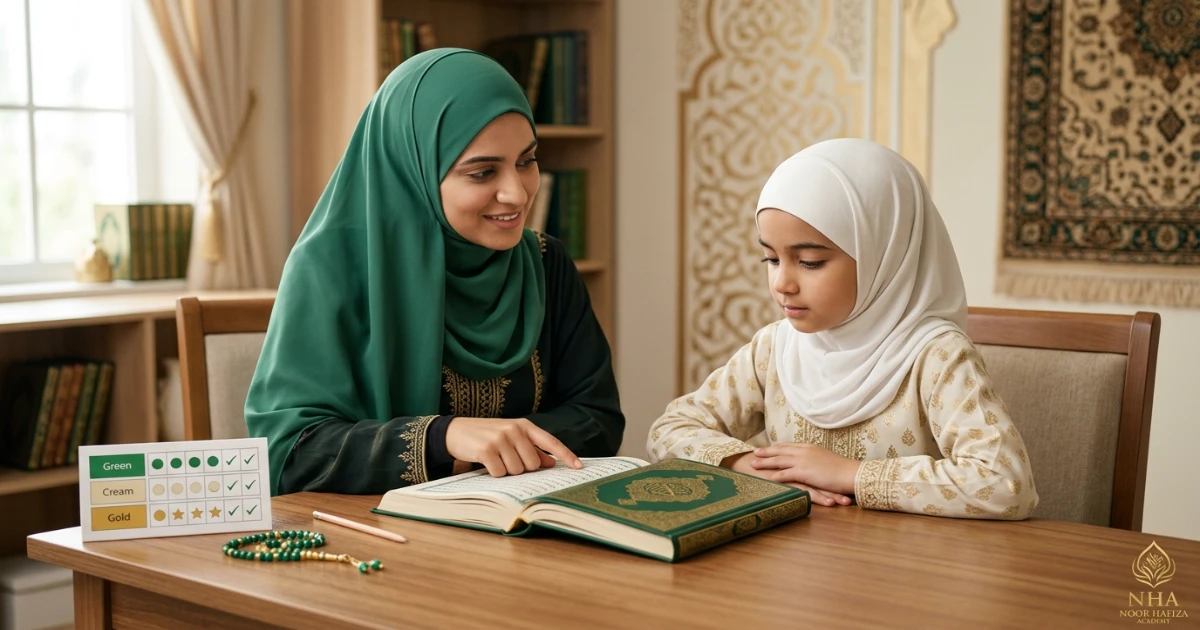
Use three labels instead of complicated Hifz charts
Recently learned
Needs daily recall and close correction. Do not assume a Surah is secure just because it was recited once correctly.
Mostly known but unstable
May contain weak transitions, repeated prompts, or one recurring pronunciation mistake.
Recited independently
Can be recalled after a gap and should remain in the weekly review rotation.
Move Surahs between the three groups based on actual recitation. A previously “strong” Surah can move back to “needs practice” if it starts to fade. That is normal and useful to notice early.
FAQs about memorizing short Surahs for kids
What is the best way for a child to memorize a short Surah?
How long should kids spend memorizing Quran each day?
How many times should a child repeat each verse?
Should a child listen to Quran while memorizing?
Which short Surah should a child memorize first?
Should kids learn Surah meanings while memorizing?
What if my child keeps forgetting yesterday’s verse?
Is it okay to memorize if the child cannot read Arabic fluently yet?
How can parents help without confusing the child?
When should a child use a new Surah in Salah?
How do I stop old Surahs from being forgotten?
What should I do if memorization becomes stressful?
Help your child build Quran memorization that is accurate, calm, and easier to retain
Start with the child’s real reading level, one suitable Surah, short daily practice, and a review routine that keeps old memorization alive while new Hifz grows.