Daily Duas for Kids: A Simple Learning Schedule
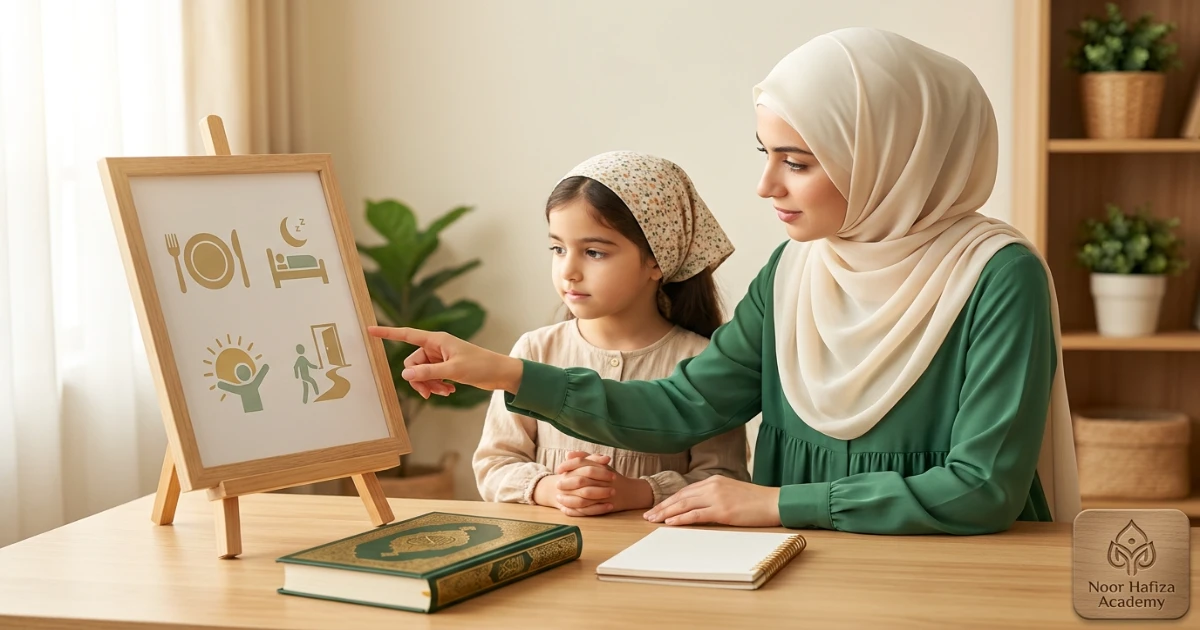
Daily duas for kids are easiest to learn when they are attached to routines children already repeat: waking up, eating, using the bathroom, leaving home, starting study, traveling, and going to sleep. Instead of giving a child a long list to memorize, teach one dua at a time, explain the simple meaning, model the Arabic accurately, practise a short portion, use it in the real situation, and review it again over the week. This guide gives parents and teachers a four-week schedule, age-based expectations, a five-minute daily routine, pronunciation tips, review methods, and practical ways to keep older duas active while new ones are added.
What is a simple way to teach daily duas to kids?
Choose one dua connected to a routine the child already does every day. Explain in one sentence what the dua means and when it is used. Let the child hear a clear teacher-approved Arabic model, then repeat a short portion slowly until the wording is reasonably accurate. Use the dua at the actual time it belongs—for example, around meals, bedtime, waking, leaving home, or study. The next day, ask the child to recall it before you prompt. Keep the same dua active for several days, then add another only when the first one can be remembered and used with little help. Once a week, review all previously learned duas so older ones do not disappear as new ones are added.
Why daily duas matter for children
Daily duas help children connect ordinary routines with remembering Allah. Eating, sleeping, traveling, studying, entering the home, and asking for help become opportunities for worship rather than isolated activities. For young children, this connection is often easier to understand than an abstract lesson about Dhikr.
The goal is not to produce a child who can recite twenty duas in a test but never remembers them at the right time. A stronger goal is a smaller set of duas that the child understands simply, pronounces reasonably accurately, and uses naturally.
Instead of saying, “Today we must memorize Dua 7,” say, “Today we are learning what Muslims say when we begin eating.” The routine gives the dua a place in memory.
Which daily duas should kids learn first?
Start with situations that happen every day or almost every day. Children usually remember these faster because the environment provides a natural reminder. The exact wording should come from the child’s trusted Islamic Studies or Quran teacher so pronunciation and source wording remain consistent.
| Routine | Why teach it early? | Simple learning goal |
|---|---|---|
| Before eating | Meals happen daily and give a predictable cue. | Remember Allah before beginning food. |
| After eating | Pairs naturally with the pre-meal routine. | Build gratitude after receiving food. |
| Before sleeping | Bedtime is repetitive and calm. | End the day remembering Allah. |
| After waking | Creates a morning Islamic routine. | Begin the day with gratitude. |
| Entering / leaving bathroom | Frequent daily routine. | Connect cleanliness and remembrance. |
| Entering / leaving home | Easy to practise as a family. | Remember Allah around transitions. |
| Before study | Useful for school and Quran lessons. | Ask Allah for beneficial knowledge and ease. |
How to teach a daily dua to a child step by step
Name the situation
Tell the child exactly when the dua is used. Keep the explanation concrete: before food, after waking, before study, or when leaving home.
Explain the meaning simply
Use one short sentence in the child’s language. The goal is understanding, not a long translation lesson.
Listen to correct Arabic
Use one teacher-approved model. Avoid mixing several reciters or transliterations when the child is still forming the pronunciation.
Repeat in small portions
If the dua is longer, divide it naturally. Practise the first short phrase until it is stable, then add the next.
Recall without hearing it first
Give the child a few seconds to remember. A small pause strengthens retrieval better than immediately supplying the first word.
Use it at the correct time
Practise the dua when the routine actually happens. This is what turns memorization into a habit.
A simple 5-minute daily dua practice for kids
Old dua recall
Ask for one previously learned dua before giving any prompt.
Current dua practice
Listen, repeat, explain meaning, and test one small portion.
Use-plan
Ask: “When will you use this today?” so the child connects memory with action.
The family does not need to sit for a formal five-minute lesson every single day if the dua is already being used naturally. Once the wording becomes stable, the real-life routine becomes the main practice.

A 4-week daily duas learning schedule for kids
This starter schedule is intentionally light. Families can slow it down, repeat weeks, or swap the order based on the child’s age and the teacher’s curriculum.
| Week | Main focus | Suggested routines | Review goal |
|---|---|---|---|
| Week 1 | Food and gratitude | Before eating, after eating | Use both at actual meals with minimal prompting. |
| Week 2 | Sleep and waking | Before sleep, after waking | Keep Week 1 duas active during meals. |
| Week 3 | Home and bathroom routines | Entering/leaving home, entering/leaving bathroom | Test one older dua each day. |
| Week 4 | Learning and travel | Before study, simple travel dua selected by teacher | Complete a family review of all learned situations. |
Repeat the week. A slower schedule that produces usable habits is better than a fast list the child cannot recall at the correct time.
How many duas should children learn at different ages?
| Age / stage | Learning approach | New dua pace | Main goal |
|---|---|---|---|
| Ages 4–6 | Very short phrases, imitation, routine cues | One new dua over several days or a week | Positive habit and correct basic pronunciation |
| Ages 7–9 | Arabic + simple meaning + recall | About one per week if older duas remain stable | Independent use in daily routines |
| Ages 10–12 | Meaning, context, vocabulary, review list | One or more depending on length and retention | Understanding and consistent practice |
| Early teens | Arabic accuracy, meaning, source context, self-tracking | Flexible | Personal ownership of Dhikr routines |
Teach the meaning so the child knows what they are saying
A dua should not feel like a password attached to an activity. Children benefit from knowing whether they are thanking Allah, asking for protection, asking for beneficial knowledge, or remembering Allah during a transition.
For younger children, one sentence is enough. Older children can gradually learn individual words, why the dua suits that situation, and how its meaning connects to Islamic character.
How to correct dua pronunciation without making practice stressful
- Use one clear teacher-approved Arabic model.
- Correct the exact word instead of restarting the whole dua every time.
- Slow difficult sounds and repeat them inside a short phrase.
- Do not let speed hide unclear letters or vowels.
- Use transliteration only as temporary support when needed.
- Gradually connect the child back to Arabic script and accurate listening.
If the same sound error continues, ask the Quran or Islamic Studies teacher to demonstrate it directly. Repeated incorrect pronunciation can become harder to change once it feels familiar.
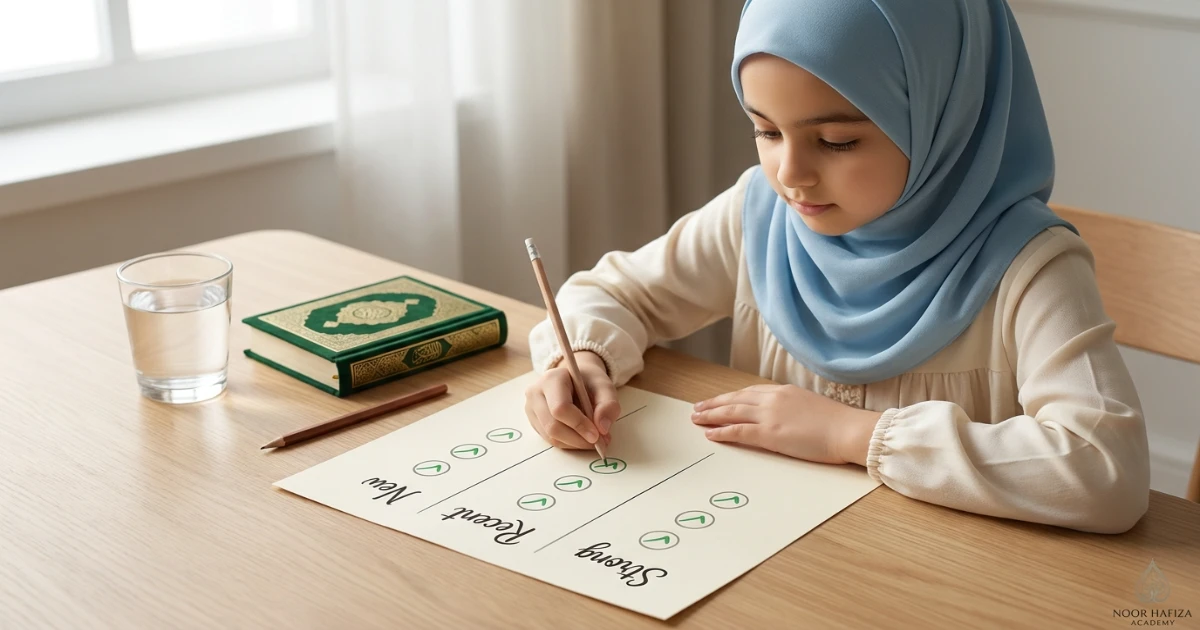
Use a simple new, recent, and strong dua tracker
Still being learned
Needs daily listening, repetition, and routine reminders.
Mostly remembered
Child can say it with little help but still needs a weekly check.
Used independently
Child remembers the wording, basic meaning, and correct situation with little prompting.
Simple 1–3–7 review rhythm
Day 1 · learnDay 2 · recallDay 3 or 4 · use + checkDay 7 · weekly reviewAfter that · routine use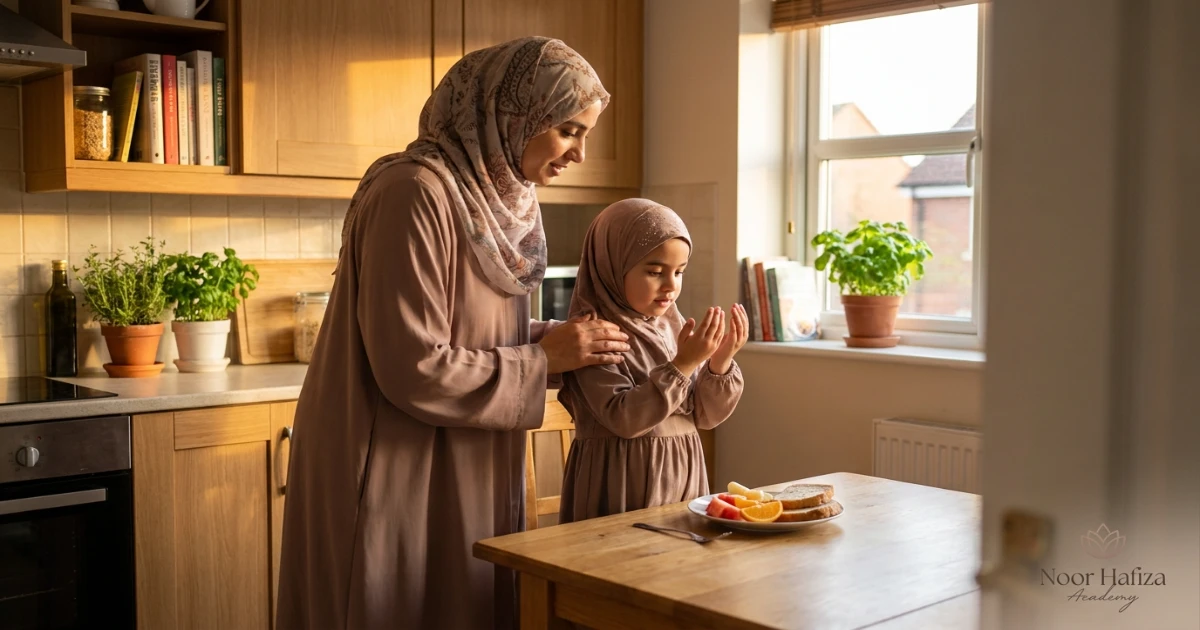
A simple morning dua routine for children
Morning routines work well because several repeated actions happen close together. A family might review the waking dua, a bathroom-related dua, a leaving-home dua, and a study-related dua before school—but only after each has been learned separately. Do not introduce all four on the same day.
- Wake up: recall the waking dua.
- Bathroom: use the appropriate taught dua at the correct point.
- Breakfast: practise the meal-related dua naturally.
- Leaving home: recall the leaving-home dua before the door closes.
- School or Quran study: use the selected knowledge-related dua.
A simple evening dua routine for kids
Evenings can include a meal dua, entering-home dua, a short family review, and the bedtime dua. Keep the review light. The goal is to end the day with remembrance, not turn bedtime into another long test.
If the child is already tired, ask for one familiar dua confidently instead of drilling several weak ones. Repair difficult wording earlier in the day when concentration is better.
How to keep daily duas active during school days
School provides natural situations for remembrance: leaving home, traveling, beginning study, eating lunch, and returning home. Parents can teach the dua at home and then ask one simple question later: “Did you remember it today?” This encourages independent use without placing a parent beside the child at every moment.
For children balancing Quran Hifz and schoolwork, keep dua learning small. One new dua plus existing Hifz may be enough for the week. Do not make every Islamic learning goal a separate large homework assignment.
How parents can make dua learning easier at home
- Use the dua yourself so the child hears it naturally.
- Pause before prompting and give the child time to remember.
- Keep the same wording and teaching model as the teacher.
- Ask for meaning occasionally, not every single time.
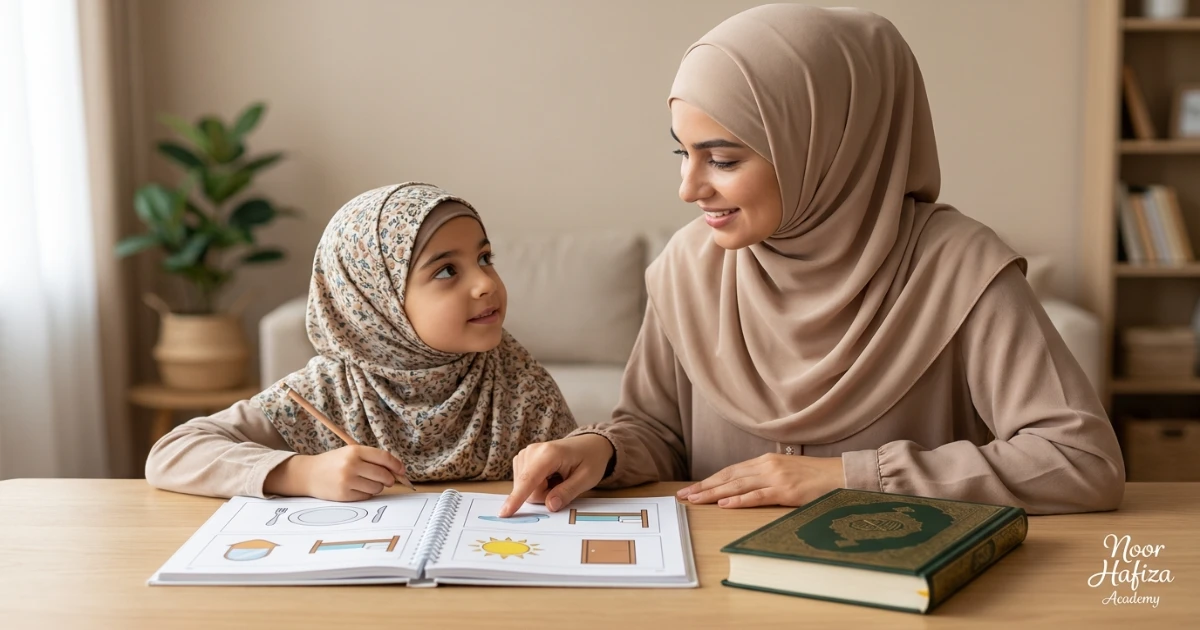
- Use visual reminders near routines only temporarily.
- Remove reminders gradually once recall becomes independent.
- Celebrate consistency and correct use rather than speed.
- Review older duas on one family day each week.
- Tell the teacher which duas remain difficult or confused.
Common mistakes when teaching daily duas to kids
Teaching too many at once
The child can repeat several lines today but cannot remember which dua belongs to which situation next week.
Using only transliteration
Helpful as temporary support, but it can preserve inaccurate sounds if the child never hears and follows correct Arabic.
Testing without real-life use
A worksheet score does not guarantee the child remembers the dua at mealtime or bedtime.
Adding new duas while old ones fade
Keep a weekly review so previously learned duas remain active.
Correcting every sound at once
Prioritize the most important repeated error, repair it, then move to the next issue.
Turning dua practice into punishment
Short, calm repetition and real routines usually build better long-term habits than pressure.
Why teacher guidance matters for daily duas
A teacher can provide the exact Arabic wording used in the curriculum, model pronunciation, explain a reliable simple meaning, and help parents avoid teaching several competing versions at the same time. The teacher can also decide whether the child should slow down or add more based on actual recall.
For younger learners, a good lesson may include one dua, one situation, one meaning, and one short role-play. Older children can learn vocabulary, source context, and how the dua fits into broader Islamic manners.
Online Islamic Studies and daily dua learning for children
Noor Hafiza Academy provides online Quran and Islamic learning for children, girls, women, adults, beginners, and returning learners with female Quran teachers. For children, daily duas can be taught alongside Quran reading, short Surah memorization, Salah, Seerah, Akhlaq, and age-appropriate Islamic Studies.
A suitable plan should consider the child’s age, Arabic reading level, existing duas, pronunciation, school schedule, attention span, and family learning goals. Current teacher availability, schedules, trial arrangements, fees, safeguarding practices, privacy policies, and enrollment terms should be confirmed directly with the academy.
Share the child’s age, current Islamic Studies level, duas already known, Arabic reading ability, time zone, and preferred lesson schedule.
FAQs about daily duas for kids
How many daily duas should a child learn at once?
What daily duas should kids learn first?
How long should daily dua practice take?
Should kids learn the meaning of duas?
Should children memorize Arabic before the translation?
How can parents help children remember duas?
What if my child mispronounces a dua?
Is it okay to use transliteration for children?
How often should old duas be reviewed?
Can daily duas be taught alongside Quran memorization?
How do I know a child has really learned a dua?
Should daily duas be tested formally?
Help daily duas become habits, not just memorized lines
Teach one meaningful dua at a time, model the Arabic carefully, use it in the real routine, and keep older duas active through simple weekly review.