How to Teach Salah to Children Step by Step
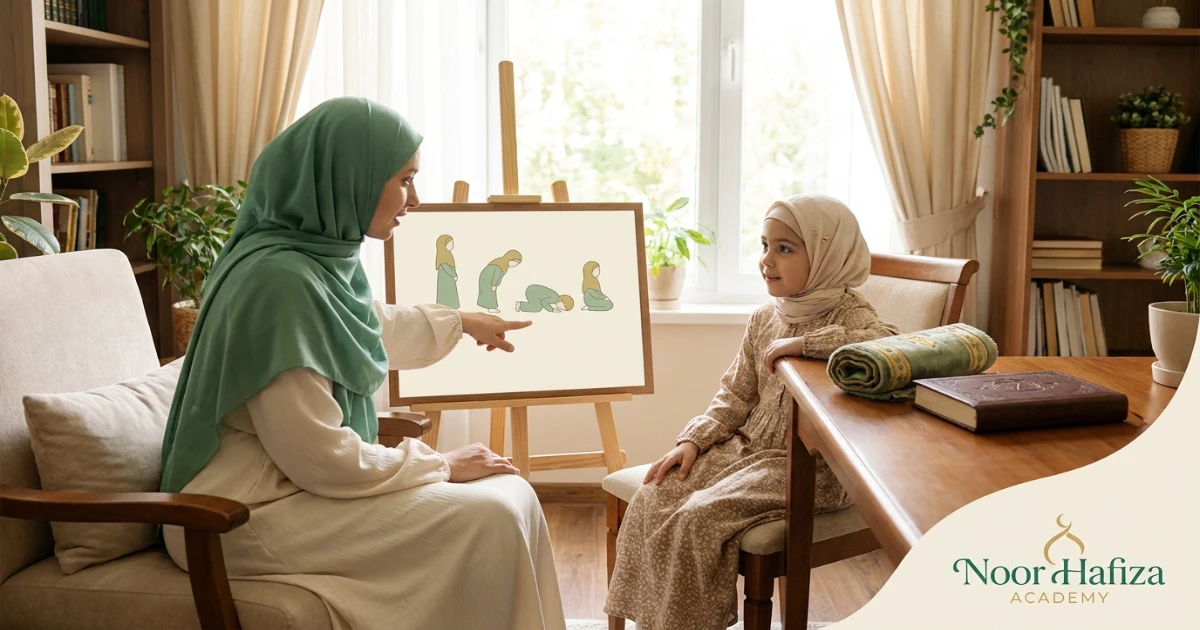
Teaching Salah to children works best when parents and teachers build the prayer in layers instead of expecting a child to memorize every movement, Arabic phrase, prayer time, and rule at once. Start by explaining why Muslims pray. Then teach basic Wudu readiness, the prayer direction and space, the main movements, and the short recitations the child needs. Practise each part separately, connect the sequence slowly, and let the child join family Salah even before everything is perfect. As confidence grows, add independence, the five daily prayer routine, age-appropriate Fiqh details, and gentle self-correction.
What is the easiest way to teach Salah to a child?
Teach Salah in layers. First explain simply that Muslims pray to worship and remember Allah. Next, practise Wudu separately until the child knows the basic sequence. Then teach the main Salah movements—standing, bowing, returning upright, prostrating, sitting, and transitioning—without expecting every recitation immediately. Add the short Arabic phrases and Surahs gradually with correct teacher guidance. Practise one complete short prayer slowly, then let the child join family Salah regularly. Correct only one or two important mistakes at a time, explain simple meanings of what is recited, and increase independence as the child becomes more confident.
Start by teaching what Salah means to a child
Children often see adults standing, bowing, and making Sujood before they understand what prayer is. That visual familiarity is useful, but the first formal lesson should include meaning. Explain that Salah is a special act of worship, a time to remember Allah, recite Quran, make Dhikr, and follow the way Muslims have been taught to pray.
Keep the explanation simple. A young child does not need a long legal lesson before learning the movements. One sentence such as “We pray because Allah deserves our worship and Salah helps us remember Him every day” gives the routine purpose.
Let the child watch, imitate, ask questions, and practise. Confidence is easier to build when the prayer is familiar before every detail is expected.
Teach Wudu before expecting independent Salah
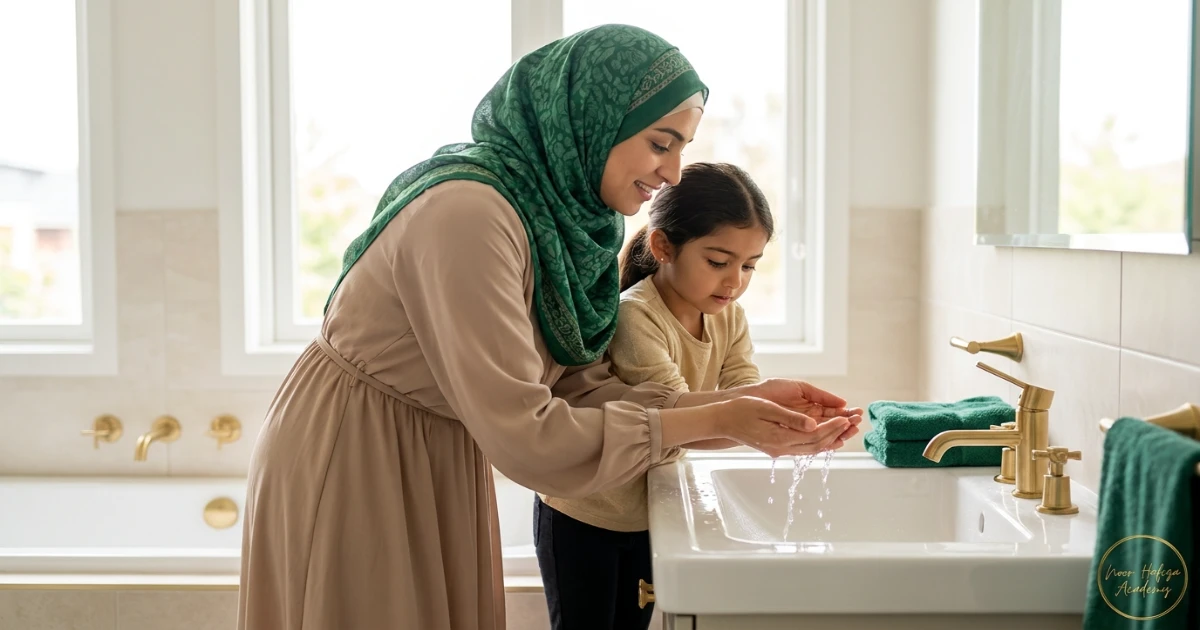
Children benefit from learning Wudu as its own routine. Demonstrate the sequence slowly, then let the child copy you. Use the same order each time and avoid overloading the first lesson with every advanced rule.
Demonstrate
Show the child the basic Wudu sequence using calm, repeatable steps.
Let the child copy
Stand beside the child and prompt only when needed instead of performing every step for them.
Reduce prompts
Ask the child what comes next so the routine gradually becomes independent.
Specific Fiqh details can vary in recognized scholarly schools, so families should keep the child’s method consistent with their trusted teacher, school, or scholarly guidance rather than mixing multiple versions in the same lesson.
Teach the main Salah movements in order
Before asking the child to remember every Arabic phrase, make the movement sequence familiar. The child should learn how the prayer flows from standing to bowing, returning upright, prostrating, sitting, and continuing.
Standing
Teach the child to stand calmly in the prayer space and face the Qiblah according to family or teacher guidance.
Ruku
Practise moving into bowing with control rather than rushing through the transition.
Return to standing
Teach the child that the prayer returns upright before moving to Sujood.
Sujood
Demonstrate prostration carefully and allow the child to copy the posture under supervision.
Sitting
Practise the sitting position separately if the child finds the transition difficult.
Repeat the sequence
Once the movements are familiar, connect them in the order used in the prayer without yet focusing on every recitation.

Add Salah recitations gradually
Once the child recognizes the movement sequence, begin connecting the appropriate Arabic recitations. Do not teach every phrase on the same day. Use a trusted teacher-approved model and keep pronunciation more important than speed.
- Start with the opening Takbir and basic phrases used frequently.
- Teach Al-Fatihah carefully because it is central to the prayer.
- Add one short Surah the child already knows well.
- Teach the short Dhikr connected to Ruku and Sujood gradually.
- Introduce sitting recitations in small portions.
- Explain one simple meaning at a time so the child knows what is being said.
If the child cannot yet read Arabic fluently, teacher-guided listening and repetition can support memorization while Arabic reading skills develop separately. Transliteration may help temporarily, but it should not become the permanent learning method when accurate Arabic models are available.
Teach Al-Fatihah with extra care
For many children, Al-Fatihah is the longest recitation they need early in Salah learning. Break it into small portions, listen carefully, repeat accurately, and test one section at a time without prompting. If a pronunciation issue keeps returning, correct the exact word instead of repeating the whole Surah carelessly.
Children who are already memorizing short Surahs can use the same Hifz method: listen, repeat while looking, recall without looking, connect the next portion, and review again the next day.
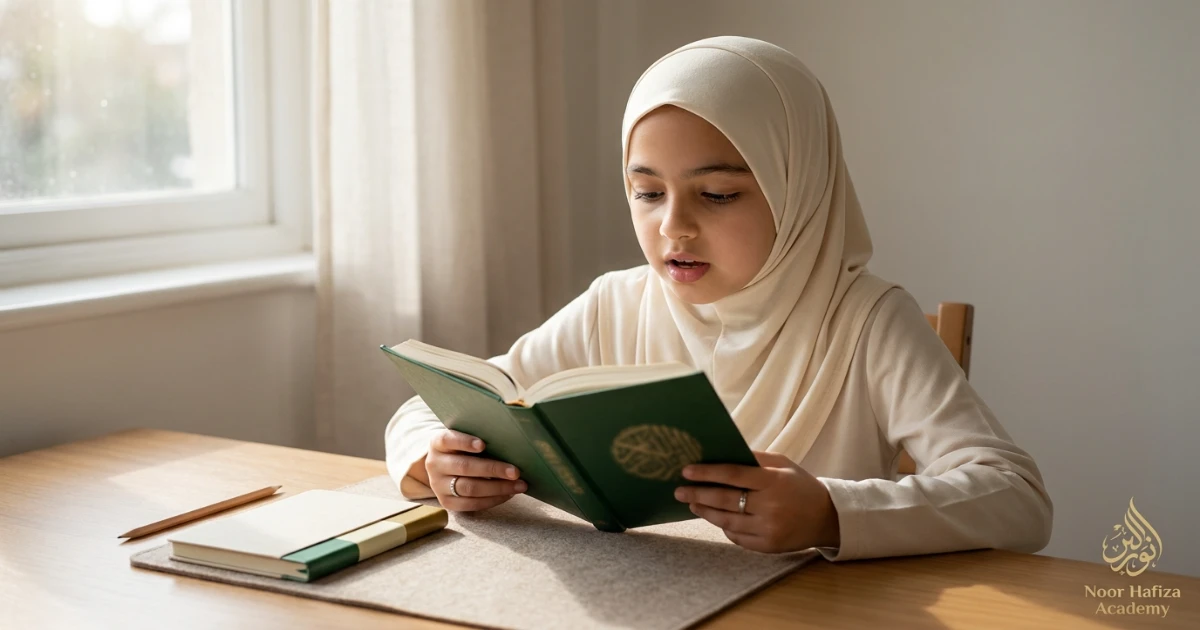
Practise one complete short prayer slowly
Once the child knows the movement order and several essential recitations, practise a complete prayer with guidance. The goal of the first full practice is connection, not perfection.
Prepare calmly
Wudu, prayer space, Qiblah, and no rushing from another activity.
Prompt only when needed
Give the child time to remember the next step before supplying the answer immediately.
Correct one or two points
Do not turn the end of every prayer into a long list of everything that was imperfect.
Repeated guided prayers help the child connect what was learned separately. After several practices, reduce prompts so the child begins to carry the sequence independently.
Introduce the five daily prayers without overwhelming the child
Children first need the common structure of Salah. Once that is familiar, teach that the five daily prayers occur at different times and have different rak’ah counts. A simple visual schedule can help younger children understand the day.
| Prayer | Simple child focus | Family practice idea |
|---|---|---|
| Fajr | Morning prayer and beginning the day with worship | Older children can gradually join when the family routine is suitable. |
| Dhuhr | Prayer during the daytime | Connect to weekends, school holidays, or home schedules when possible. |
| Asr | Afternoon prayer | Use as a regular after-school family prayer when timing allows. |
| Maghrib | Prayer after sunset | Often a practical family teaching time because children are usually home. |
| Isha | Night prayer | Keep the routine from becoming so late that the child is exhausted. |
Prayer times change by location and season, so parents should use a reliable local timetable or mosque guidance. For young children, focus on recognizing the names and sequence of the five prayers before expecting full independent scheduling.
How to teach Salah at different ages
| Age / stage | Main focus | Teaching style | Expected independence |
|---|---|---|---|
| Ages 4–6 | Watching, copying movements, prayer vocabulary | Imitation, short practice, family participation | Very low; familiarity is the goal |
| Ages 7–9 | Wudu, movement order, Al-Fatihah, short Surah, basic Dhikr | Demonstration, repetition, simple checklists | Growing with prompts |
| Ages 10–12 | Five-prayer routine, more accurate recitation, prayer conditions | Practice, meaning, self-checking, teacher correction | Moderate to high |
| Early teens | Personal responsibility, Fiqh details, consistency, Khushu’ awareness | Respectful explanation, evidence, practical problem-solving | High, with guidance as needed |
Sample four-week Salah teaching schedule
| Week | Main goal | Home practice | Teacher check |
|---|---|---|---|
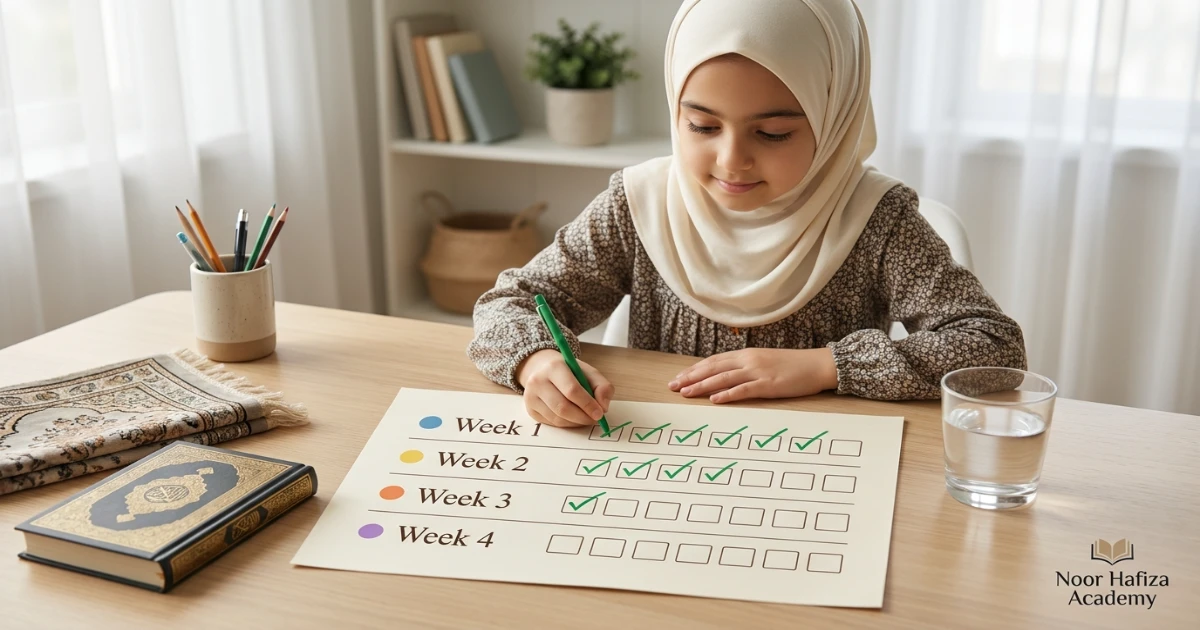
| Week 1 | Meaning of Salah + Wudu routine | Copy Wudu and join one family prayer | Sequence and basic readiness |
| Week 2 | Prayer movements in order | Movement-only rehearsal + family Salah | Posture sequence and transitions |
| Week 3 | Al-Fatihah + short phrases | Short recitation practice | Pronunciation and recall |
| Week 4 | Connect one full prayer | Guided full Salah + fewer prompts | Sequence, recitation, confidence |
Should children learn the meaning of what they say in Salah?
Yes. Even a simple meaning can make the prayer feel less like a sequence of unfamiliar Arabic phrases. Explain that Takbir declares Allah’s greatness, Al-Fatihah contains praise, worship, and guidance, and Sujood is a position of humility and worship.
Do not overload young children with a word-by-word translation of every phrase in the first week. Build understanding gradually alongside memorization.
Use family Salah as the main practice environment
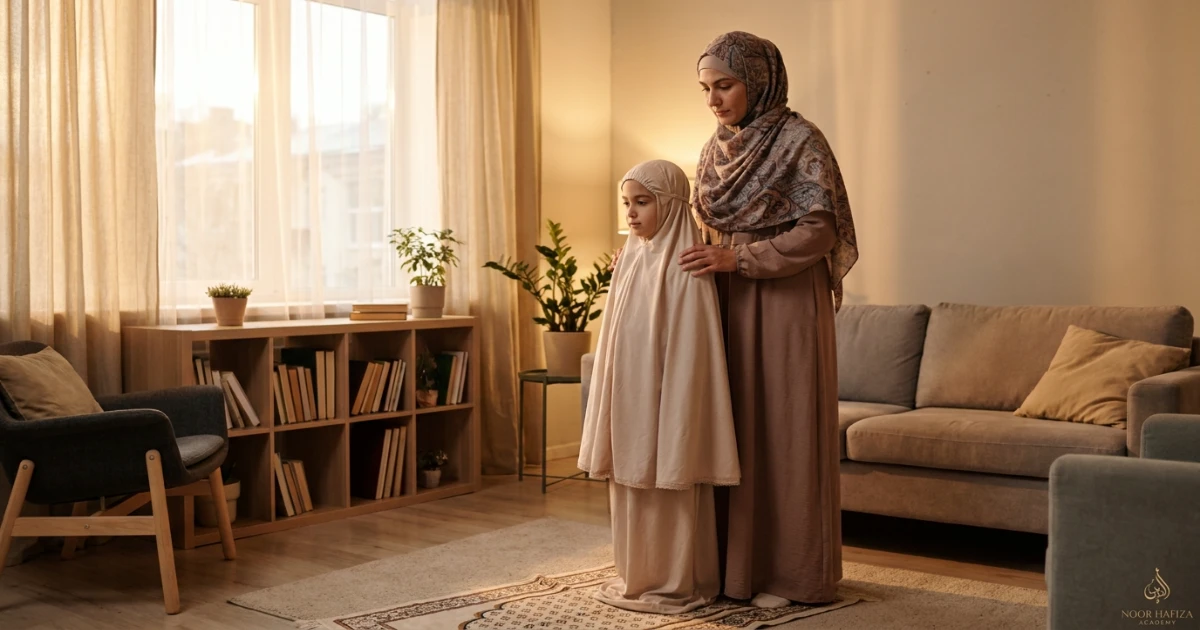
Children learn by seeing adults pray consistently. Family Salah provides repetition without turning every practice into a formal lesson. The child can join, watch the sequence, hear recitations, and gradually become more independent.
- Let the child prepare the prayer mat occasionally.
- Ask which prayer is next during the day.
- Give the child time to complete Wudu with less help.
- Use one family prayer for gentle observation instead of correcting during every Salah.
- After prayer, choose only one important correction if needed.
- Praise consistency, attention, and improvement rather than perfection.
Common problems when teaching Salah to children
The child mixes the movements
Practise the movement sequence without Arabic first, then reconnect the recitations later.
Al-Fatihah is rushed
Break it into smaller portions and correct pronunciation before speed.
The child waits for prompts
Pause for a few seconds before giving the next word or movement cue.
Every prayer becomes a correction session
Choose one or two priorities instead of interrupting every small mistake.
Too many Fiqh details are introduced early
Build the basic prayer confidently, then add deeper rules as the child matures.
Different adults teach different methods
Use one trusted family or teacher approach for recognized differences so the child is not confused.
How to teach children about Salah around school schedules
As children grow older, they need to understand that prayer times continue through school days. Families should teach the names and general timing of the prayers, then gradually explain how to plan around school according to local circumstances, school policies, and trusted Islamic guidance.
For young children, begin with home routines. For older students, discuss what to do when prayer time enters during school, whom to ask, how to find a suitable place where allowed, and how to follow the family’s scholarly guidance regarding practical situations.
Why a teacher helps children learn Salah more accurately
A teacher can check movement order, Wudu sequence, Al-Fatihah pronunciation, short Surahs, Dhikr, and the child’s understanding of prayer. Live correction is especially helpful when a child is memorizing Arabic phrases by sound.
The teacher can also explain which details are essential for the child’s current stage and which can wait. This prevents the first Salah lessons from becoming overloaded with advanced Fiqh.
Online Salah and Islamic Studies lessons for children
Noor Hafiza Academy provides online Quran and Islamic learning for children, girls, women, adults, beginners, and returning learners with female Quran teachers. For children, Salah can be taught alongside Wudu, daily duas, short Surahs, Quran reading, Seerah, Akhlaq, and age-appropriate Islamic Studies.
A suitable learning plan should consider the child’s age, Arabic reading level, Al-Fatihah accuracy, Surahs already memorized, current Wudu knowledge, family practice, school schedule, and the Fiqh approach followed at home. Current teacher availability, schedules, trial arrangements, fees, safeguarding practices, privacy policies, and enrollment terms should be confirmed directly.
Share the child’s age, current prayer knowledge, Quran reading level, Surahs memorized, time zone, and the parts of Salah that need the most help.
FAQs about teaching Salah to children
At what age should children start learning Salah?
What should I teach first: Wudu or Salah?
How do I teach Salah to a child who cannot read Arabic?
Should children memorize all Salah recitations at once?
How long should Salah practice take for kids?
How can parents make Salah easier for children to remember?
What if my child keeps mixing prayer movements?
Should kids learn the meaning of what they say in Salah?
How do I correct Salah mistakes without discouraging a child?
Can children learn Salah through online lessons?
How do I teach the five daily prayers without overwhelming a child?
What if our family follows a different Fiqh school on some prayer details?
Teach Salah as a lifelong act of worship, not a one-week memorization task
Build the meaning, Wudu routine, movements, recitations, and daily prayer habit one layer at a time so confidence grows with understanding.