How Long Should an Online Quran Class Be for a Child?
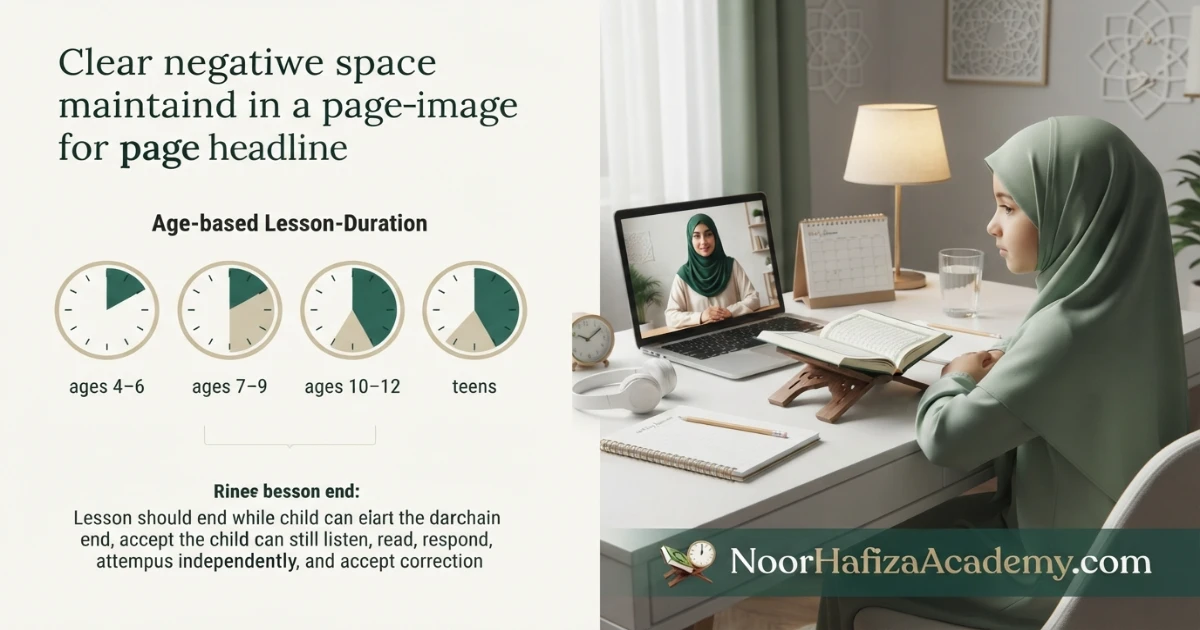
For many children, an effective online Quran class is approximately 15–20 minutes for ages four to six, 20–30 minutes for ages seven to nine, 25–35 minutes for ages ten to twelve, and 30–45 minutes for teens. These are starting ranges, not fixed rules. The best duration depends on attention, reading level, course type, lesson frequency, school workload, teacher style, and whether the child remains actively involved until the end. A shorter class with accurate recitation, independent attempts, and clear feedback is usually more valuable than a longer session filled with passive repetition.
What is the ideal online Quran class length for a child?
The ideal online Quran class length is the shortest duration that allows a child to warm up, revise previous work, learn one clear target, practise with guidance, attempt it independently, and receive feedback without losing meaningful attention. Many young children begin well with 15–20 minutes. Children aged seven to nine often manage 20–30 minutes, ages ten to twelve may use 25–35 minutes, and teens may benefit from 30–45 minutes. Hifz, Tajweed, and advanced reading can sometimes require a longer session, but the teacher should divide the lesson into short active stages. Reduce the duration when the child becomes passive, guesses repeatedly, leaves the seat, or cannot retain the final part. Increase it only after several weeks of calm, accurate participation.
What does the “right” online Quran class length actually mean?
The right class length is not the longest period a child can remain visible on a video call. It is the amount of time in which she can participate meaningfully. Meaningful participation includes listening to the female Quran teacher, locating the correct page, reading aloud, answering a simple question, repeating after correction, attempting the skill independently, and finishing with enough calm to understand the next assignment.
A child may sit for forty minutes while only learning effectively for the first twenty. The remaining time may be filled with repeated reminders, passive imitation, guessing, camera distraction, or correction that no longer transfers into accurate recitation. On the other hand, a focused twenty-minute lesson can include useful revision, one new Qaida pattern, several independent attempts, and a clear home-practice step. The clock alone does not reveal which lesson was better.
A suitable lesson length helps the child retain the main correction, repeat it later, and return to the next class without feeling overwhelmed. Duration should support consistency, not become a test of endurance.
Parents should also separate class length from total weekly learning. A child may take three twenty-five-minute live lessons and complete five-minute reviews on other days. Another may take two thirty-five-minute lessons with longer independent practice. The best plan combines duration, frequency, course demands, and the child’s real home routine.
Recommended online Quran class length by age
Age gives parents a practical starting point, but it should never be used as a rigid promise. Two eight-year-olds may have different reading levels, confidence, attention, sleep schedules, and previous online-learning experience. Begin within the appropriate range and observe the final third of the lesson.
| Age range | Useful starting duration | Best lesson style | Home review | Main warning sign |
|---|---|---|---|---|
| 4–6 years | 15–20 minutes | Short tasks, visual pointing, repetition, praise, and frequent response | 3–7 minutes | The child stops responding or needs constant redirection |
| 7–9 years | 20–30 minutes | Revision, one teaching goal, guided practice, independent attempt | 5–12 minutes | Accuracy drops sharply in the final minutes |
| 10–12 years | 25–35 minutes | Clear target, more independent recitation, correction, progress note | 8–20 minutes | The learner becomes passive and waits for every answer |
| 13 years and older | 30–45 minutes | Private goals, focused feedback, sustained reading, responsibility | Course-based | The lesson becomes lecture-heavy or overloaded with corrections |
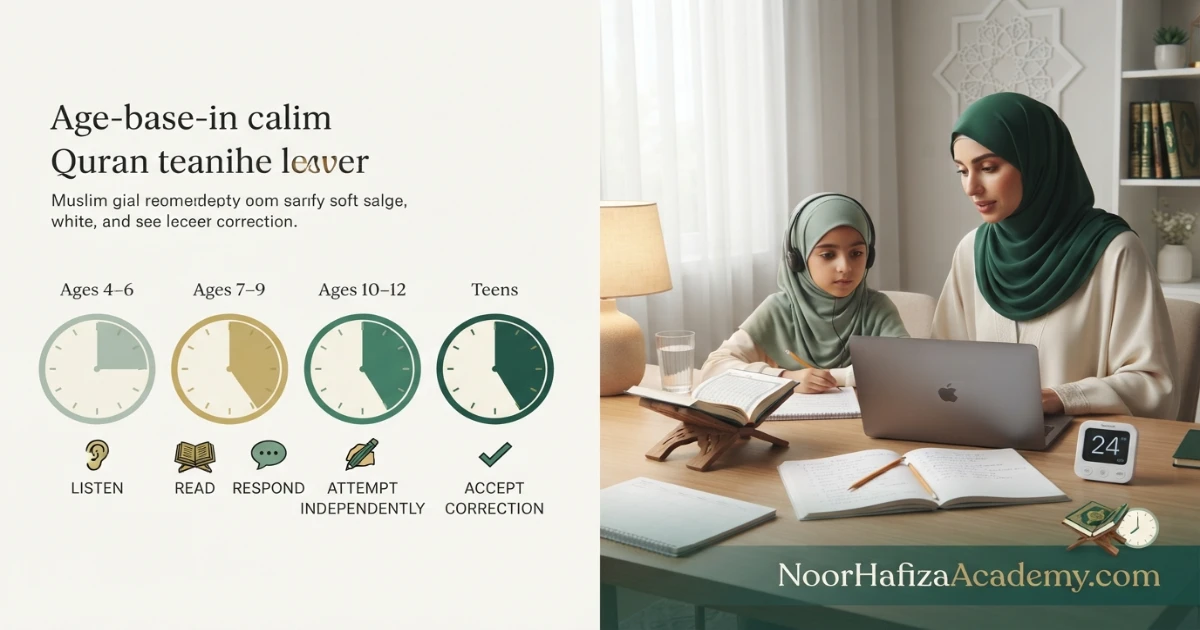
For a four- or five-year-old, the goal may be sitting calmly, responding to the teacher, recognizing several letters, or repeating one short Surah accurately. Extending the lesson because the child has not completed a full page can reduce learning quality. For an older child, the teacher may use a longer session when the learner can read independently, understand corrections, and maintain concentration through revision and new work.
The range should also reflect experience. A child new to online classes may begin at the lower end. After several weeks, the teacher may increase the class by five minutes when the child consistently finishes with strong attention. A child who previously managed thirty minutes may temporarily need twenty during exams, illness, Ramadan, travel, or a difficult school week.
How to tell whether the Quran lesson is too long, too short, or about right
Parents do not need to guess from mood alone. The lesson itself provides evidence. Observe what happens during the final five to ten minutes and what the child can do after class.
The length is about right
The child continues responding, reads with reasonable care, attempts after correction, and can explain or repeat the home task.
The class may be too long
The learner guesses, rubs the eyes, leaves the seat, becomes unusually silly, needs repeated prompts, or forgets corrections immediately.
The class may be too short
The lesson regularly ends before revision, independent recitation, correction transfer, or a clear assignment can be completed.

One difficult lesson does not prove the duration is wrong. The child may be tired, hungry, worried, unwell, or distracted by an unusual event. Look for a pattern across at least several sessions. If the same loss of attention appears at approximately the same minute, the duration or lesson structure should be reviewed.
Parents should share observations without blaming the child. Instead of saying, “She cannot focus,” report specific evidence: “During the last eight minutes she stopped reading independently and needed every first word.” This gives the teacher something practical to adjust.
How long should Quran classes be for Qaida, reading, Tajweed, Hifz, and Islamic Studies?
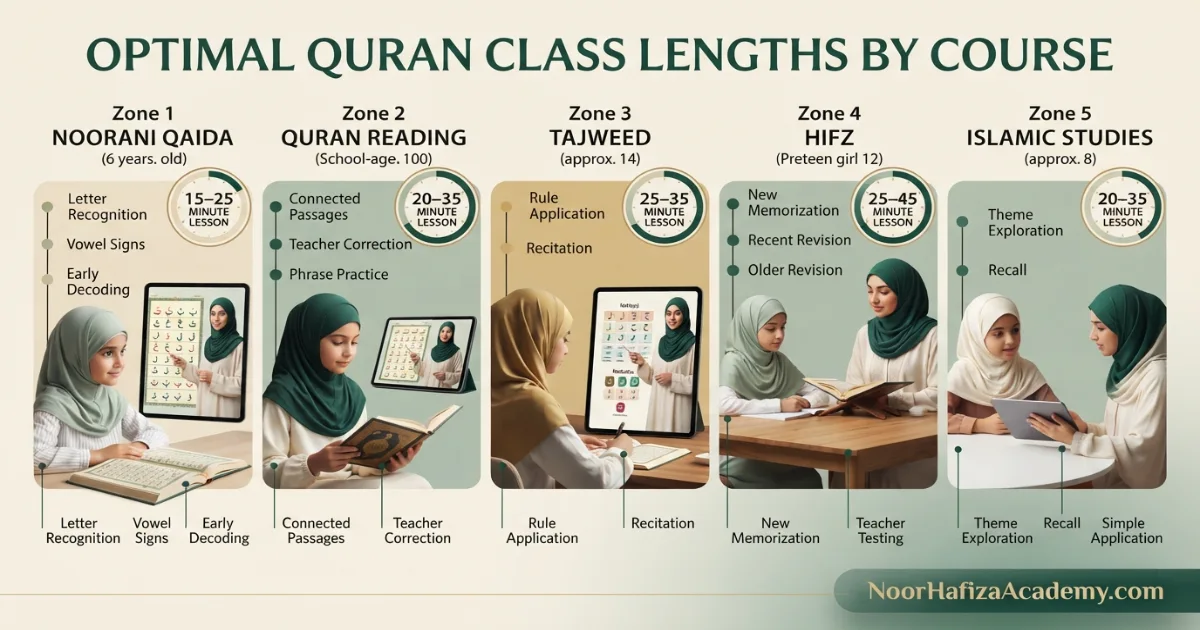
The same child may need different class lengths for different courses. Noorani Qaida often uses short, concentrated decoding tasks. Quran reading needs enough time for revision and connected recitation. Tajweed combines explanation with application. Hifz requires testing of new and previous memorization. Islamic Studies may include conversation, stories, and understanding. Course design therefore matters as much as age.
| Course | Common child-friendly range | What the class should include | When to shorten |
|---|---|---|---|
| Noorani Qaida | 15–25 minutes | Review, one pattern, guided decoding, independent examples | The child begins guessing letters or repeating without looking |
| Quran reading | 20–35 minutes | Familiar review, new passage, phrase reading, stopping, correction | Accuracy and phrase flow collapse near the end |
| Tajweed | 25–35 minutes | One rule or sound, examples, application inside recitation | Too much theory replaces actual recitation |
| Hifz | 25–45 minutes | New work, recent revision, older revision, random testing | Testing becomes rushed or new work replaces revision |
| Islamic Studies | 20–35 minutes | One theme, discussion, examples, recall, simple application | The child becomes a passive listener for most of the class |

Noorani Qaida classes
A short Qaida lesson can be highly productive because the teacher is working with a narrow skill: letter recognition, vowel signs, joining, sukoon, shaddah, madd, or blending. The child should see the pattern, hear it, read several examples, and then attempt unfamiliar examples. When the session becomes too long, children may stop decoding and begin repeating the teacher mechanically. Families can explore the academy’s Noorani Qaida online pathway for foundational reading support.
Quran reading classes
Reading lessons usually need enough time for a familiar warm-up, correction of previous errors, a manageable new passage, phrase connection, and independent recitation. The class should not be measured only by lines completed. A twenty-five-minute session that improves decoding and stopping may be better than forty minutes of rushed page reading. The guide to improving Quran recitation explains how accuracy develops into fluency.
Tajweed classes
Tajweed needs explanation, listening, mouth-position guidance, repetition, and transfer into connected Quran reading. Younger children should work with one active target at a time. A long lesson filled with rule names can overload memory. A well-designed thirty-minute class may spend only a few minutes explaining and most of the time applying the rule. See online Tajweed classes for course-specific guidance.
Hifz classes
Hifz may require longer or more frequent contact because the teacher needs to hear new memorization, recent revision, and older revision. However, one long class is not always the best solution. Some children benefit from shorter, frequent teacher checks, especially when the new portion is small. If a forty-minute class is used, the teacher should divide it clearly and protect revision before adding new work. Learn more about online Hifz Quran classes.
Islamic Studies
Islamic Studies can include stories, manners, prayer, duas, beliefs, and age-appropriate discussion. The child should answer, explain, connect examples to life, or complete a simple recall activity. The class becomes too long when the teacher speaks continuously and the child only listens. Conversation and short activities help maintain meaningful attention.
What should happen inside a well-designed online Quran class?
A good lesson has a visible beginning, middle, and end. Changing the activity every few minutes does not mean entertainment is required. It means the teacher moves the learner through different cognitive tasks: recall, listening, decoding, recitation, correction, and independent performance.
Begin with a familiar success
Use a familiar Surah, previous Qaida line, or short revision passage. This helps the teacher check readiness and allows the child to settle into the lesson.
Test the previous target
The teacher checks whether the last correction remains without giving the answer immediately. Weakness is repaired before the new target expands.
Introduce one clear objective
The teacher models a sound, rule, line, or memorization segment and explains only what the child needs for the current task.
Move from guidance to independence
The child repeats, reads, connects, or recalls. Prompts are gradually reduced so the teacher can see what the learner can do alone.
Confirm learning and the next step
The child performs one final attempt, hears concise feedback, and understands the exact home assignment.
A twenty-minute class may use three minutes for warm-up, four minutes for review, seven minutes for the new target, four minutes for independent practice, and two minutes for feedback. A thirty-minute class can expand each stage without losing focus. A forty-minute class should normally include meaningful changes in task and may include a brief reset or stretch for younger learners.
What can a 20-, 30-, or 40-minute Quran lesson look like?
| Class length | Suggested structure | Often suitable for | Teacher priority |
|---|---|---|---|
| 20 minutes | 3-minute warm-up, 4-minute review, 7-minute teaching, 4-minute independent practice, 2-minute feedback | Young beginners, short Qaida work, familiar Surah correction | One narrow target and high participation |
| 30 minutes | 4-minute warm-up, 6-minute review, 10-minute teaching and guided practice, 7-minute independent recitation, 3-minute feedback | School-age Qaida, Quran reading, basic Tajweed, beginner Hifz | Transfer the correction into a new example |
| 40 minutes | 5-minute warm-up, 10-minute revision, 12-minute new work, 9-minute testing or application, 4-minute feedback | Older children, teens, Hifz testing, advanced Tajweed | Protect revision and prevent lecture-heavy teaching |
These timelines are examples, not scripts. A Hifz class may spend more time on revision. A new Qaida learner may need more repetition and fewer stages. The important principle is that the learner remains active and that the final minutes still produce useful evidence.
Is a short online Quran class better than a long class?
A short class is better when it preserves attention, accuracy, and willingness to practise again. A longer class is better when the child can use the extra time productively. Duration is not a quality score. Parents should compare what the teacher and child accomplish.
Short focused lesson
- Begins on time with materials ready
- Targets one important skill
- Keeps the learner reciting and responding
- Includes an independent attempt
- Ends with a clear assignment
- Leaves enough energy for short home review
Overly long lesson
- Uses page count as the main goal
- Repeats after attention has dropped
- Requires constant parent reminders
- Adds several unrelated corrections
- Ends without checking retention
- Creates resistance to later practice

The opposite is also possible. A fifteen-minute lesson may be too short for an older Hifz learner if it ends before the teacher hears recent and older revision. The solution may be a longer class, an additional weekly check, or a better division of responsibilities. The parent and teacher should identify which stage is regularly being missed.
Is it better to have shorter Quran classes more often or longer classes fewer times?
For many young learners, shorter and more frequent contact supports recognition, pronunciation, and routine. A child may benefit more from three twenty-minute lessons than one sixty-minute lesson because correction is repeated across the week and less material is forgotten between sessions. Older learners may manage two longer lessons when they also complete independent practice.
| Pattern | Possible advantage | Possible limitation | Useful for |
|---|---|---|---|
| 3–4 short lessons | Frequent correction and easier attention | Needs reliable weekly scheduling | Young Qaida learners, early reading, small Hifz portions |
| 2 medium lessons | Enough time for revision and new work | Home practice becomes more important | School-age reading, Tajweed, Islamic Studies |
| 1 long lesson | Can support mature independent learners | Too much delay between corrections and high fatigue risk | Selected teens or review sessions, not most young beginners |
| Frequent Hifz checks | Protects new and recent memorization | Requires disciplined revision between checks | Committed Hifz students with small daily targets |
The best pattern is the one the family can keep. A theoretically perfect four-day schedule is not useful when activities cause repeated cancellations. Review the broader routine with the guide to the best online Quran class schedule for school-age children.
How class format changes the ideal Quran lesson duration
A one-to-one lesson can often be shorter because the teacher hears the child continuously, adjusts the level immediately, and does not divide attention among several students. A twenty-five-minute private lesson may provide more direct recitation time than a forty-minute group class.
Group lessons need additional time for turn-taking, shared explanation, and listening to classmates. They can support motivation and community, but parents should ask how much individual recitation each child receives. A group class is not automatically suitable because the total session is longer. Compare format, participation, and correction using the guide on one-to-one versus group Quran classes.
Direct recitation, correction, and independent response are stronger indicators of value than the advertised class duration.
How school, meals, prayer, activities, and sleep affect class length
A thirty-minute class can feel manageable at one time and exhausting at another. The learner may have the skill and attention for thirty minutes, but not immediately after a long school commute, before dinner when hungry, or late at night. Class duration must be evaluated together with timing.
- Allow a transition after school before beginning the lesson.
- Avoid scheduling the class directly against dinner or bedtime.
- Protect prayer times and avoid making the child feel rushed.
- Consider sports, tutoring, homework, and sibling schedules.
- Use an earlier class for younger children whenever possible.
- Shorten temporarily during exams, illness, travel, or sleep disruption.
- Test a new time through a trial lesson before changing the whole week.
During summer, the family may move lessons to a calm morning period and increase frequency without increasing each class. During Ramadan, children may need a shorter technical lesson or a different time because fasting and sleep affect attention. Use the guides to summer Quran classes for kids and the Ramadan Quran learning plan for seasonal adjustments.
How to adjust Quran class length for a child who needs more movement, repetition, or processing time
Some children need shorter tasks, additional repetition, a visual schedule, more response time, or a brief physical reset. This does not mean they cannot learn online. It means the class should be designed around how they participate best. Parents can tell the teacher what helps at school or during homework without attaching blame or making unsupported assumptions.
A child who needs more processing time may benefit from a slower twenty-five-minute lesson rather than a fast forty-minute lesson. Another child may need a thirty-minute class divided into two active blocks with a one-minute reset. The teacher can use predictable stages, concise instructions, visual pointing, and one correction at a time.
When a child has an established educational or health support plan, parents should follow relevant professional guidance and share practical accommodations with the academy. The Quran teacher’s role is to adapt teaching and communication, not to diagnose a condition.
What should parents do during an online Quran class?
Young children may need a mother or female guardian nearby to open the lesson link, position the device, provide the correct book, and reduce household interruptions. The parent should support the environment without becoming a second teacher during every recitation attempt.
- Prepare the device, book, headphones, and water before class.
- Stay close enough to solve technical problems for a young child.
- Do not give the first word immediately when the child hesitates.
- Avoid correcting over the teacher or using a different pronunciation method.
- Observe the child’s final-minute attention and note patterns.
- Ask for one clear home-practice instruction.
- Share repeated fatigue, school changes, or schedule problems early.
Parents can protect the learning routine while the female Quran teacher handles technical reading, Tajweed, and Hifz correction. This balance also helps the teacher evaluate independent ability. Related support is explained in how parents can help a child memorize the Quran.
A simple three-class method for finding the right online Quran lesson length
One trial lesson can reveal teacher communication and basic level, but three similar sessions provide better evidence about duration. Use the same approximate time of day and avoid testing during an unusually busy week.
Begin at the lower end of the age range
Choose a manageable duration and tell the teacher the child’s age, level, course, school routine, and previous online-learning experience.
Observe the final third
Note response time, accuracy, posture, prompting, willingness to attempt, and whether the child can understand feedback.
Check retention later
Ask the child to repeat the main target after a short gap or during the next home-practice period.
Repeat for two more lessons
Look for a pattern rather than reacting to one tired or unusually energetic day.
Adjust by five to ten minutes
Shorten, extend, split the task, or change frequency according to evidence from the lesson and home review.
Review again after four weeks
Attention and level change. A duration that worked at enrollment may need adjustment after the child progresses or the school routine changes.
What should parents and the Quran teacher review before changing class duration?
| Area | Question | Evidence | Possible adjustment |
|---|---|---|---|
| Attention | When does participation begin to fall? | Repeated loss of response during the same final minutes | Shorten or add a brief task reset |
| Accuracy | Does reading quality remain stable? | More guessing, omitted signs, or weak recall near the end | Reduce duration or material load |
| Coverage | Are key lesson stages being completed? | Revision or independent testing is always skipped | Extend slightly or improve structure |
| Retention | What remains after class? | Child can repeat the main correction later | Keep length or increase carefully |
| Wellbeing | Does the child approach class calmly? | Consistent readiness versus repeated resistance and fatigue | Change time, frequency, or duration |
| Home practice | Is there energy for the assigned review? | Short practice is completed without conflict | Avoid using all capacity in the live lesson |

The review should end with one decision: keep the duration, shorten it, increase by five minutes, divide the class differently, change frequency, or move to a better time. Avoid changing duration, teacher, schedule, and course target at the same time because the family will not know which change helped.
Mistakes to avoid when choosing how long a child’s Quran class should be
Choosing by price per minute
A longer class can look like better value while giving the child less active recitation. Compare teaching quality, correction, and retention.
Copying another child’s duration
Siblings and classmates can differ in age, course, attention, level, and school workload. Use the learner’s evidence.
Increasing length too quickly
One excellent lesson does not prove the child is ready for a permanent increase. Look for consistency across several weeks.
Using duration to force page targets
Adding minutes does not solve weak foundations. The teacher may need a smaller target or a different method.
Ignoring the final minutes
Parents notice the strong beginning and miss that the child becomes passive near the end. Review the whole session.
Removing all home practice
A longer live lesson cannot always replace short review between classes, especially for Qaida, pronunciation, and Hifz.
Scheduling too late
The class may appear too long when the real problem is sleepiness, hunger, or a rushed evening.
Waiting until the child refuses
Repeated fatigue and passive learning should be reviewed before they become strong resistance to the routine.
How technology affects the useful length of an online Quran class
A thirty-minute booking does not provide thirty minutes of learning when the first ten are spent finding the link, charging the device, correcting audio, and locating the book. A prepared environment allows a shorter lesson to feel complete.
- Open the lesson link and test audio before the start time.
- Use a stable device positioned where the child can see the teacher and text.
- Keep the correct Mushaf, Qaida, notebook, pencil, and headphones ready.
- Turn off games, notifications, videos, and unrelated browser tabs.
- Use good lighting so the teacher can see attention and page position.
- Provide a respectful desk or rehal for the Mushaf.
- Tell siblings and visitors that the class needs a protected quiet period.
When technical problems occur repeatedly, parents may believe the child needs a longer class. The better solution is often a stronger setup and punctual start. Useful teaching minutes matter more than the calendar booking.
How Noor Hafiza Academy approaches child-friendly online Quran lesson length
Noor Hafiza Academy offers live online Quran learning with female Quran teachers for children, girls, women, sisters, beginners, Quran readers, Tajweed learners, and Hifz students. A suitable class plan begins with the child’s age, current level, course, prior learning, available practice time, time zone, school routine, and realistic attention.
The first lesson should help identify whether the learner needs foundational Qaida, Quran reading, Tajweed correction, memorization, revision, or Islamic Studies. The teacher and family can then discuss an appropriate duration and weekly frequency. Current teacher availability, lesson lengths, schedules, trial arrangements, fees, policies, and enrollment terms should be confirmed directly with the academy.
Share age, course, reading level, existing memorization, previous class length, attention concerns, school hours, activities, time zone, and the result you want the child to achieve.
A practical checklist for choosing the right online Quran class duration
Start by age
Choose a sensible starting range rather than the maximum duration available.
Match the course
Qaida, reading, Tajweed, Hifz, and Islamic Studies need different structures.
Protect the time
Use a calm period around school, prayer, food, activities, and sleep.
Watch the ending
Observe accuracy, response, prompts, and emotional regulation in the final minutes.
Check retention
Confirm that the main correction or assignment remains after a short delay.
Review regularly
Adjust duration as level, school routine, course demands, and independence change.
FAQs about online Quran class length for children
How long should an online Quran class be for a child?
Is a 30-minute Quran class too long for a five-year-old?
Is 20 minutes enough for an online Quran lesson?
How long should a Quran class be for a seven-year-old?
How long should a Quran class be for a ten-year-old?
Do Hifz classes need to be longer than Quran reading classes?
Are shorter Quran classes better for young children?
How many online Quran classes should a child take each week?
How do I know my child’s Quran class is too long?
Should I increase class length when my child is progressing quickly?
Does a one-to-one Quran class need to be as long as a group class?
Can the Quran class length change during school exams, Ramadan, or summer?
Choose a Quran class length your child can use well
Share the child’s age, Quran level, current course, previous class experience, school hours, activities, time zone, attention pattern, and family goals. Noor Hafiza Academy can discuss a suitable starting assessment and lesson plan with a female Quran teacher.