
What Is an Ijazah in Quran Recitation?

An ijazah in Quran recitation is a formal authorization from a qualified teacher confirming that a student has completed a defined standard of recitation, memorization, or study under supervision. It may be connected to a sanad—a chain of teachers through whom the recitation or text has been transmitted. However, the word ijazah is used in different ways, so learners should never assume that every certificate means the same thing. Some ijazahs relate to reciting the entire Quran in a specific reading, some relate to memorization, some relate to Tajweed texts, and some explicitly include permission to teach. A genuine ijazah should have a clear scope, a known teacher, an assessment process, and conditions that can be explained without vague claims.
What is an ijazah in Quran recitation?
An ijazah in Quran recitation is a teacher’s formal authorization confirming that a student has completed a specific recitation, memorization, text, or teaching standard under supervision. In many cases, the authorization is connected to a sanad—a chain of teachers through whom the Quran recitation or scholarly text has been transmitted. The scope must be stated clearly. An ijazah may cover the complete Quran in one recognized reading, memorization with recitation, a Tajweed text, or permission to teach a defined subject. It does not automatically mean the holder is qualified for every Quran course, every qira’ah, or every age group. Learners should verify who issued it, what was assessed, which reading or text it covers, whether teaching permission is included, and how the teacher’s own authorization is documented.
What does the word ijazah mean in Quran study?
Ijazah means authorization or permission. In traditional learning, a teacher grants it after confirming that a student has completed a defined work, recitation, memorization, or standard. The teacher is not simply handing over a decorative certificate. She is giving testimony about what the student completed under her supervision and, depending on the wording, may also authorize the student to transmit or teach that material.
The exact meaning depends on the document and learning tradition. An ijazah for reciting the complete Quran in one reading is different from an ijazah in a Tajweed poem, a memorization certificate, a course-completion certificate, or a teaching license from an academy. The title alone is not enough. The learner should understand the content, conditions, reading, teacher, and scope.
A responsible teacher can explain what the student completed, what standard was used, which mistakes were corrected, and what permission the document does or does not include.
For many learners, the process itself is more valuable than the paper. Reading the entire Quran carefully to a qualified teacher, maintaining correction, returning to weak passages, and learning consistent Tajweed can create disciplined recitation habits. The final authorization records that supervised journey.
Ijazah, sanad, qira’ah, riwayah, and shahadah: what is the difference?
Authorization
A teacher’s permission or certification confirming a defined completion or transmission scope.
Chain of teachers
The sequence of teachers through whom the recitation, reading, or text was received.
Recognized mode of Quran recitation
A broader recognized reading tradition with established transmission principles.
Narrated transmission within a qira’ah
A specific transmission associated with a narrator within the wider reading tradition.
Certificate or testimony
A general certificate may confirm attendance or completion, but it is not automatically the same as an ijazah with sanad.
Precision and mastery
A term often used for strong, controlled performance; exact expectations depend on the teacher and program.
These terms should not be used loosely. A website may say “ijazah course” when the program actually provides only a completion certificate. A learner may say “I have sanad” without explaining the reading or teacher chain. Clear language protects both the student and the public.
What is a sanad in Quran recitation?
A sanad is a chain of teachers. In Quran recitation, it describes how a learner received the recitation through a teacher, who received it through another teacher, and so on. The chain reflects supervised oral transmission rather than self-study alone.
The sanad does not remove the need to evaluate the current teacher. A long or respected chain does not automatically prove that every holder teaches children well, communicates clearly, maintains professional standards, or is suitable for every course. The sanad addresses transmission; teaching skill and learner fit still need separate evidence.
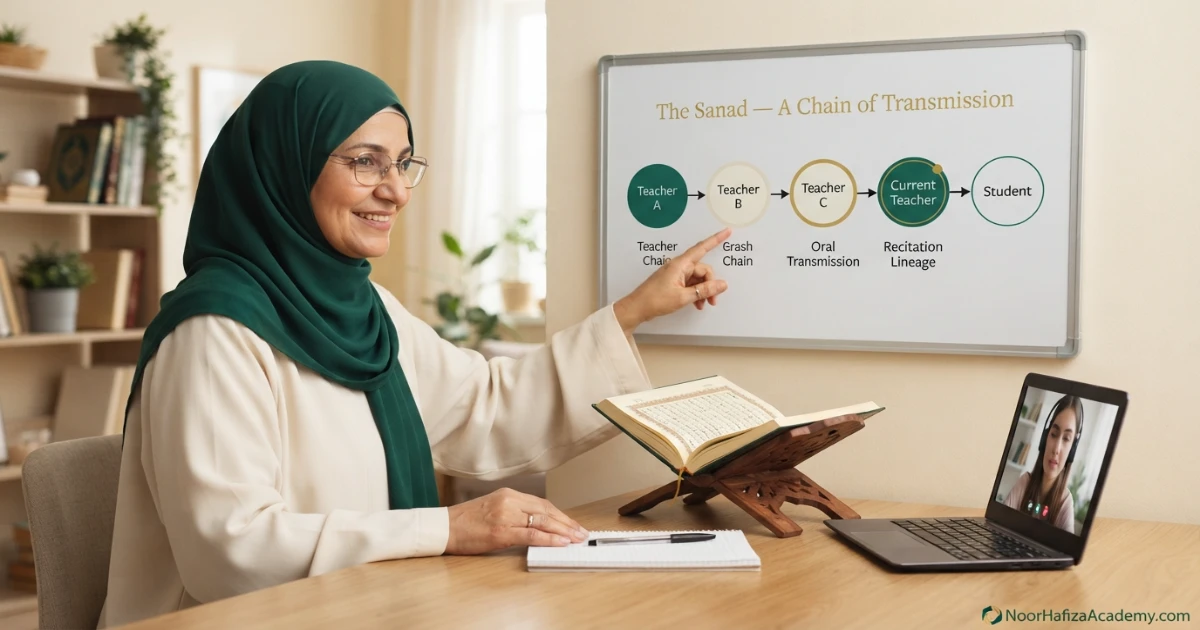
Questions to ask about a sanad
- Which reading or text does the chain relate to?
- Who is the immediate authorizing teacher?
- Can the teacher explain the chain and its scope?
- Is the sanad included in the document or maintained separately?
- Was the entire required material recited or studied directly?
- Does the authorization include teaching or transmission permission?
Types of Quran ijazah learners may encounter
Recitation ijazah
The student recites the complete Quran to the teacher in a defined reading or transmission and is assessed for accuracy and Tajweed.
Memorization ijazah
The student recites from memory according to the teacher’s conditions, often with testing of continuity, accuracy, and retention.
Recitation and Hifz ijazah
The authorization may combine memorization with complete supervised recitation, depending on the teacher’s standard.
Tajweed text ijazah
The student studies or recites a recognized Tajweed text or poem under a qualified teacher and receives authorization in that text.
Teaching authorization
The wording may explicitly permit the student to teach or transmit the defined material; this should never be assumed unless stated.
Qira’at authorization
Advanced learners may study one or more recognized readings under specialized teachers with stricter prerequisites.

What an ijazah does not automatically prove
An ijazah can be an important qualification, but it should not be treated as a universal guarantee. Its value depends on the scope, assessment, teacher, and way the holder applies the learning.
It does not cover every qira’ah
Authorization in one reading or transmission does not automatically authorize all recognized readings.
It does not prove child-teaching skill
A holder may recite accurately yet need separate experience in age-appropriate teaching and safeguarding.
It does not guarantee perfect lifelong recitation
Skills require maintenance. Weakness can return without regular review and careful teaching.
It does not replace subject boundaries
A Quran recitation ijazah does not automatically qualify someone to issue legal rulings or teach unrelated Islamic sciences.
It does not prove academy quality
The broader program still needs reliable schedules, safety, communication, feedback, and professional policies.
It does not make every certificate equal
Some documents record completion; others include sanad and transmission permission. The wording matters.
What are the usual requirements for a Quran recitation ijazah?
Requirements vary by teacher, reading, and program. There is no single universal checklist that applies identically everywhere. However, a serious recitation ijazah process commonly includes a strong reading foundation, complete supervised recitation, correction of recurring errors, Tajweed application, consistency, and final teacher approval.
| Area | Typical expectation | Evidence | Possible reason for delay |
|---|---|---|---|
| Reading accuracy | Letters, vowels, shaddah, sukoon, and word forms remain reliable | Consistent full-word and connected reading | Repeated foundational errors |
| Tajweed | Required rules are applied in real recitation | Stable pronunciation and timing across passages | Rules known in theory but not applied |
| Complete recitation | The required Quran portion is read directly to the teacher | Teacher records completion and corrections | Missed sections or interrupted continuity |
| Consistency | Corrections remain stable after review | Fresh passages and repeated patterns remain accurate | Improvement appears only in memorized examples |
| Memorization | Required only for ijazahs that include Hifz or memory recitation | Random starts, joins, and old revision | Prompt dependence or weak retention |
| Teacher approval | The authorizing teacher is satisfied with the defined standard | Clear authorization and document wording | The learner has not met the teacher’s threshold |
How does a Quran ijazah assessment usually work?
Initial recitation assessment
The teacher hears familiar and unfamiliar passages to identify reading accuracy, Tajweed, stopping, fluency, and major recurring errors.
Readiness decision
The learner may begin the ijazah route immediately or first complete targeted Tajweed, Makharij, or reading repair.
Systematic supervised recitation
The student recites the required material directly to the teacher while corrections and weak patterns are recorded.
Review and correction transfer
The teacher checks whether previous corrections remain stable in later verses and unfamiliar contexts.
Completion and final review
Any incomplete, weak, or disputed areas are revisited before the teacher makes a final authorization decision.
Document and scope explanation
The student should understand what the ijazah covers, the reading or text, the sanad, and whether teaching permission is included.

How long does it take to earn an ijazah in Quran recitation?
There is no trustworthy universal completion time. The duration depends on the learner’s current reading, Tajweed accuracy, lesson frequency, correction load, reading speed, consistency, memorization requirement, teacher availability, and the scope of the ijazah.
A strong reader who already applies Tajweed may progress much faster than a learner who needs Makharij repair or foundational reading work. A memorization ijazah may take longer when older revision is unstable. Advanced qira’at study is a different level of commitment from a beginner recitation course.
Ask whether the learner can complete unfamiliar recitation accurately, retain corrections across later passages, apply Tajweed without prompts, and meet the teacher’s stated standard consistently.
Can a Quran ijazah be completed online?
Online study can support an ijazah route when the teacher hears the student live, verifies the learner’s identity, maintains clear records, uses reliable audio, and applies the same assessment standard required for direct supervised recitation. Technology changes the location of the lesson, not the need for actual teacher–student transmission.
The quality of online audio is critical. Tajweed, Makharij, timing, nasalization, and subtle corrections cannot be assessed reliably through distorted sound. The teacher should pause the assessment when technical quality prevents accurate listening.

Online ijazah quality checklist
- Lessons are live and the teacher hears the student directly.
- The learner’s identity is known and consistent.
- Audio quality is suitable for detailed recitation correction.
- The teacher records completion and recurring corrections.
- Missed portions or technical failures are revisited.
- The final document states the same scope discussed during study.
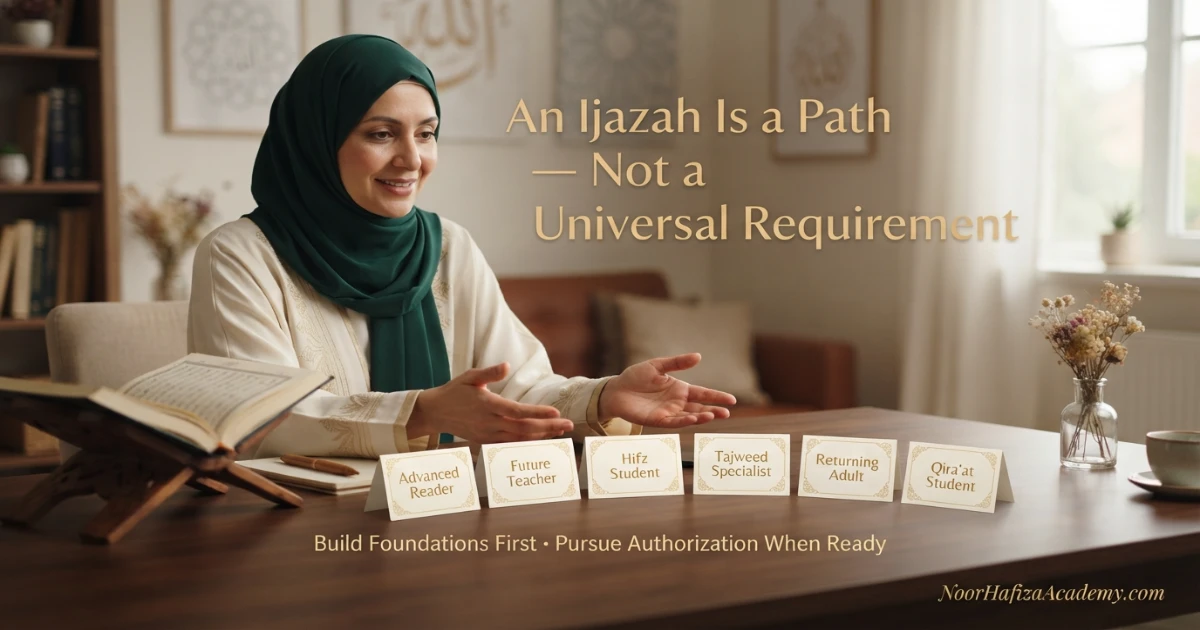
Who should consider pursuing a Quran ijazah?
An ijazah is not required for every Muslim who wants to read the Quran correctly. Many learners should first focus on accurate reading, Tajweed, understanding, regular recitation, or Hifz revision. An ijazah becomes especially relevant when the learner wants formal authorization, advanced supervised completion, or preparation to teach a defined recitation or text.
Advanced Quran readers
Learners who already recite accurately and want a complete supervised route with formal authorization.
Future Quran teachers
Students seeking documented recitation training before teaching, while also developing pedagogy and safeguarding skills.
Hifz learners
Memorizers who want formal testing of complete recitation and long-term retention under a qualified teacher.
Tajweed specialists
Learners progressing beyond basic rule study into carefully supervised application or text study.
Adult returners
Strong returning readers who want structured correction and a meaningful advanced goal.
Students of qira’at
Advanced students with the prerequisites for specialized study under authorized teachers.
Can children receive an ijazah in Quran recitation?
A child may complete an ijazah when she meets the teacher’s required standard. Age alone should not be used to lower the recitation requirements or create pressure. The child needs stable reading, attention, emotional readiness, consistent practice, and enough maturity to maintain a long supervised route.
Parents should protect the child from treating ijazah as a status competition. The goal is careful Quran learning, not collecting a certificate before siblings or classmates. A slower route with stronger foundations is better than rushed completion with unstable recitation.
The teacher should also be qualified to work with children. Recitation authorization does not automatically prove age-appropriate teaching, safeguarding awareness, or parent communication. These need separate evaluation.
Does an ijazah automatically allow someone to teach Quran?
Not always. Some ijazahs explicitly include permission to transmit or teach the defined material. Others confirm completion without broad teaching permission. The wording and teacher’s intention matter.
Even where teaching permission exists, a responsible Quran teacher still needs pedagogy, communication, learner assessment, professional boundaries, safeguarding, reliability, and course-specific experience. Authorization in recitation answers one part of teacher qualification; it does not answer every part.
Parents should review the teacher’s ijazah scope, own recitation, correction method, child experience, trial quality, safety, reliability, and progress system.
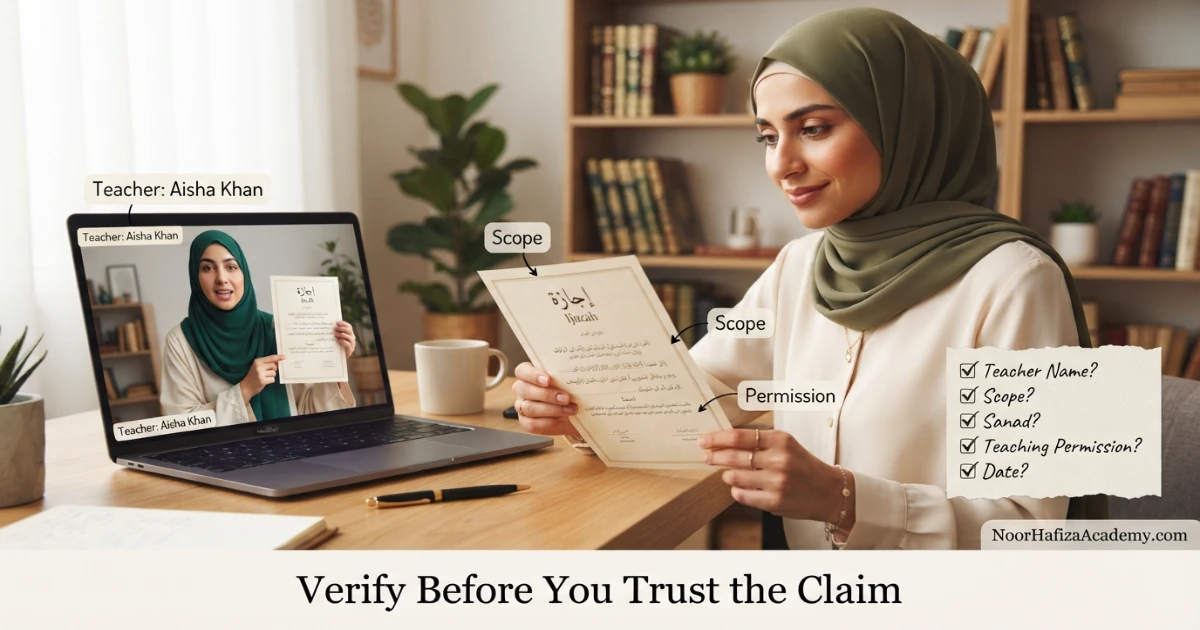
How can learners verify a Quran ijazah?
Read the document carefully
Look for the learner’s name, teacher’s name, date, reading or text, completion scope, and teaching permission where applicable.
Ask what was assessed
Confirm whether the complete Quran was recited, whether memorization was required, and how errors were reviewed.
Understand the sanad
Ask whether the chain is included, maintained separately, or explained by the teacher.
Confirm the immediate teacher
Where appropriate, verify that the named teacher issued the authorization and recognizes its scope.
Compare claims with wording
Do not accept claims to teach every qira’ah, level, or course when the document covers one limited area.
Evaluate present ability
For teacher selection, use a live trial to assess current recitation, explanation, correction, professionalism, and learner fit.
Questions to ask before joining an ijazah course
Use these questions to clarify the program before enrollment
- Which recitation, riwayah, qira’ah, or text does the ijazah cover?
- Who is the authorizing teacher?
- What is the teacher’s own authorization in this area?
- Must the entire Quran be recited directly to the teacher?
- Is memorization required, optional, or not part of this ijazah?
- What Tajweed and reading level is required before beginning?
- How are corrections documented and reviewed?
- What happens when audio quality is not sufficient online?
- Does the final authorization include permission to teach?
- Will the sanad appear on the document or be supplied separately?
- What are the schedule, fees, absence, and completion policies?
- Can the academy explain what is not covered by the ijazah?
Warning signs in an online Quran ijazah program
Guaranteed ijazah before assessment
The program promises authorization to every enrollee without checking current recitation or readiness.
Very fast completion claims
A fixed short timeline is promised without considering reading level, correction needs, or scope.
Unclear teacher identity
The learner cannot confirm who will assess and authorize the recitation.
Vague sanad language
The program uses the word chain but cannot explain the immediate teacher or reading covered.
Certificate replaces live recitation
The student completes videos, quizzes, or recordings without direct supervised assessment.
Teaching permission is assumed
The academy markets every certificate holder as a qualified teacher without checking scope or pedagogy.
Audio problems are ignored
The teacher continues detailed assessment despite sound too weak for reliable correction.
No written scope
The final document does not identify what was recited, memorized, studied, or authorized.
Is an ijazah the same as a Quran course certificate?
| Feature | Ijazah | General course certificate | What to verify |
|---|---|---|---|
| Purpose | Authorization or testimony within a defined transmitted scope | Records attendance, completion, or achievement | Exact wording and authority |
| Teacher relationship | Usually direct supervised study with an authorizing teacher | May be issued by an institution after a course | Who actually heard or assessed the learner |
| Sanad | May be connected to a chain of transmission | Usually no sanad | Which chain and reading it covers |
| Teaching permission | May be included when stated | Usually not implied | Whether permission is explicit |
| Scope | Specific recitation, text, memorization, or transmission | Specific course completion | Do not treat either as universal qualification |
Discussing advanced Quran recitation and ijazah readiness
Noor Hafiza Academy offers live online Quran learning for children, girls, women, sisters, adults, beginners, readers, Tajweed students, and Hifz learners with female Quran teachers. Learners interested in advanced recitation or an ijazah route should first discuss their current level, Tajweed accuracy, reading experience, memorization status, preferred reading, time zone, schedule, and goal.
A level assessment can help determine whether the learner is ready for advanced supervised recitation or should first complete a Tajweed, Makharij, fluency, or revision plan. Teacher qualifications, authorization scope, program availability, assessment requirements, sanad details, schedules, fees, privacy practices, and enrollment terms should be confirmed directly before beginning.
Share the learner’s age, current recitation level, Tajweed background, memorization status, previous teachers, preferred schedule, and exact ijazah goal.
FAQs about ijazah in Quran recitation
What is an ijazah in Quran recitation?
What is a sanad in Quran?
Does an ijazah mean the person memorized the Quran?
Can an ijazah be completed online?
Does every ijazah include permission to teach?
How long does it take to get a Quran ijazah?
Do I need an ijazah to read Quran correctly?
Can children receive a Quran ijazah?
Is an ijazah the same as a certificate?
How can I verify an ijazah?
Does an ijazah qualify someone to teach children?
What are red flags in an ijazah course?
Build the recitation accuracy and consistency required for a meaningful ijazah journey
Share the learner’s age, current Quran reading level, Tajweed background, memorization status, previous teachers, preferred reading goal, time zone, and schedule. Noor Hafiza Academy can discuss readiness and suitable female-teacher availability.