
Qalqalah Rules Explained with Easy Examples

Qalqalah is one of the first Tajweed rules that beginners can hear clearly once it is explained properly. It applies to five letters—ق, ط, ب, ج, and د—when the Qalqalah letter is sakin, meaning it has a Sukoon or becomes sakin because the reader stops on it. The sound is a brief controlled echo or rebound that releases the consonant clearly without turning it into a full Fathah, Kasrah, or Dammah. Beginners usually learn a lighter internal Qalqalah and a stronger Qalqalah when stopping at the end of a word. The exact terminology for strength can vary slightly between teaching traditions, but the practical reading principle remains the same: keep the consonant clear, do not swallow it, and do not add a complete vowel.
What is Qalqalah in Tajweed?
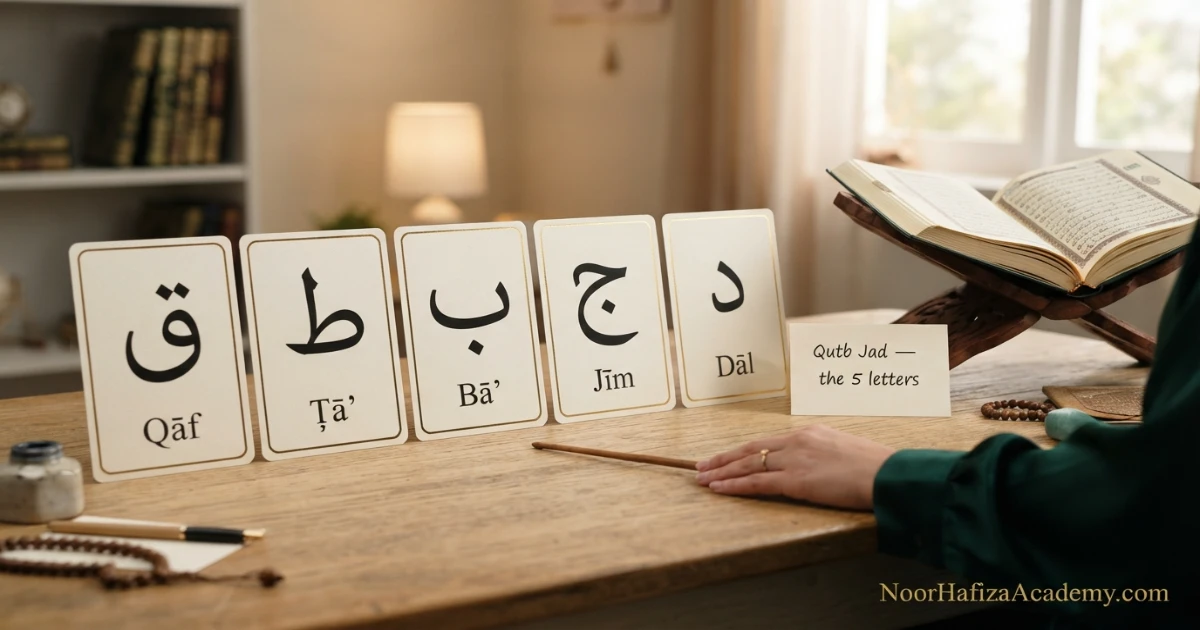
Qalqalah is a brief echo-like release heard on one of five letters—ق, ط, ب, ج, or د—when that letter is sakin. The letters are commonly remembered as “Qutb Jad.” If the sakin Qalqalah letter appears inside a word or connected reading, the bounce is lighter; this is commonly called Qalqalah Sughra. If the reader stops on a word ending with a Qalqalah letter, the letter becomes sakin at the stop and the bounce is stronger; this is commonly called Qalqalah Kubra. The sound should make the consonant clear without adding a complete vowel. A beginner should hear the teacher model the difference between a normal voiced vowel and the short Qalqalah release.
What are the five Qalqalah letters?
The five Qalqalah letters are ق ط ب ج د. Students often memorize them using the phrase قُطْبُ جَدٍّ, commonly transliterated as “Qutb Jad.” The phrase is a memory device; Qalqalah does not happen every time one of these letters appears. The letter must be sakin.
A deep letter from the back of the tongue. Its Qalqalah should stay distinct from kāf.
A heavy emphatic letter. The bounce should keep its heaviness without becoming “ta.”
A lip letter. With Qalqalah, the lips release the consonant clearly without adding “ba.”
The consonant should release clearly without turning into a full “ja” sound.
A clear tongue-tip consonant. The rebound should not become an extra “da.”
When does Qalqalah happen?
Qalqalah happens when one of the five letters is in a state of Sukoon. That Sukoon can be visible in the written word, or it can arise when the reader stops on the final letter of a word.
Written Sukoon
The Qalqalah letter already carries Sukoon inside the written word. The reader gives a light, clear rebound while continuing the recitation.
Sukoon caused by stopping
A final Qalqalah letter may carry a vowel in connected reading, but when the reader stops, it becomes sakin and Qalqalah is heard more strongly.
If a Qalqalah letter carries a normal short vowel and the reader continues, there is no Qalqalah simply because the letter belongs to the Qalqalah group. This distinction prevents one of the most common beginner mistakes: bouncing every ق, ط, ب, ج, and د.
What is Qalqalah Sughra?
Qalqalah Sughra is the lighter form commonly taught when a Qalqalah letter has a fixed Sukoon inside a word or during connected recitation. The sound should be present enough to prevent the consonant from disappearing, but it should remain controlled.
When you see a form such as ـقْـ, ـطْـ, ـبْـ, ـجْـ, or ـدْـ inside connected reading, release the consonant with a brief bounce and continue immediately.
The beginner should not create a separate syllable. If دْ is read as “da,” the reader has added Fathah. If it becomes “di” or “du,” another vowel has been invented. The Qalqalah release is much shorter and belongs to the consonant itself.

What is Qalqalah Kubra?
Qalqalah Kubra is the stronger form commonly heard when the reader stops on a word ending in one of the five Qalqalah letters. At the stop, the final consonant becomes sakin. Because the sound is released at a complete stop, the rebound is clearer and stronger than the internal form.
For beginners, the simplest contrast is: inside and continuing = lighter; at the end and stopping = stronger. Some Tajweed curricula use additional labels for degrees of strength, especially when the final consonant carries Shaddah. Those naming systems can vary. A beginner does not need to memorize every label before hearing the practical difference.
The sakin Qalqalah letter appears inside the flow of recitation and receives a brief release.
The word ends on a Qalqalah letter and the stop makes the rebound clearer.
If a final Qalqalah letter is doubled with Shaddah, teachers may describe the stopping Qalqalah as especially strong.

How do you pronounce Qalqalah without adding a vowel?
The safest beginner idea is “release the consonant clearly.” The organs of speech come together for the letter, then release with a small rebound. The sound should not become a complete new syllable.
Correct direction
Make the consonant audible, brief, and controlled. The listener should clearly hear the Qalqalah letter itself.
Incorrect direction
Do not deliberately attach a full “a,” “i,” or “u.” Qalqalah is not Fathah, Kasrah, or Dammah.
Beginners sometimes ask whether Qalqalah should sound closer to “a” or another vowel. Different teachers may use comparison language to help students hear the release, but the learner should not intentionally manufacture a full vowel. Live correction is important because written transliteration cannot capture the subtlety reliably.

Easy Qalqalah examples for beginners
Before using full Quran words, a teacher may isolate the five letters with Sukoon so the learner can hear the rebound clearly. These are training patterns rather than vocabulary lessons.
| Training form | What to practise | What to avoid | Teacher check |
|---|---|---|---|
| اَقْ | Clear qāf release | Turning it into “qa” after the stop | Qāf remains deep and distinct |
| اَطْ | Heavy ṭā’ with controlled rebound | Light “ta” or exaggerated bounce | Heaviness remains |
| اَبْ | Clean lip release | Adding “ba” | No extra vowel |
| اَجْ | Clear jīm release | Adding “ja” | Consonant stays brief |
| اَدْ | Clear dāl release | Adding “da” | Tongue releases cleanly |
What happens when a Qalqalah letter has Shaddah?
A Shaddah represents a doubled consonant. If a Qalqalah letter with Shaddah occurs at a stopping point, the stop can produce a particularly strong and clear Qalqalah. The reader must still preserve the doubled consonant correctly rather than treating it as one simple letter with a loud bounce.
For beginners, it is enough to understand that Shaddah and Qalqalah are separate ideas working together: Shaddah doubles the consonant, while Qalqalah governs the rebound when that consonant is sakin at the relevant point.
Common Qalqalah mistakes beginners make
Bouncing every Qalqalah letter
The learner adds Qalqalah even when ق, ط, ب, ج, or د carries a normal vowel.
Adding a full vowel
The consonant becomes “qa,” “ta,” “ba,” “ja,” or “da” instead of a brief rebound.
No Qalqalah at all
The sakin consonant becomes weak or swallowed and loses clarity.
Overbouncing
The reader exaggerates the echo so much that a new syllable seems to appear.
Making Sughra too strong
The internal bounce sounds like an end-of-word stop and disrupts connected recitation.
Making Kubra too weak
The stop occurs, but the final Qalqalah letter is not released clearly.
Losing letter quality
Qāf becomes kāf-like or ṭā’ loses heaviness during the rebound.
Learning from spelling alone
Transliteration is used instead of listening to a teacher model the actual sound.

A simple Qalqalah practice method
Memorize the five letters
Recognize ق ط ب ج د quickly in isolated and joined forms.
Check for Sukoon
Do not bounce the letter unless it is sakin or becomes sakin because you stop.
Listen to a model
Hear the difference between a normal vowel and a Qalqalah release.
Practise Sughra
Use short internal examples and keep the rebound light.
Practise Kubra
Stop on a final Qalqalah letter and make the rebound clearer without adding a vowel.
Transfer to Quran reading
Apply the rule in unfamiliar passages while maintaining normal flow and other Tajweed rules.
A simple 30-day Qalqalah practice plan
| Week | Main focus | Home practice | Teacher checkpoint |
|---|---|---|---|
| Week 1 | Five letters and Sukoon condition | Identify ق ط ب ج د and mark which examples are sakin | Check rule recognition before sound |
| Week 2 | Qalqalah Sughra | Short internal examples with a light rebound | Check no extra vowel is added |
| Week 3 | Qalqalah Kubra | Stop on final Qalqalah letters and compare strength | Check clarity without exaggeration |
| Week 4 | Mixed Quran reading | Find Qalqalah in short passages and decide Sughra or Kubra | Check rule transfer during natural recitation |

What parents should notice when a child learns Qalqalah
Parents do not need to judge fine Tajweed detail. They can listen for broad patterns and report them to the teacher.
Simple parent checklist
- Can the child name or recognize the five Qalqalah letters?
- Does the child check for Sukoon before applying Qalqalah?
- Is the internal Qalqalah brief and controlled?
- Is the stopping Qalqalah clearer than the internal one?
- Does the child accidentally add “a,” “i,” or “u”?
- Does Qāf stay qāf and ṭā’ stay heavy?
- Can the child find Qalqalah in a fresh Quran example?
- Does the rule remain correct without the teacher modeling every word?
Questions beginners should ask a Tajweed teacher about Qalqalah
Use these during a trial or Tajweed lesson
- How do you teach the five Qalqalah letters?
- How do you explain the difference between Sukoon and a vowel?
- What is the practical difference between Qalqalah Sughra and Kubra?
- How do you stop students from adding a full vowel?
- How strong should the bounce be inside a word?
- How strong should it be when stopping?
- How do you teach Qalqalah on ق and ط without losing heaviness?
- How do you handle a final Qalqalah letter with Shaddah?
- Do you use unfamiliar Quran examples to test transfer?
- How much home practice should a beginner do?
- How do you know when Qalqalah is stable enough to move on?
- How do you correct overbouncing without making the sound disappear?
Online Tajweed classes for beginners learning Qalqalah
Noor Hafiza Academy offers live online Quran learning for girls, women, children, adults, new Muslims, complete beginners, and returning readers with female Quran teachers. A Tajweed assessment can review Arabic letters, Makharij, Harkaat, Sukoon, Shaddah, Qalqalah, common connected rules, stopping, and current Quran reading level.
A suitable beginner plan may include Noorani Qaida, Quran reading, Tajweed foundations, Makharij correction, Qalqalah, ghunnah, noon and meem rules, and controlled fluency. Current female-teacher qualifications, availability, schedules, trial arrangements, fees, privacy practices, policies, and enrollment terms should be confirmed directly.
Share the learner’s age, current Quran level, Tajweed experience, time zone, schedule, and whether the main difficulty is recognizing the letters, Sukoon, Qalqalah strength, or stopping.
FAQs about Qalqalah rules
What are the five Qalqalah letters?
When does Qalqalah happen?
What is Qalqalah Sughra?
What is Qalqalah Kubra?
Does every Qaf, Ta, Ba, Jim, or Dal have Qalqalah?
Should Qalqalah sound like a vowel?
Is Qalqalah stronger at the end of a word?
What happens if a Qalqalah letter has Shaddah?
Why do beginners overbounce Qalqalah?
Can children learn Qalqalah online?
How should beginners practise Qalqalah?
Do all Tajweed teachers use exactly the same Qalqalah level names?
Learn Qalqalah as a clear consonant release and build more accurate Tajweed
Share the learner’s age, current Quran level, Tajweed experience, time zone, schedule, and whether the main challenge is the five letters, Sukoon, Qalqalah strength, stopping, or pronunciation.