How to Practice Tajweed at Home Between Online Lessons

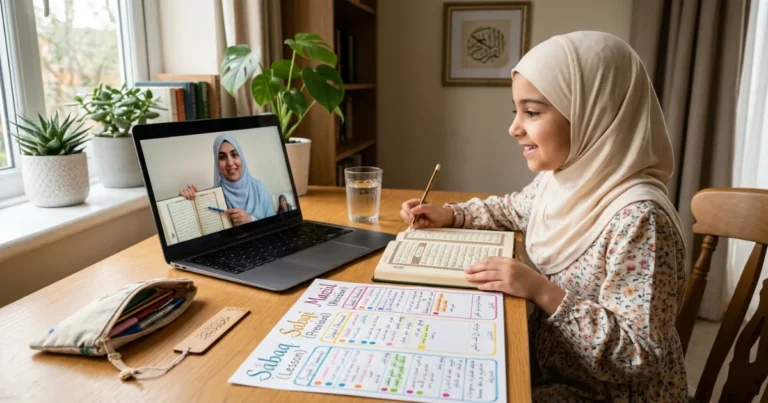
The best way to practice Tajweed at home between online lessons is to keep practice short, specific, and tied directly to the teacher’s last corrections. Beginners often slow their progress when they try to revise every rule at once, copy multiple reciters, or repeat a long passage without knowing what to listen for. A stronger routine is to choose one or two correction targets—such as Makharij, Ghunnah, Qalqalah, Madd timing, Noon Sakinah, Meem Sakinah, or Waqf—then practise a small passage, record one short attempt, listen back, correct the target, and repeat. This guide gives children, adults, parents, and returning readers a realistic daily and weekly home-practice system.
How should you practice Tajweed at home between lessons?
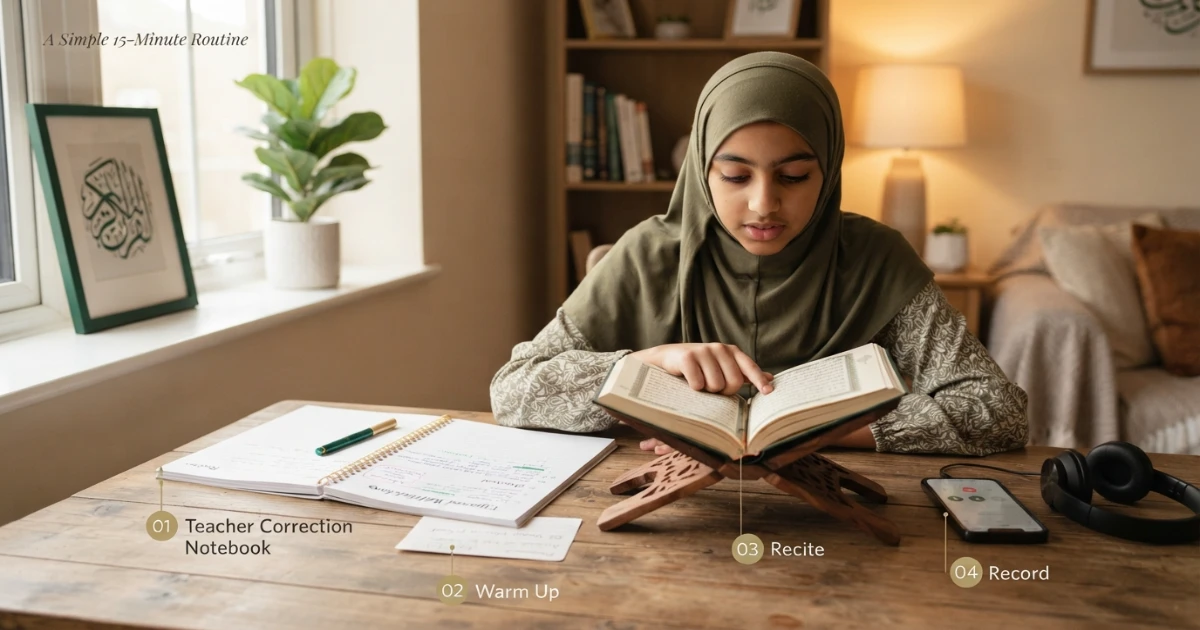
Use a simple 10–15 minute routine: review the teacher’s last correction notes, choose one or two Tajweed targets, warm up the difficult letters or sounds, recite a short passage slowly, record one attempt, listen back for the target error, correct it, and repeat the same passage once or twice. Do not try to teach yourself several new advanced rules from random videos between lessons. Home practice should reinforce the method your teacher already uses. Keep a small mistake tracker so you can see whether repeated issues—such as heavy and light letters, Ghunnah timing, Madd counts, Qalqalah, or stopping—are becoming more stable before the next online lesson.
Tajweed improves between lessons, not only during class
An online lesson gives diagnosis, explanation, live modeling, and correction. Home practice is where those corrections begin to become automatic. Without review, the next lesson may be spent correcting the same sound again. With focused repetition, the teacher can move from basic correction toward consistency and fluency.
The important word is correct repetition. Thirty minutes of repeating an inaccurate sound can strengthen the wrong habit. Ten minutes of carefully repeating the teacher’s corrected version can be far more valuable. The purpose of home practice is therefore not to “finish more Quran” but to strengthen the exact skill that the teacher is currently building.
A realistic daily Tajweed practice routine
Read the teacher’s last correction targets before opening a new passage.
Practise one difficult sound, Madd count, Ghunnah pattern, or rule.
Read a small passage slowly while paying attention to the target.
Listen back, find one error, correct it, and recite again.
The routine can be shorter for younger children and slightly longer for adults, but the structure is more important than the exact number of minutes. A focused five-minute session is better than twenty minutes of distracted recitation.
Let the last online lesson decide what you practise
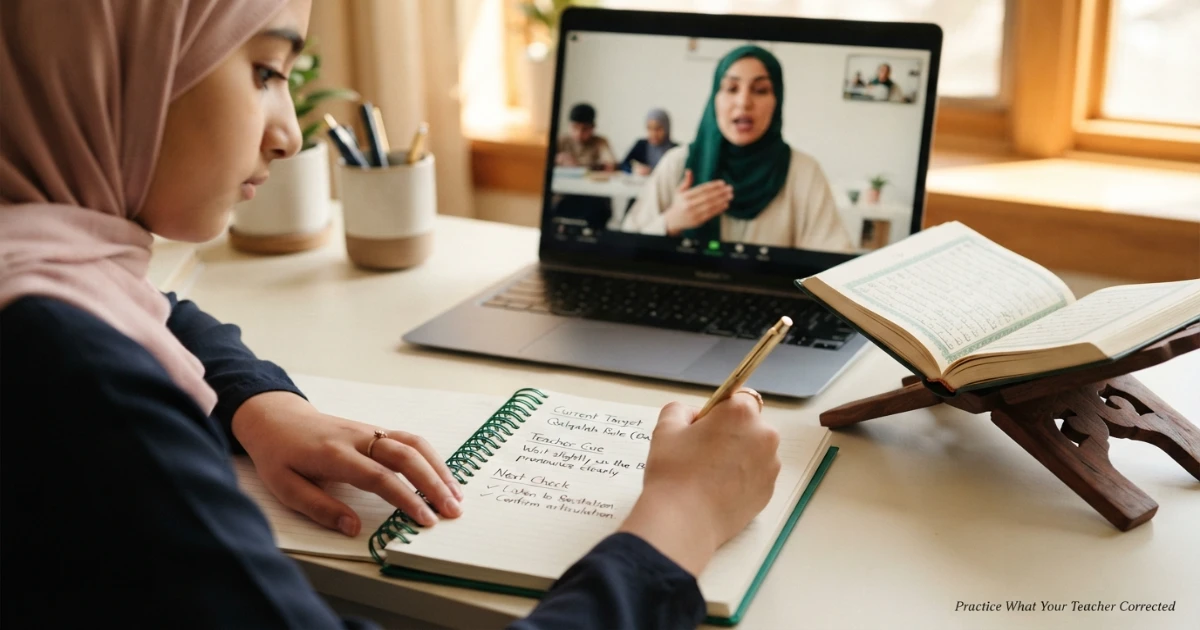
The strongest home practice begins with the teacher’s correction list. If Qāf was too light, make that the week’s primary Makharij target. If Ghunnah was inconsistent, practise only the examples the teacher marked. If Madd timing was unstable, work first on the two-count baseline before trying longer Madd.
Name the mistake
“Qāf becomes too light” is much more useful than writing only “pronunciation.”
Keep the correction cue
Write the mouth, tongue, timing, or listening cue that helped in class.
Know the test
Choose a word or passage where the teacher can check the correction next time.
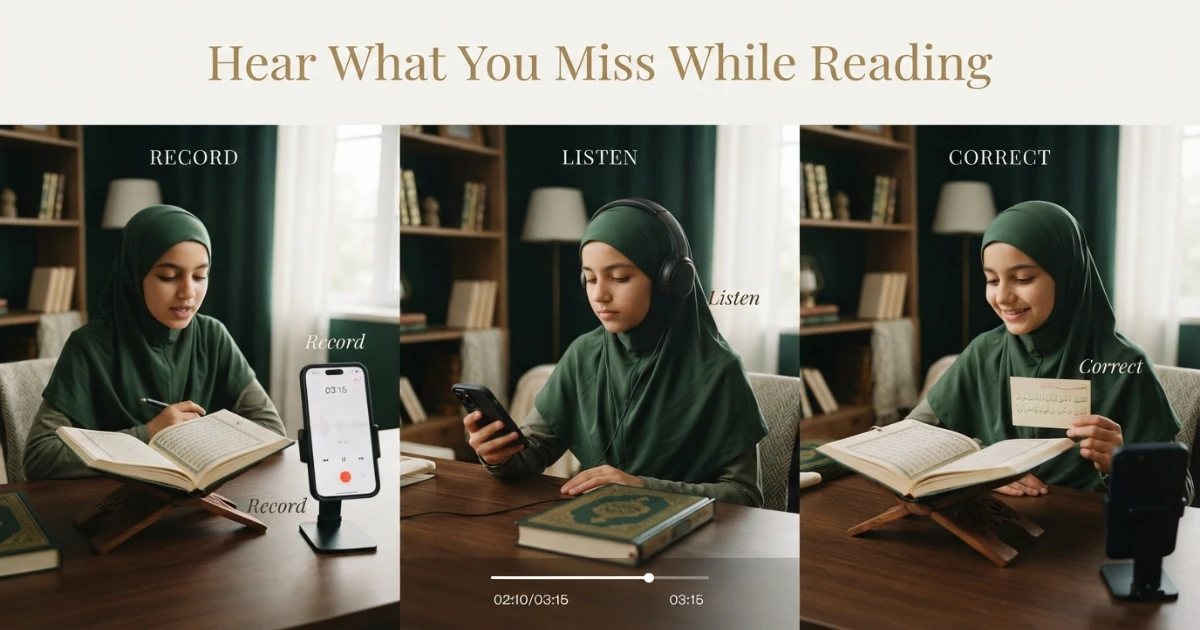
Use short recordings as a mirror
While reciting, your attention is divided between reading, breathing, remembering the rule, and producing the sound. When you listen to a recording, you can focus on only one thing. This often reveals mistakes that were not obvious in the moment.
Keep recordings short—around twenty to sixty seconds. Listen specifically for the current target. Ask: Did my Qalqalah create an extra vowel? Did my Madd stay even? Did I hold Ghunnah too long? Did a heavy letter become light? This turns recording into a focused self-check rather than a general performance review.
How to practise Makharij at home
Makharij practice should reinforce a sound the teacher has already demonstrated. Start with the isolated letter, then add a simple vowel, then use the sound in one or two words, and finally return to Quran context. This progression helps prevent a common problem: producing the letter correctly in a drill but losing it inside real recitation.
Isolate
Repeat the teacher-modeled letter without unnecessary force.
Add a vowel
Use Fathah, Kasrah, or Dammah and keep the articulation stable.
Use a word
Practise one or two teacher-selected words.
Return to the verse
Read naturally and check whether the correction survives in context.
Do not force the throat, jaw, tongue, or lips. If a drill causes discomfort, stop and ask the teacher. Tajweed precision comes from correct placement and controlled repetition, not physical strain.

How to practise common Tajweed rules at home
| Rule | Home focus | Self-check | Common risk |
|---|---|---|---|
| Ghunnah | Even nasal hold in marked examples | Was the hold consistent? | Overholding or extra vowel |
| Qalqalah | Clear rebound on sakin ق ط ب ج د | Did I create a new syllable? | Overbouncing |
| Madd | Stable two-count baseline | Was my timing even? | Random stretching |
| Meem Sakinah | Identify the next letter | Did I choose the right rule? | Holding every Meem |
| Noon/Tanween | Identify the following letter and rule | Was Ghunnah used correctly? | Rule confusion |
| Waqf | Plan stops and restart meaningfully | Did the ending change correctly? | Stopping only when breath ends |
Use listening to correct, not replace, reading
Listening to a skilled reciter can train the ear, but imitation alone can hide weak reading. A learner may reproduce a familiar verse accurately from memory while still being unable to apply the same Tajweed rule in an unfamiliar passage.
Attempt first
Read before listening so your real reading ability is visible.
Listen with a target
Focus on one feature such as Madd, Ghunnah, or a difficult letter.
Retry without audio
Check whether the correction remains when the model stops.
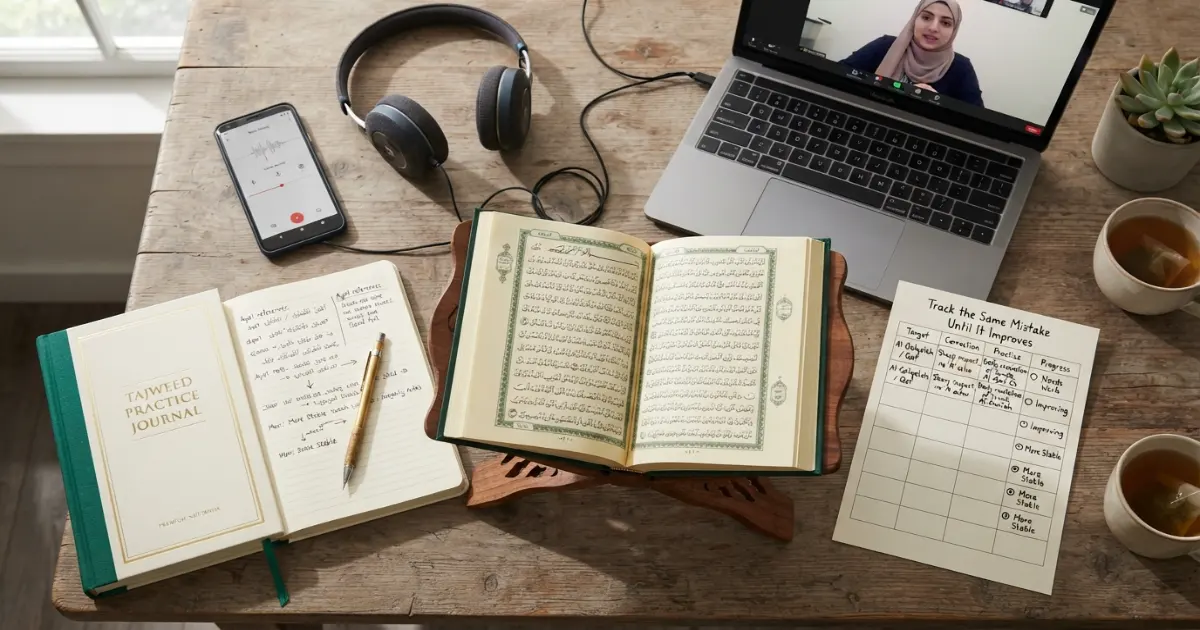
Track repeated Tajweed mistakes instead of guessing progress
A one-minute mistake log can make the next lesson much more useful. Record the recurring error, the teacher’s correction, and whether the sound is improving in drills, words, or full recitation.
| Stage | Error | Correction | Result |
|---|---|---|---|
| Day 1 | Qāf too light | Teacher’s tongue-position cue | Still inconsistent |
| Day 3 | Qāf in drills | Same cue | Mostly correct |
| Day 5 | Qāf in verse | Transfer slowly | Improving in context |
A weekly Tajweed practice plan between online lessons
Days 1–2: Correct
- Review lesson notes.
- Practise the hardest target slowly.
- Use short teacher-selected examples.
- Record one short clip.
Days 3–4: Stabilize
- Use the same rule in fresh examples.
- Reduce visual prompts.
- Read before listening.
- Check whether the correction survives independently.
Day 5: Transfer
- Read a fresh passage.
- Mark only the target rule.
- Record natural recitation.
- Write one question for the teacher.
Day 6: Light Review
- Review old corrections.
- Do not add several new rules.
- Keep practice short.
- Prepare the next lesson passage.

Common mistakes when practicing Tajweed alone
Too many rules at once
The learner tries to correct Makharij, Madd, Ghunnah, Qalqalah, and Waqf in one short passage.
Repeating without feedback
The same error is practised until it feels normal.
Random videos
Different terminology or recitation paths create confusion between lessons.
Copying instead of reading
The student follows audio but cannot apply the rule independently.
Only familiar Surahs
Memorization hides weak decoding and rule recognition.
Speed before accuracy
Fluency rises while pronunciation and timing become less reliable.
Ignoring old corrections
Every new class replaces the previous target instead of building on it.
One long weekly session
An exhausting session replaces short, repeatable practice across the week.
How home Tajweed practice should change by age
Children and adults can use the same basic system, but children often need shorter practice, simpler feedback, and parent-supported routine. Adults can usually manage recordings, written correction logs, and self-analysis more independently.
| Learner | Session | Main focus | Support |
|---|---|---|---|
| Young child | 5–10 minutes | One sound or short passage | Parent routine + teacher note |
| Older child/teen | 10–15 minutes | One rule plus transfer | Light accountability |
| Adult beginner | 10–20 minutes | Correction + recording | Self-tracking and questions |
| Returning reader | 10–15 minutes | Targeted weak areas | Avoid restarting everything from zero |
How parents can help without overcorrecting
Helpful parent actions
- Protect a regular short practice time.
- Ask the child what the teacher’s current target is.
- Use the teacher’s notes instead of adding a different method.
- Encourage the child to attempt before listening to audio.
- Help make a short recording when needed.
- Notice consistency rather than demanding perfection.
- Report repeated pronunciation problems to the teacher.
- Keep practice calm enough to remain sustainable.
Prepare three things before your next Tajweed class
One improved target
Know which correction became more stable during the week.
One unresolved problem
Bring the exact sound, word, or rule that is still difficult.
One short passage
Prepare a section where the teacher can test the target in natural recitation.
Questions to ask your online Tajweed teacher about home practice
Ask these before the lesson ends
- What are my one or two main correction targets this week?
- Which exact lines or words should I practise?
- How many minutes of practice do you recommend?
- Should I record myself or send you a sample?
- Which reciter or audio source should I use?
- What should I listen for in my recording?
- Which old correction should I continue reviewing?
- What should I avoid practising alone?
- How do I know if my Madd or Ghunnah timing is stable?
- How should I practise difficult Makharij without straining?
- What will you test in the next lesson?
- When should I add a new Tajweed rule?
Online Tajweed lessons with focused between-class practice
Noor Hafiza Academy offers live online Quran learning for girls, women, children, adults, new Muslims, complete beginners, and returning readers with female Quran teachers. A Tajweed lesson can focus on current recitation, Makharij, Ghunnah, Qalqalah, Madd, Noon and Meem rules, Waqf, fluency, and repeated errors.
A practical learning plan may include lesson notes, short homework passages, target rules, review checkpoints, and progress tracking. Current teacher qualifications, availability, schedules, trial arrangements, fees, privacy practices, policies, and enrollment terms should be confirmed directly.
Share the learner’s age, Quran level, current Tajweed challenges, time zone, schedule, and whether the main issue is Makharij, Ghunnah, Qalqalah, Madd, Waqf, or home-practice consistency.
FAQs about practicing Tajweed at home
How long should I practice Tajweed at home?
What should I practice between Tajweed lessons?
Should I learn new Tajweed rules by myself?
Is recording my recitation useful?
How should I practise Makharij at home?
Should I listen to a reciter before practicing?
How many Tajweed rules should I focus on at once?
How can I tell if my Tajweed is improving?
Can parents correct a child’s Tajweed at home?
What if I keep making the same mistake?
Is daily Tajweed practice necessary?
What should I prepare before the next lesson?
Make every day between lessons count with short, focused Tajweed practice
Share the learner’s age, Quran level, current Tajweed challenges, time zone, schedule, and whether the main difficulty is Makharij, Ghunnah, Qalqalah, Madd, Waqf, or home-practice consistency.