How to Read the Quran If You Do Not Know Arabic
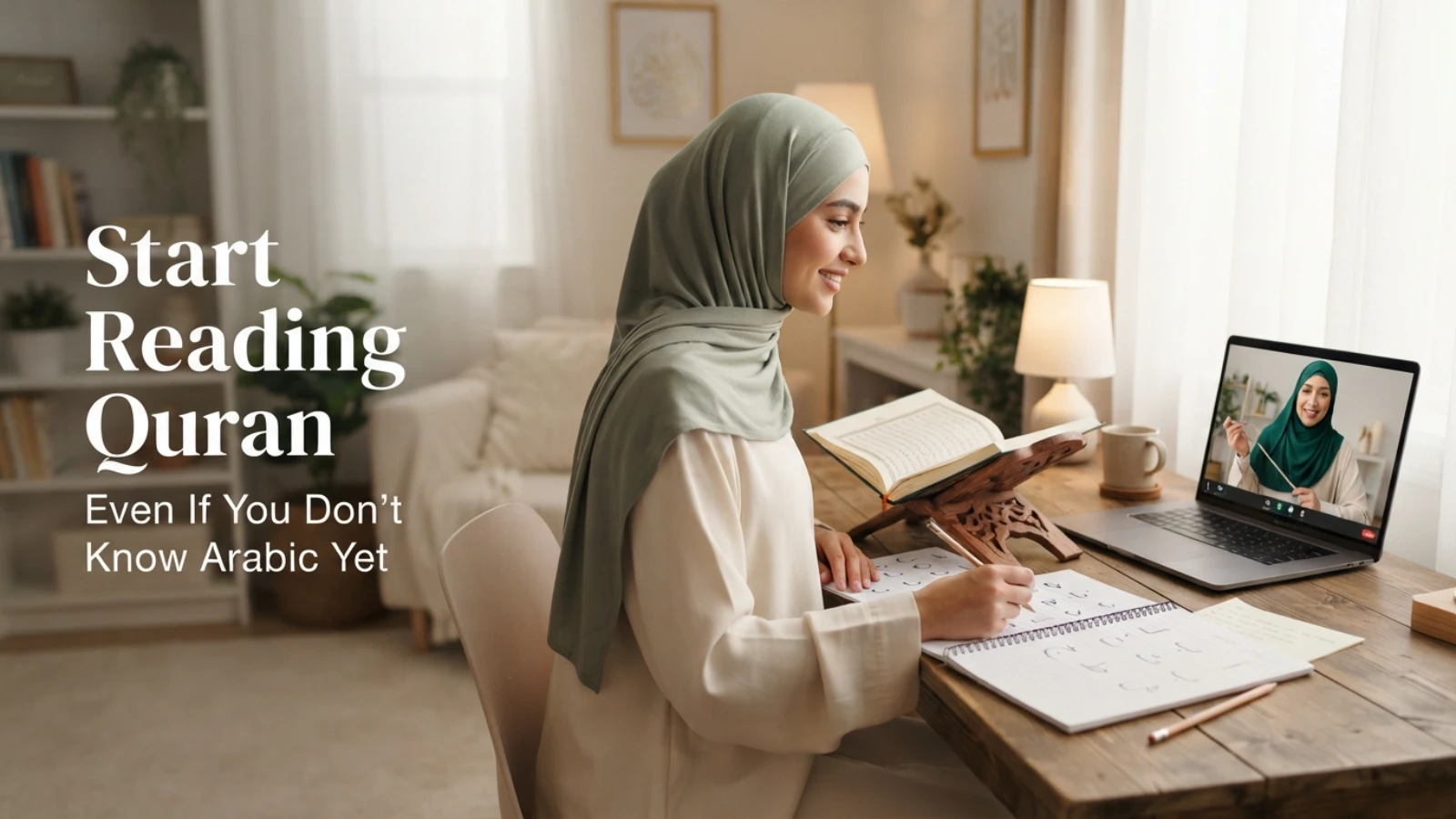
You can learn to read the Quran even if you do not speak or understand Arabic. Quran reading and Arabic-language fluency are related, but they are not the same skill. A complete beginner can start with the Arabic alphabet, letter shapes, short vowels, joined forms, Sukoon, Shaddah, and simple blending before moving into Quran words. Translation can help you understand the meaning, while listening to a skilled reciter can help your ear recognize pronunciation and rhythm. Transliteration can be useful for a short time, especially when learning familiar recitations, but it cannot represent every Arabic sound accurately and should not become a permanent replacement for Arabic script. A qualified teacher can correct pronunciation early and help you build independent reading step by step.
Can you read the Quran if you do not know Arabic?
Yes. You do not need to speak Arabic fluently before learning to read the Quran. Start by learning the 28 Arabic letters and their sounds, then learn how letters change when joined, how Fathah, Kasrah, Dammah, Sukoon, and Shaddah work, and how to blend simple words. Use a reliable translation alongside the Arabic text to understand meaning. Listening to accurate recitation can support pronunciation, while transliteration can be used briefly as a bridge if needed, but it should not replace learning Arabic script because many Quranic sounds cannot be represented precisely in English letters. A beginner can make steady progress with 10–15 minutes of daily practice and regular correction from a qualified Quran teacher.
Reading Quran is not the same as speaking Arabic
Many beginners delay Quran reading because they assume they must first learn Arabic grammar, conversation, and vocabulary. Those skills are valuable, but they are not prerequisites for learning to decode Quranic Arabic script.
A learner can recognize letters, read vowels, blend words, and recite short Quran passages before being able to hold a conversation in Arabic. Understanding the language can develop alongside reading through translation, vocabulary study, and later Arabic lessons.
Track 1 is learning to read the Arabic script accurately. Track 2 is learning what the Quran means through reliable translation, explanation, and gradual Arabic study.
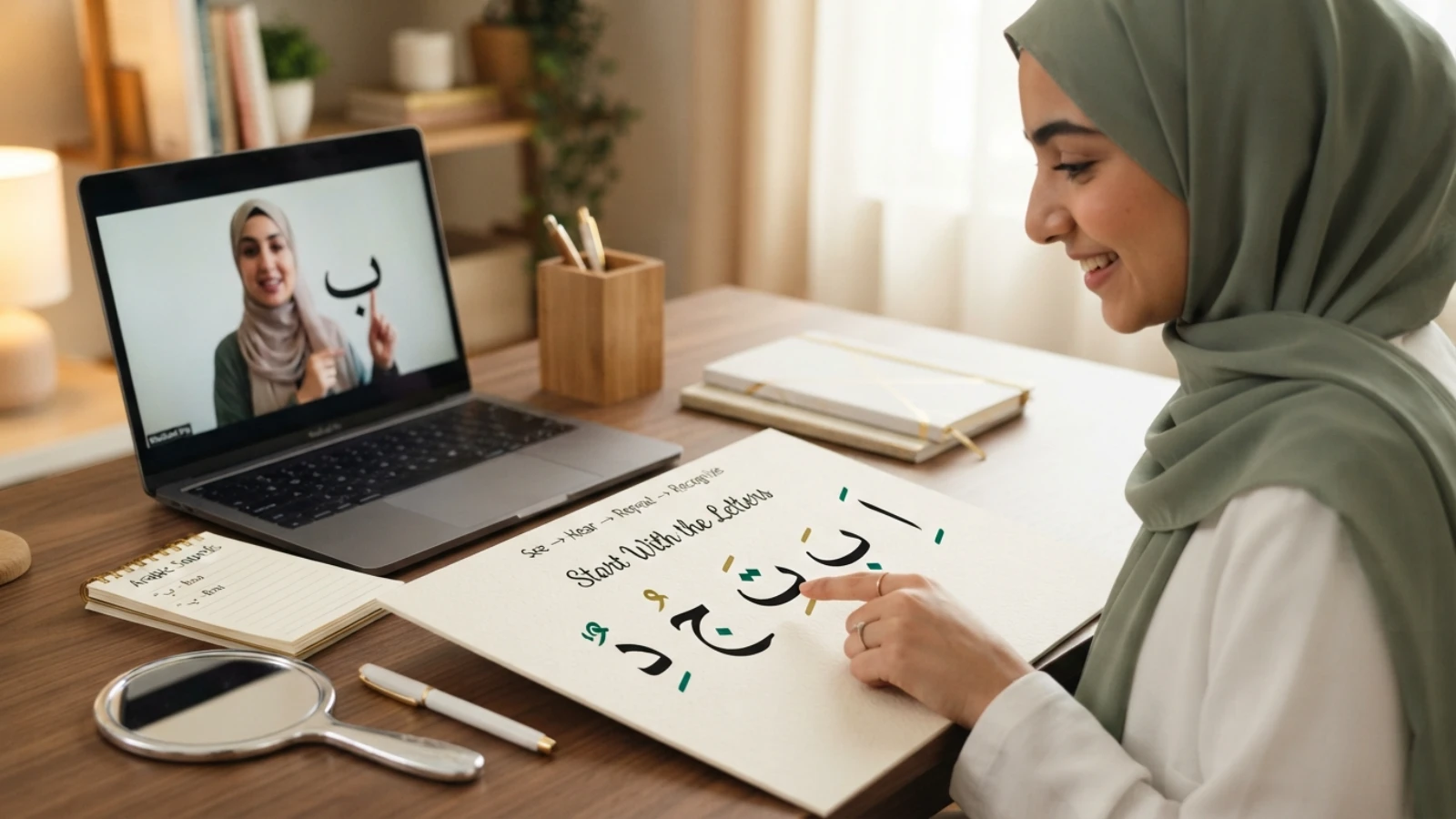
Start with the Arabic alphabet and sounds
The Arabic alphabet has 28 basic letters. A beginner should learn each letter as both a shape and a sound. English sound comparisons can help temporarily, but several Arabic sounds do not have exact English equivalents.
Letter identity
Recognize the letter without relying on alphabetical order.
Letter sound
Listen to an accurate model and repeat the sound carefully.
Joined forms
Recognize how the same letter changes at the beginning, middle, and end of words.
Fresh recognition
Test the letter in unfamiliar examples instead of memorizing one alphabet chart.
Letters such as ح, خ, ع, غ, ص, ض, ط, ظ, and ق often need direct teacher correction because English spelling cannot show their articulation precisely. Learning these correctly early can prevent habits that become harder to change later.
Learn Harkaat, Sukoon, Shaddah, and basic blending
Once letters are recognizable, the next step is learning the reading signs that tell you how letters sound inside words. Fathah gives a short a-type sound, Kasrah a short i-type sound, and Dammah a short u-type sound. Sukoon shows that the consonant has no short vowel of its own, while Shaddah indicates a doubled consonant.
The goal is to stop naming individual letters and start blending them. For example, a beginner should move from “this is Bā’, this is Fathah” toward immediately reading the combined sound.
Read combinations such as بَ, بِ, and بُ accurately.
Add Sukoon and learn to connect sounds without inventing an extra vowel.
Use Shaddah correctly rather than reading the letter as a single consonant.
Should beginners use Quran transliteration?
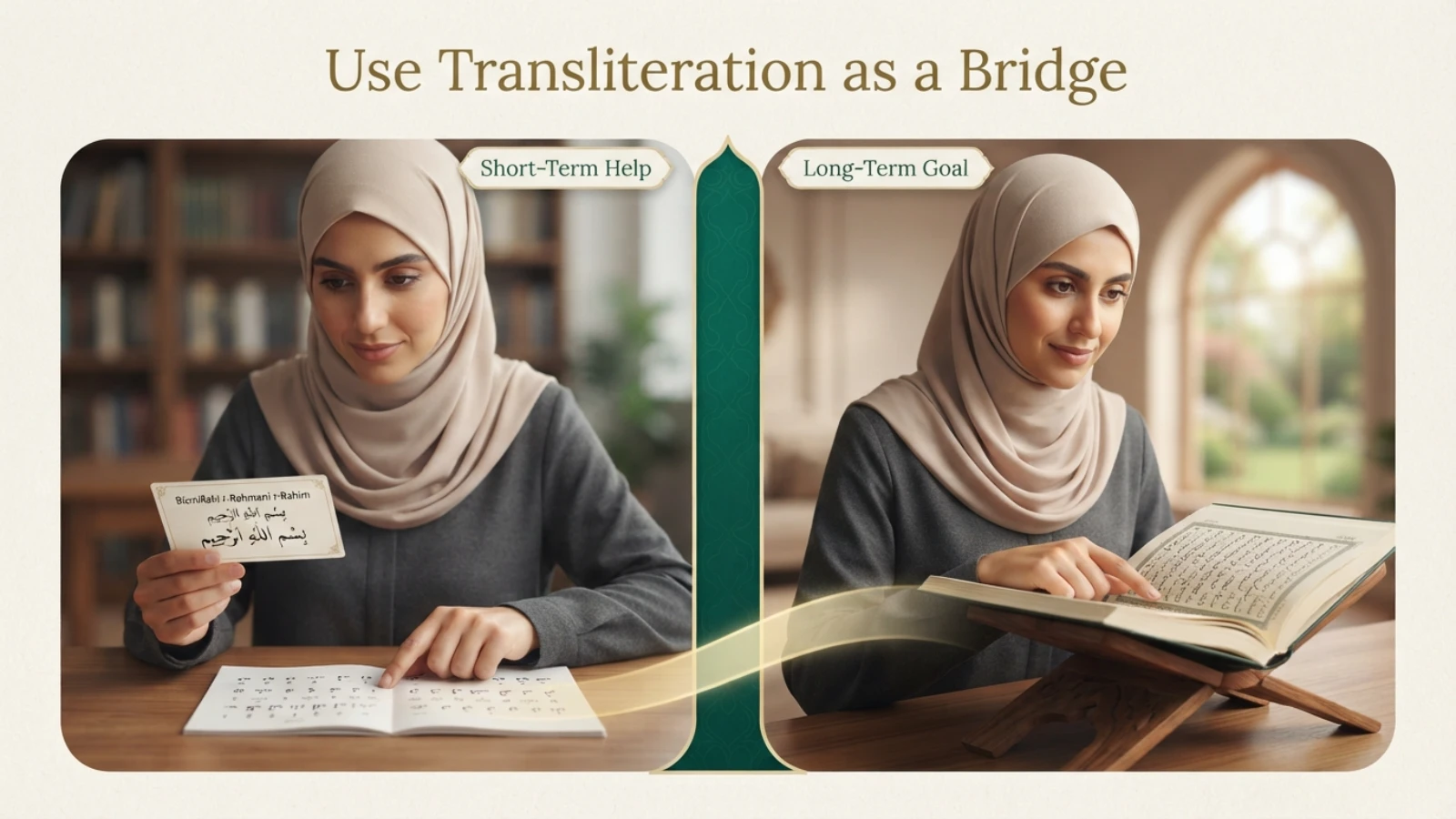
Transliteration can help a new learner recognize the approximate sound of a familiar phrase, but it has serious limitations. English letters cannot represent every Arabic sound exactly, and different transliteration systems use different symbols.
| Method | Useful for | Limitation | Best role |
|---|---|---|---|
| Arabic script | Independent Quran reading | Requires initial learning | Main long-term method |
| Transliteration | Temporary sound support | Cannot show many Arabic sounds precisely | Short-term bridge |
| Audio | Pronunciation and rhythm | Can create imitation without decoding | Listening model |
| Translation | Understanding meaning | Does not teach Arabic recitation | Meaning support |
A good transition is to place transliteration beside Arabic at first, then cover or ignore the transliteration for selected words, then move to Arabic-only practice. If transliteration remains the learner’s primary reading system for months, it can delay Arabic-script independence.
Use listening to train pronunciation
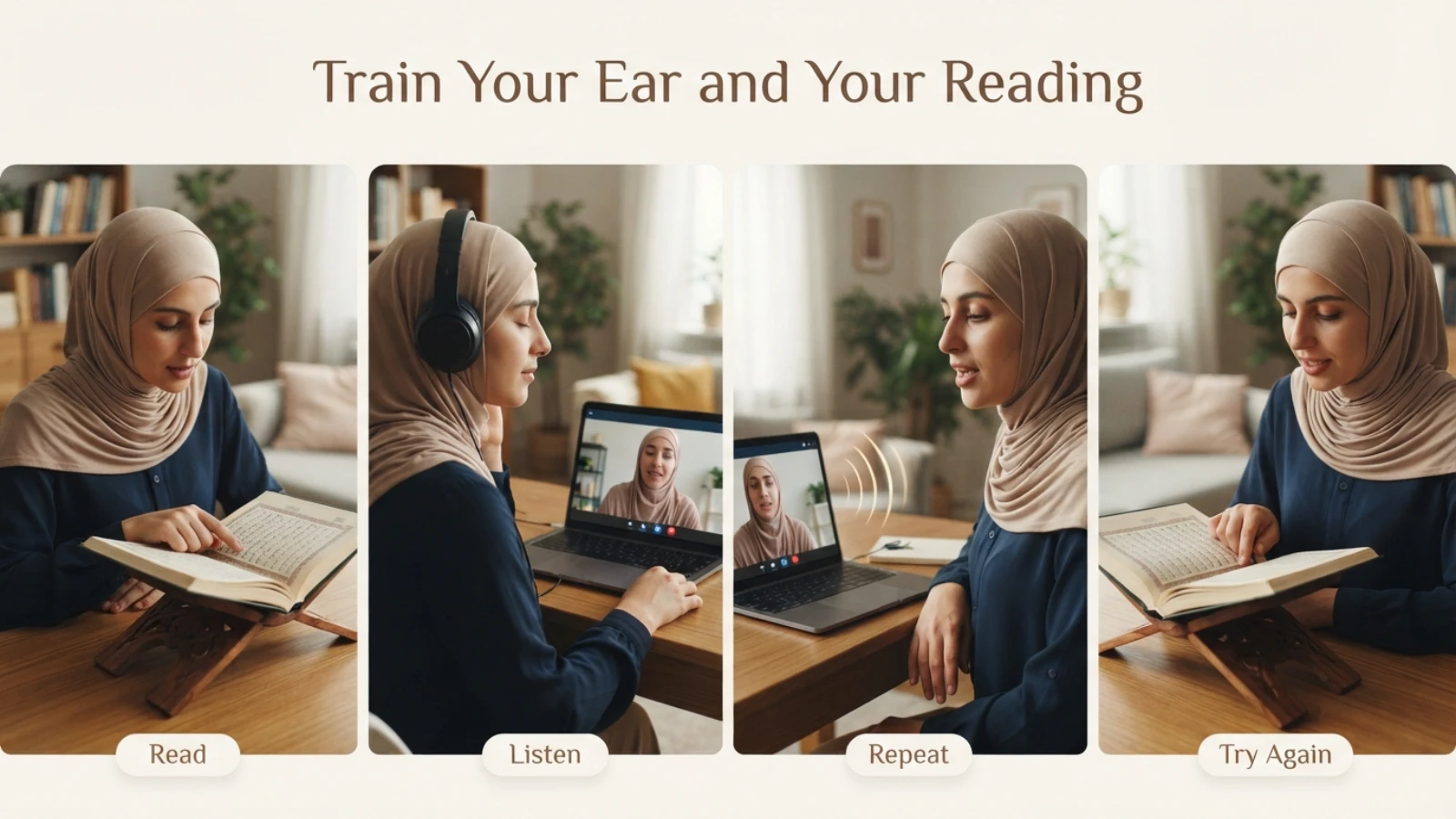
Listening is especially helpful for non-Arabic speakers because it trains the ear to notice sounds that may not exist in their first language. Use a teacher-approved recitation and listen to a short phrase rather than an entire page.
Read first
Attempt the Arabic text before listening so your actual decoding ability is visible.
Listen carefully
Focus on one sound, Madd, Ghunnah, or stopping point.
Repeat
Copy the correct sound while looking at the Arabic text.
Try again alone
Read without audio to confirm that the correction has transferred.
Avoid memorizing the sound sequence without looking at the Arabic. The goal is to connect what you hear with what you see.
Use translation to understand meaning while learning Arabic reading
A reliable translation can help a non-Arabic speaker understand the message of the verses being studied. This can make practice more meaningful and help the learner connect familiar Arabic words with their meanings over time.
Translation and Arabic recitation have different roles. Translation supports understanding; Arabic-script reading develops recitation. Beginners can do both in the same session: read a short passage in Arabic, then read its translation, then return to the Arabic with better awareness of the meaning.
Read Arabic
Decode the assigned lines slowly and accurately.
Read translation
Understand the broad meaning in your strongest language.
Notice vocabulary
Recognize repeated Quranic words gradually.
Return to recitation
Read again without replacing the Arabic with translation.
For detailed interpretation, legal rulings, or theological questions, use reliable scholarly resources or ask a qualified scholar rather than relying on a translation alone.

A practical learning sequence for non-Arabic speakers
| Stage | What to learn | Move forward when | Avoid |
|---|---|---|---|
| 1 | Arabic letters and sounds | You can recognize most letters out of order | Memorizing alphabet sequence only |
| 2 | Joined forms and Harkaat | You can read simple combinations | Treating joined forms as new letters |
| 3 | Sukoon, Shaddah, Tanween | You can blend short words | Adding extra vowels |
| 4 | Short Quran words and phrases | You can attempt unfamiliar examples | Reading from memory only |
| 5 | Basic Tajweed and Waqf | Decoding is stable enough to add rules | Too many rules at once |
What should a new Muslim prioritize first?
A new Muslim does not need to learn every Arabic skill immediately. A practical plan can combine basic Arabic-script reading with essential worship-related recitations and short Surahs through teacher-guided listening and repetition.
Al-Fatihah is often an early priority because of its role in Salah. However, exact religious obligations, accommodations for new Muslims, and timing questions should be discussed with a qualified local scholar or imam. From a reading perspective, the learner can work on Arabic letters and basic decoding while also learning essential recitations orally.
A simple 15-minute Quran reading routine for non-Arabic speakers
Practise one difficult letter, joined form, or reading sign.
Read a small new section slowly without relying on transliteration.
Check pronunciation, read the translation, and retry the Arabic.
If fifteen minutes feels too long, use ten. If you can focus longer, use twenty. Consistency and accurate repetition matter more than a fixed duration.
Why non-Arabic speakers benefit from live Quran correction
A teacher can hear whether a letter is being replaced by the nearest English sound, whether a short vowel is being stretched, whether Sukoon is followed by an extra vowel, and whether a learner is reading from memory rather than decoding.
Pronunciation
Correct difficult sounds before they become automatic.
Level placement
Start from the actual weakness instead of repeating material already known.
Progression
Know when to move from Qaida to Quran words and from decoding to Tajweed.
Accountability
Keep a regular routine and bring repeated mistakes back for correction.

Common mistakes non-Arabic speakers make when learning Quran reading
Waiting to learn full Arabic first
The learner delays Quran reading unnecessarily because conversation fluency feels too large.
Depending on transliteration
English letters become the permanent reading system and Arabic recognition develops slowly.
Using English sounds for Arabic letters
Difficult letters are replaced by approximate sounds that change pronunciation.
Listening without decoding
The learner memorizes the sound but cannot read the same pattern in a new word.
Only reading translation
Understanding grows, but Arabic recitation skill does not develop.
Only reading Arabic without meaning
Recitation improves, but the learner misses an easy opportunity to understand the passage through translation.
Rushing into advanced Tajweed
Rule terminology overwhelms a learner who still struggles to identify letters and vowels.
Practising only familiar Surahs
Memorization can hide weak Arabic-script reading.
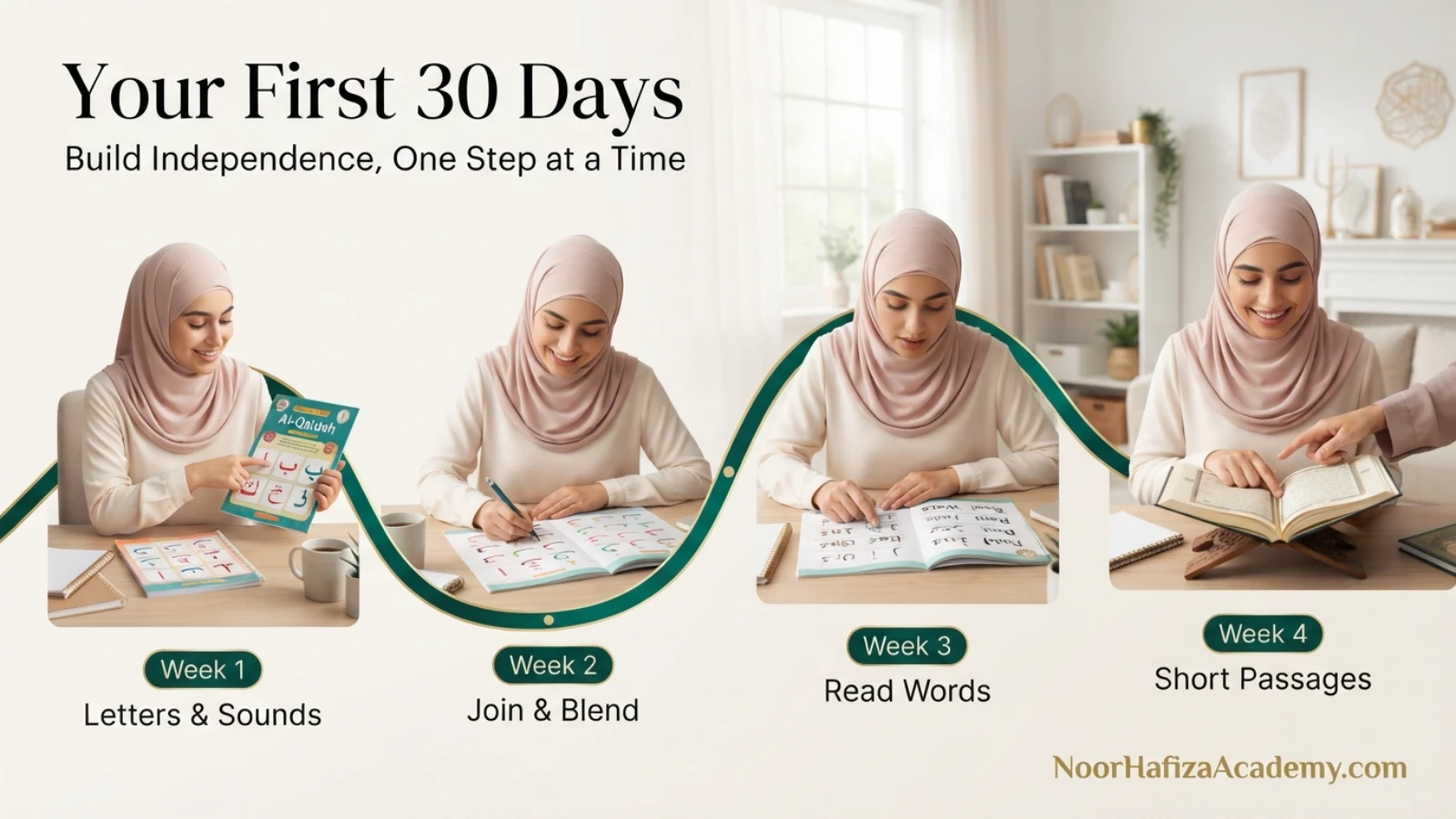
A simple 30-day Quran reading plan for non-Arabic speakers
| Week | Main focus | Daily practice | Progress check |
|---|---|---|---|
| Week 1 | Letters and sounds | Recognize 28 letters, shape families, and difficult sounds | Identify letters in random order |
| Week 2 | Harkaat and joining | Short vowels, joined forms, simple blending | Read fresh two- and three-letter combinations |
| Week 3 | Sukoon, Shaddah, and words | Closed syllables, doubled letters, simple Quran words | Less guessing and fewer extra vowels |
| Week 4 | Short passages and basic Tajweed | Read new lines, listen, correct, and review meaning | Attempt unfamiliar passage with less support |
Thirty days is a useful structure, not a guarantee. A complete beginner may need longer on each stage, while someone who already knows the alphabet may move faster.
How parents can help children who do not speak Arabic
Helpful parent actions
- Keep practice short and regular.
- Ask the teacher which letters or symbols are the current focus.
- Use audio for listening but let the child attempt the Arabic first.
- Avoid correcting difficult sounds if you are unsure of the Makharij.
- Use translation to discuss the broad meaning of the passage.
- Reduce transliteration gradually rather than removing it abruptly if the child still needs support.
- Test unfamiliar words so memorization does not hide weak reading.
- Celebrate improved recognition and independence, not just page completion.
Questions to ask a Quran teacher if you do not know Arabic
Use these during a trial or first lesson
- Do I need to start from the Arabic alphabet or can I begin at a higher level?
- How do you teach difficult Arabic sounds to English-speaking beginners?
- Do you use Noorani Qaida or another beginner reading method?
- How long should I use transliteration, if at all?
- How do you test whether I can read without memorization?
- When should I begin Tajweed?
- Which translation do you recommend for understanding the lesson?
- How much daily practice should I do?
- What should I listen to between lessons?
- How do you track pronunciation and reading progress?
- When will I be ready to move from Qaida to Quran pages?
- What should I practise before the next lesson?
Online Quran classes for non-Arabic-speaking beginners
Noor Hafiza Academy offers live online Quran learning for girls, women, children, adults, new Muslims, complete beginners, and returning readers with female Quran teachers. A beginner assessment can review Arabic letter recognition, sounds, joined forms, Harkaat, Sukoon, Shaddah, blending, pronunciation, Tajweed readiness, and current Quran reading ability.
A suitable plan may include Arabic alphabet lessons, Noorani Qaida, Quran reading, pronunciation correction, basic Tajweed, short Surahs, and gradual translation-based understanding. Current teacher qualifications, availability, schedules, trial arrangements, fees, privacy practices, policies, and enrollment terms should be confirmed directly.
Share the learner’s age, current Arabic knowledge, Quran experience, time zone, schedule, and whether the main goal is letters, reading, pronunciation, Tajweed, or short Surahs.
FAQs about reading the Quran without knowing Arabic
Can I read the Quran if I do not speak Arabic?
Do I need to understand Arabic before learning Quran recitation?
Can I read Quran using transliteration?
Should I learn the Arabic alphabet first?
How long does it take to learn Quran reading?
Can I use a Quran translation while learning?
Is listening to Quran recitation enough?
When should I start Tajweed?
Can a new Muslim start Quran reading immediately?
How much should I practice each day?
Do I need an Arabic-speaking teacher?
What is the best first goal for a non-Arabic speaker?
Begin Quran reading from the alphabet and grow toward independent Arabic recitation
Share the learner’s age, current Arabic knowledge, Quran experience, time zone, schedule, and whether the main goal is letters, pronunciation, reading, Tajweed, or short Surahs.