
Online Quran Classes for Teenagers: Keeping Learning Relevant and Consistent

Online Quran classes for teenagers work best when they recognize that a teen is no longer a small child but is not yet an adult with complete control over school, transportation, work, and family commitments. A strong program should respect growing independence while still providing structure. Teen learners may need Quran reading correction, Tajweed, Hifz revision, Islamic Studies, short Surah study, or help rebuilding consistency after a gap. The challenge is often not ability—it is relevance, scheduling, motivation, and ownership. Lessons should have clear goals, measurable progress, meaningful explanation, and enough flexibility to fit school, exams, sports, tutoring, clubs, and family life. For teenage girls, families may also prefer female Quran teachers. Current teacher availability, lesson length, schedules, curriculum details, trials, fees, and policies should be confirmed directly.
How can online Quran classes stay relevant for teenagers?
Teen Quran classes stay relevant when the learner has a clear reason for attending, understands the next goal, and can see progress. Instead of repeating the same page-based routine indefinitely, the teacher can work toward specific outcomes such as smoother Quran reading, correcting Makharij, mastering a Tajweed rule, rebuilding Hifz revision, memorizing selected Surahs, or improving Waqf and fluency. Lessons should respect a teenager’s growing independence, avoid a childish tone, allow appropriate questions, and fit realistically around school, exams, sports, clubs, work, and family responsibilities. Parents can support consistency without turning every lesson into a conflict by agreeing on a protected schedule, checking progress periodically, and letting the teacher handle technical correction.
Why teenagers need a different Quran-learning approach
A method that worked at age seven may not work at fourteen. Teenagers are developing stronger opinions, more complex schedules, greater sensitivity to how adults speak to them, and a growing desire to understand the purpose behind what they are asked to do.
That does not mean Quran classes should become entertainment. It means the lesson should communicate respect and purpose. A teenager is more likely to take ownership when the teacher explains the skill being developed, gives specific feedback, and shows what better reading or stronger revision actually looks like.
The teacher should also distinguish between a teen who is resistant to learning and a teen who is bored because the work is too easy, overwhelmed because the work is too hard, tired because the class is badly timed, or disengaged because the same material is repeated without a clear target.
The parent and teacher can set boundaries while giving the learner more voice over goals, timing, and practice methods.
Give the teenager a Quran goal they can understand
“Attend Quran class” is not a learning goal. A teen needs to know what the class is trying to improve. This makes progress more concrete and reduces the feeling of repeating the same routine forever.
Reading goal
Read one page with fewer pauses, less guessing, and more accurate pronunciation.
Tajweed goal
Correct one repeated issue such as Madd timing, Ghunnah, Qalqalah, Waqf, or Makharij.
Hifz goal
Strengthen revision or complete a realistic memorization target without sacrificing accuracy.
Independence goal
Prepare assigned reading and identify mistakes before the teacher gives the answer.
A good goal is specific enough to measure but small enough to reach. “Improve Tajweed” is vague. “Keep two-count Madd consistent in this week’s passage” gives both the teacher and the teenager something concrete to check.

How to schedule Quran classes around a teenager’s real week
Teenagers often have one of the most complicated schedules in the household. School days can be followed by sports, tutoring, extracurricular clubs, homework, social commitments, college preparation, part-time work, or family responsibilities.
Useful when the teen comes home early and wants Quran completed before heavy homework.
Can work for older teens who prefer finishing activities or homework first, provided fatigue is manageable.
A Saturday or Sunday lesson can reduce school-night pressure and make longer review easier.
The goal is consistency, not squeezing the lesson into every available gap. A recurring time that works during exam weeks and activity seasons is stronger than an ideal slot that gets cancelled repeatedly. Where possible, let the teen participate in choosing between two acceptable options.

What makes Quran lessons feel relevant to teenagers?
Relevance does not require turning every lesson into a motivational speech. It usually comes from helping the learner understand why a skill matters and how it connects to real recitation, worship, memorization, or understanding.
Show how accurate recognition reduces hesitation and makes independent Quran reading easier.
Let the teen hear the difference between accurate and inaccurate pronunciation instead of memorizing definitions only.
Teach why revision protects what has already been memorized rather than chasing new pages only.
Show how stopping and restarting affect clarity instead of treating Waqf signs as random symbols.
Teenagers often engage more deeply when sincere questions can be asked respectfully.
Compare recordings, repeated errors, Hifz retention, or teacher prompts over time.
For Islamic Studies, teachers should distinguish between age-appropriate educational discussion and complex legal, theological, or disputed questions that may require a qualified scholar. A teen should feel able to ask, while the teacher should also know when not to improvise an answer.
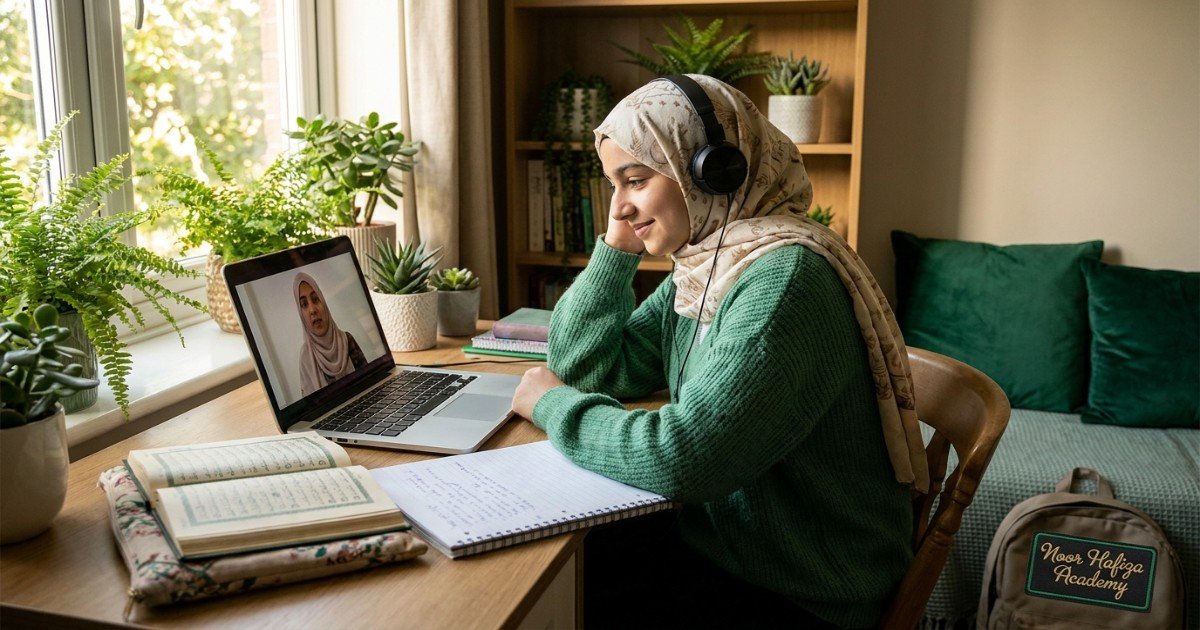
What should online Quran classes for teenagers include?
| Track | Who it suits | Lesson focus | Progress sign |
|---|---|---|---|
| Quran reading | Teens who still hesitate or guess | Decoding, Makharij, fluency, Waqf | Fewer pauses and corrections |
| Tajweed | Readers ready for more precision | Ghunnah, Madd, Qalqalah, Noon/Meem rules | Rules transfer into fresh passages |
| Hifz | Students memorizing or rebuilding revision | New lesson, recent revision, old revision | Stronger retention over time |
| Islamic Studies | Teens needing broader religious learning | Age-appropriate beliefs, worship, manners, Seerah | Better understanding and application |
The curriculum should follow the learner’s actual needs. A teenager who reads slowly may need reading foundations before advanced Tajweed terminology. A strong reader may need targeted Tajweed rather than restarting Qaida simply because it is the default beginner course.
Female Quran teachers for teenage girls
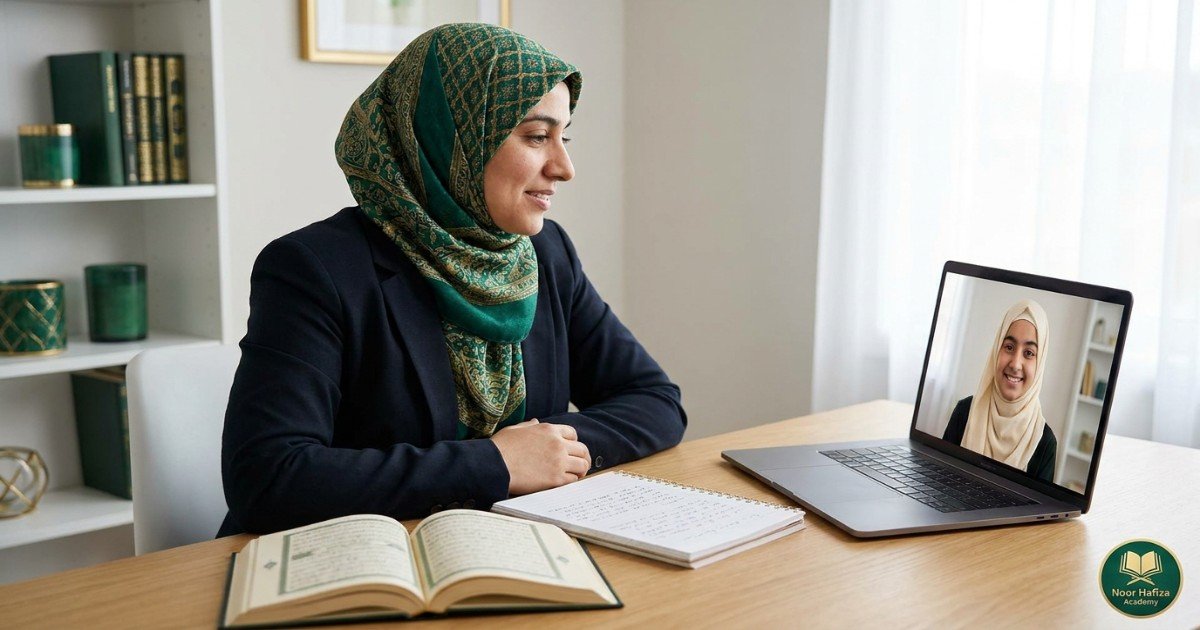
Some families and teenage girls prefer a female Quran teacher because it can support comfort, privacy, and age-sensitive communication. That preference can be especially important when the learner is shy about reading aloud, asks personal questions, or needs a learning environment that feels culturally comfortable.
Teacher gender alone does not prove teaching quality. Parents should also evaluate Quran accuracy, Tajweed knowledge, communication, patience, boundaries, lesson structure, feedback, and whether the teacher treats the teenager respectfully rather than like a small child.
How parents can support teen Quran classes without constant conflict
Teenagers still need accountability, but parents can gradually shift from minute-by-minute supervision toward shared responsibility. The aim is to help the teen own the routine instead of making the parent the permanent class manager.
Agree on the schedule
Choose the recurring time together where possible so the teen understands what other commitments must work around it.
Ask about goals, not every mistake
Let the teacher handle technical correction while the parent checks broader progress.
Reduce repeated reminders
Use calendar alerts, routine cues, or the teen’s own device so attendance becomes more independent.
Review periodically
Check in weekly or monthly rather than turning every class into a performance review.
A parent can still set non-negotiable expectations around attendance and respectful participation. The difference is that the teen is given a growing role in how those expectations are met.
How much Quran practice should teenagers do between lessons?
A teen does not necessarily need long daily sessions. Ten to twenty focused minutes on most days can be enough to reinforce one or two correction targets, depending on goals and level. Hifz students may need a different schedule because revision volume can be larger.
| Goal | Home practice | Best method | Avoid |
|---|---|---|---|
| Reading | 10–15 minutes | Short fresh passage + correction review | Only familiar Surahs |
| Tajweed | 10–15 minutes | One rule + short recording | Too many rules at once |
| Hifz | Depends on target | New lesson + recent + old revision | New memorization without review |
| Consistency | Short daily anchor | Same time or routine cue | One long irregular session |
How to motivate a teenager who is losing interest in Quran class
Loss of interest can have different causes: the lesson may be too easy, too hard, too repetitive, scheduled at a bad time, overly childlike, disconnected from the teen’s goals, or associated with constant correction and pressure.
Before assuming the teen does not care, identify the friction. Ask what feels difficult, repetitive, or pointless. Then change one variable at a time: the goal, teacher, lesson format, schedule, amount of homework, or course track. This makes it easier to learn what actually improves engagement.
Use fresh passages, targeted Tajweed, stronger Hifz goals, or meaningful discussion.
Shorten assignments and focus on one correction target.
Choose a time that survives sports, homework, and exam weeks.
How to show teenagers that their Quran reading is improving
Visible progress can strengthen motivation. Teenagers may respond better to evidence than vague praise such as “you are doing better.”
| Area | What to track | Good progress sign | Useful evidence |
|---|---|---|---|
| Reading | Repeated errors and pauses | Fewer corrections | Monthly recording |
| Tajweed | One or two recurring rules | Accurate use in new passages | Teacher checklist |
| Hifz | Retention, not only new lines | Old memorization stays stable | Revision log |
| Independence | Prompts and preparation | Teen prepares without reminders | Attendance and homework consistency |
The point of tracking is not to turn Quran learning into a school grade. It is to make growth visible and help the teacher decide what to work on next.

Why online Quran classes can work well for busy teenagers
Online lessons remove travel, which can make it easier to fit Quran into a crowded teen schedule. A student can move from homework to a thirty-minute lesson and then return to study without a long commute.
Online learning also expands teacher choice. A family is not limited to whoever teaches nearby. This can be useful when looking for a female teacher, a Tajweed-focused instructor, a Hifz teacher, or simply a teacher whose communication style works better with teenagers.
The trade-off is that home distractions are real. A teen should use a quiet space, keep unrelated notifications away during class, and treat the online lesson as a real appointment rather than background activity.
Common mistakes families make with teen Quran classes
Using a childish teaching style
The teenager feels talked down to and disengages even if the content is correct.
Setting no clear goal
The teen attends class but cannot explain what is improving.
Scheduling during peak homework
The lesson becomes a weekly source of conflict rather than a protected routine.
Comparing siblings
Different ages, levels, and personalities are treated as if progress should look identical.
Too much parent correction
The teen receives technical feedback from the teacher and conflicting correction at home.
Hifz without revision
New memorization grows while older portions weaken.
Changing teachers too quickly
Normal adjustment is mistaken for failure before the teacher and learner establish a rhythm.
Ignoring genuine mismatch
The family keeps an unsuitable teacher, level, or schedule long after the problem is obvious.
What should parents and teenagers evaluate in a trial Quran class?
Let the teenager have a voice in the decision
- Did the teacher speak respectfully and at an age-appropriate level?
- Did the teacher assess the real Quran reading level?
- Were corrections specific and easy to understand?
- Did the teen get enough chance to attempt independently?
- Did the teacher explain what the next goal would be?
- Was the class time realistic around school and activities?
- Did the teen feel comfortable asking a question?
- Could this teacher-student relationship work consistently for several months?

Questions to ask before enrolling a teenager in online Quran classes
Use these before choosing a program
- How do you assess a teenager’s real Quran reading level?
- How do you keep teen lessons age-appropriate rather than childlike?
- Can the student help shape learning goals?
- What is the best track for this teen: reading, Tajweed, Hifz, or Islamic Studies?
- How much home practice is expected each week?
- How do you handle school exams and changing extracurricular schedules?
- Are female Quran teachers available for teenage girls?
- How do you track reading and Tajweed progress?
- How do you track Hifz revision and retention?
- How often do parents receive progress feedback?
- What happens if the teen loses motivation or feels the level is wrong?
- Can the teen try a trial class before enrolling?
Online Quran classes for teenagers with female teachers
Noor Hafiza Academy offers live online Quran learning for girls, women, children, adults, new Muslims, complete beginners, returning readers, and teenagers with female Quran teachers. Teen learners can ask about Quran reading, Tajweed, Hifz support, and Islamic Studies according to current level and goals.
A suitable teen plan may include a level assessment, one or two clear learning targets, a realistic recurring schedule, short between-class practice, and periodic progress review. Current teacher qualifications, teenage-student availability, lesson duration, trial arrangements, fees, rescheduling rules, privacy practices, policies, and enrollment terms should be confirmed directly.
Share the learner’s age, Quran level, current challenges, school schedule, preferred days, and whether the priority is reading, Tajweed, Hifz, Islamic Studies, or rebuilding consistency.
FAQs about online Quran classes for teenagers
Are online Quran classes suitable for teenagers?
How are teen Quran classes different from children’s classes?
What should teenagers study in Quran class?
How often should a teenager take Quran classes?
How can parents motivate a teenager to attend Quran class?
Are female Quran teachers available for teenage girls?
Can teenagers study Tajweed online?
Can teenagers do Hifz online?
How much should a teen practice between Quran lessons?
What if my teenager says Quran class is boring?
Should parents sit through a teenager’s Quran class?
What should I send when asking about teen Quran classes?
Help teenagers build a Quran routine they can understand, own, and keep consistently
Share the learner’s age, Quran level, school schedule, preferred days, main challenges, and whether the priority is reading, Tajweed, Hifz, Islamic Studies, or rebuilding consistency.