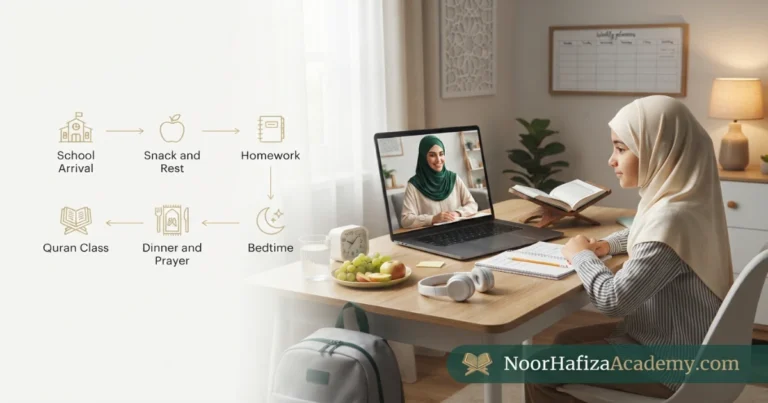
Female Hifz Teacher Online: A Guide for Women and Girls

A female Hifz teacher online can be a strong option for women, teenage girls, younger girls, returning learners, and adults who prefer Quran memorization in a female-led setting. The right teacher does more than listen to new verses. She should help the student correct pronunciation before memorization, manage recent and older revision, identify weak transitions, adjust the memorization target when retention drops, and build a routine that fits the learner’s age and schedule. For girls, parents may also value a female teacher for comfort, privacy, and age-sensitive communication. For adult women, scheduling and respectful one-to-one support can make consistency easier. Still, gender alone does not prove teaching quality. Families should verify Hifz background, Tajweed accuracy, revision method, teaching experience, safeguarding practices, privacy, and current availability.
What should you look for in a female Hifz teacher online?
Look for a female Quran teacher who can demonstrate accurate recitation, strong Tajweed, a clear Hifz revision system, and experience teaching the learner’s age group. A good Hifz teacher should check pronunciation before heavy memorization, divide the routine between new lesson and revision, listen carefully for missed words and weak transitions, and reduce the new target when retention becomes unstable. For women and girls, also confirm privacy, camera expectations, class format, parent involvement for minors, safeguarding practices, scheduling, and whether one-to-one or small-group lessons are offered. A trial class is useful because it shows how the teacher actually corrects, communicates, and manages Hifz—not just what titles appear on a profile.
Why women and girls may prefer a female Hifz teacher online
For many women and girls, a female teacher can make the learning environment feel more comfortable and private. This may be especially helpful for teenage girls, adult women, mothers learning from home, and students who feel shy reciting aloud.
A female teacher may also make it easier to discuss scheduling around school, family responsibilities, motherhood, work, or other personal routines. But these are comfort and communication advantages—not automatic proof of Hifz expertise.
The learner should feel comfortable, but the teacher must also be able to correct recitation, manage revision, and teach memorization effectively.
Female Hifz teachers for girls
Girls may benefit from female Hifz teachers at different stages: beginning short Surah memorization, building Juz Amma, strengthening revision, or continuing a longer Hifz plan.
Young girls
Need short lessons, repetition, visual structure, encouragement, and parent support.
Teenage girls
Need respect, more independence, realistic scheduling, and clear progress goals.
Hifz students
Need strong revision systems, accurate listening, and careful correction.
Returning students
May need to rebuild old memorization before adding new portions.
Parents should ask how much independent recitation the girl gets during class, how mistakes are recorded, and how the teacher keeps the student from memorizing pronunciation errors.
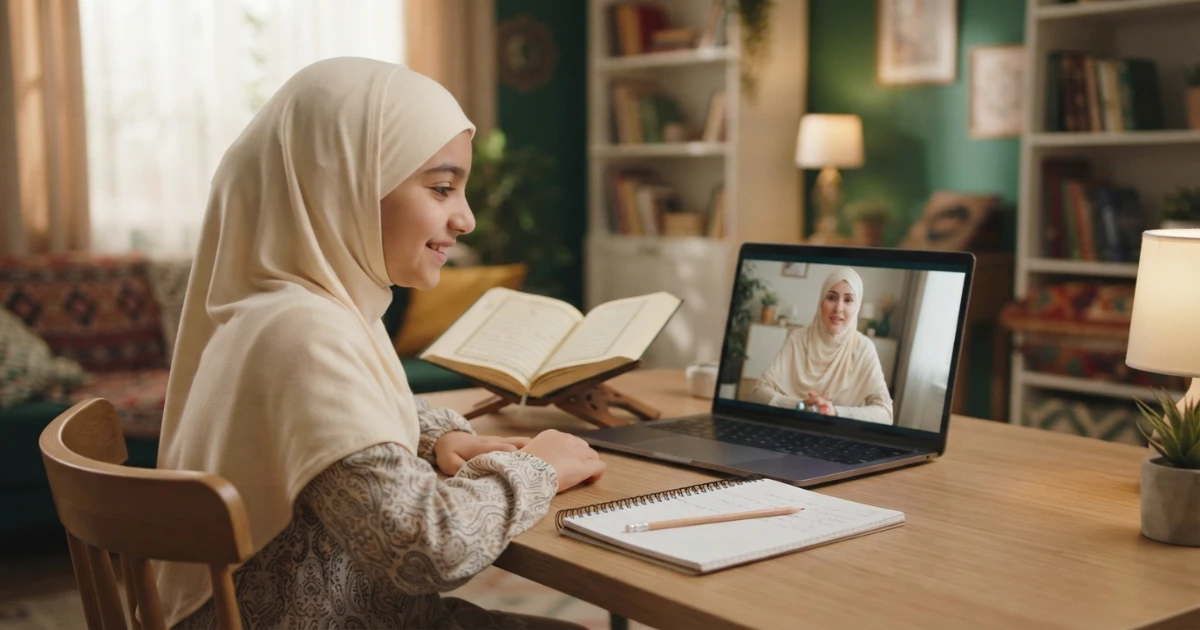
Female Hifz teachers for adult women
Adult women often need a different Hifz model from school-age students. A mother, university student, professional, or returning learner may have only short memorization windows and may need the teacher to adjust targets around real responsibilities.
New memorization should shrink during heavy work, study, or family weeks.
Old memorization may need rebuilding before a new Hifz target is added.
Pronunciation and reading should be stable enough that repeated errors are not memorized.
A good female Hifz teacher for women should understand that progress may be measured over months and years rather than through child-style daily quotas. She should be willing to reduce new memorization during busy seasons instead of treating every slower week as failure.

What qualifications should a female Hifz teacher have?
There is no single universal job title that proves every required skill. A Hafiza may have excellent memorization, but teaching experience still matters. A Qaria may recite beautifully, but may not specialize in Hifz coaching. A Tajweed teacher may correct recitation well without having a long Hifz teaching background.
| Area | What to verify | Why it matters | Do not assume |
|---|---|---|---|
| Hifz background | Own memorization and revision strength | Helps with retention strategy | Every Hafiza teaches well |
| Tajweed | Accurate applied recitation | Prevents memorizing errors | Rule names equal strong application |
| Teaching skill | Correction, pacing, explanation | Students need usable feedback | Recitation skill equals pedagogy |
| Experience | Age groups and learner types | Girls and adult women need different approaches | One method fits everyone |
An Ijazah may be valuable, especially for advanced recitation study, but its scope should be understood. It should not be treated as an automatic guarantee that the teacher is skilled at motivating a child, managing Hifz revision, or teaching every level.

A female Hifz teacher should manage more than the new lesson
A Hifz class is incomplete if it focuses only on today’s new lines. The teacher should also protect recent and older memorization. Otherwise, the student may appear to progress while forgetting material from previous weeks or months.
Check pronunciation, wording, and accurate memorization before moving on.
Strengthen newer memorization before it becomes fragile.
Use a rotation so older Surahs do not disappear from the schedule.
Some teachers use terms such as Sabaq, Sabqi, and Manzil. Others use different labels. The names matter less than the principle: every stage of memorization needs review. If old material weakens, the teacher should be willing to reduce the new target temporarily.

Is one-to-one Hifz better for women and girls?
One-to-one lessons can give each learner more active recitation time and allow the teacher to tailor the new target and revision load. This can be useful for beginners, returning learners, shy students, and anyone with a variable schedule.
Small groups can still work when learners have similar levels and goals. They may create motivation and community, but the teacher must make sure each student receives enough listening time. Private classes are not automatically better; the key question is how much meaningful correction and recitation the learner actually receives.
Privacy and safeguarding in online Hifz classes
Women and parents of girls should confirm the academy’s current camera, recording, communication, safeguarding, and parent-access policies before enrolling. If the student is a minor, parents should understand how the academy handles teacher communication, meeting links, attendance, and any lesson recordings.
Adult women may prefer headphones, a private room, and a female-only learning environment. These arrangements can support comfort, but should be discussed directly because academy policies and technology setups can vary. A trustworthy program should make expectations clear before regular classes begin.
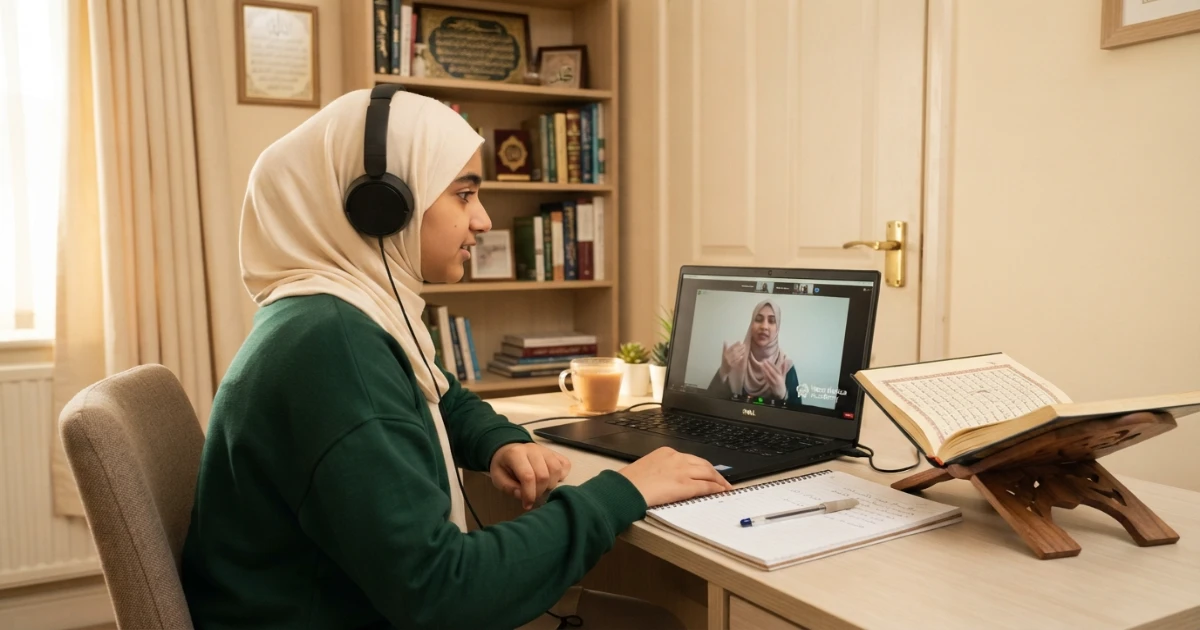
How to schedule online Hifz for women and girls
| Learner | Good scheduling principle | Common problem | Better approach |
|---|---|---|---|
| Young girl | Short, predictable lesson | Too late in the evening | Earlier focused slot |
| Teen girl | Fit around school and activities | Constant rescheduling | One protected recurring time |
| Working woman | Flexible but repeatable | Waiting for long free time | Short consistent windows |
| Mother | Use quiet household periods | Frequent interruptions | Protected class + short home review |
A good schedule should survive ordinary life. If the student misses the same class every week because of school, work, or family responsibilities, the issue is usually the schedule—not motivation.
Why Tajweed correction matters before heavy repetition
Hifz relies on repetition. If the student repeats an incorrect letter, wrong Madd, or extra vowel many times, the error can become deeply attached to the memorized passage. The teacher should therefore correct major pronunciation and recitation issues before asking for heavy repetition.
This does not mean the student must finish a full advanced Tajweed curriculum before memorizing. It means the current passage should be read accurately enough to memorize safely, with difficult letters or rules corrected as they appear.
How should a female Hifz teacher track progress?
| Area | What to track | Healthy progress | Warning sign |
|---|---|---|---|
| New memorization | Next-day recall | New portion stays stable | Constant relearning |
| Recent revision | Errors and prompts | Fewer corrections | Weak transitions |
| Old revision | Rotation coverage | Older Surahs remain accessible | Long gaps in review |
| Tajweed | Repeated recitation errors | Corrections transfer | Same errors return daily |
Parents and adult learners should ask for progress feedback that explains retention, accuracy, and revision—not only how many new lines have been memorized.
What to evaluate in a female Hifz teacher trial class
Use the trial to test the real teaching method
- Did the teacher listen carefully rather than rush the student?
- Did she correct pronunciation before discussing memorization targets?
- Did she ask about previous Hifz and revision strength?
- Was the new target realistic for the learner’s age and schedule?
- Did she explain how recent and old revision will be handled?
- Were corrections clear and respectful?
- Did the student get enough time to recite independently?
- Did the teacher adjust for a child, teenager, or adult appropriately?
- Were privacy and camera expectations clear?
- For minors, was parent involvement explained?
- Did the teacher give a clear next-step plan?
- Could this schedule and teaching style be sustained for months?
Common mistakes when choosing a female Hifz teacher online
Choosing by gender alone
Comfort matters, but recitation and teaching skill still need verification.
Choosing by title alone
“Hafiza” does not automatically prove strong pedagogy or Tajweed teaching.
Ignoring revision structure
The teacher focuses only on new lines and old Hifz gradually weakens.
Setting targets too high
The student memorizes quickly but spends every lesson repairing yesterday’s portion.
No clear privacy policy
Families discover camera or recording expectations only after enrolling.
Too little student recitation
The teacher talks or demonstrates for most of the lesson while the student rarely recites.
Ignoring age fit
A teaching style suitable for adults is used with a young child or vice versa.
Skipping the trial lesson
The family commits before seeing how corrections and revision are actually handled.
Questions to ask before choosing a female Hifz teacher
Ask these before enrollment
- Are you a Hafiza, and how do you maintain your own revision?
- What Tajweed training have you completed?
- Do you hold an Ijazah? If yes, what is its scope?
- How many years have you taught Hifz?
- Which age groups do you teach most often?
- How do you divide new lesson, recent revision, and old revision?
- How do you respond when old memorization weakens?
- How do you correct Tajweed before memorization?
- How do you track errors and retention?
- What are your camera, privacy, and recording policies?
- How are parents involved for girls under 18?
- Can we take a trial lesson before enrolling?
Female Hifz teachers online for women and girls at Noor Hafiza Academy
Noor Hafiza Academy offers live online Quran learning for women, girls, children, adults, new Muslims, returning readers, teenagers, siblings, and homeschool families with female Quran teachers. Learners can ask about Hifz support, Quran reading, Tajweed, pronunciation correction, Noorani Qaida, and Islamic Studies according to their current level and goals.
A suitable Hifz plan may include new memorization, recent revision, older revision, listening practice, Tajweed correction, teacher testing, and periodic progress review. Current female-teacher qualifications, Hifz background, Ijazah details, schedules, class length, trial arrangements, fees, rescheduling policies, privacy practices, safeguarding policies, and enrollment terms should be confirmed directly.
Share the learner’s age, current Quran level, previous memorization, revision strength, preferred schedule, and whether the main goal is short Surahs, Juz Amma, selected portions, or a longer Hifz journey.
FAQs about female Hifz teachers online
Can women study Hifz with a female teacher online?
Can girls take online Hifz classes with female teachers?
Does a female Hifz teacher have to be a Hafiza?
Should a female Hifz teacher have an Ijazah?
What should a Hifz teacher do besides listen to new memorization?
Are one-to-one Hifz classes better for women and girls?
How often should a Hifz student revise old memorization?
How can parents check a female Hifz teacher for their daughter?
Can a female Hifz teacher help an adult with a busy schedule?
Should Tajweed be corrected before memorization?
What happens if old Hifz becomes weak?
What should I send when asking about a female Hifz teacher?
Choose a female Hifz teacher who supports comfort, accurate recitation, and strong long-term revision
Share the learner’s age, Quran level, previous memorization, revision strength, preferred schedule, and whether the goal is short Surahs, Juz Amma, selected portions, or a longer Hifz journey.