What Is the Best Age to Start Quran Classes for Kids? A Practical Parent Guide

Parents often ask whether Quran classes should begin at age three, four, five, seven, or later. The most useful answer is not one fixed birthday. A strong start depends on readiness, teaching method, lesson duration, family consistency, and whether the child feels safe enough to listen, repeat, make mistakes, and try again.
What is the best age to start Quran classes for kids?
For many children, ages four to six are a practical time to begin short, structured Quran classes, especially Noorani Qaida and basic pronunciation. However, the best age is when the child can listen for a brief period, follow a simple instruction, point to the correct place, imitate a sound, and accept gentle correction without becoming overwhelmed. Children younger than four can still build a loving Quran connection through listening, short duas, Arabic sound exposure, and positive family routines. Children who begin at seven, ten, twelve, or later are not behind; they simply need an honest level assessment and a respectful plan suited to their current ability.
Why the best starting age is not only a number
Two children with the same birthday can be ready for very different learning experiences. One five-year-old may enjoy sitting with a teacher, pointing to letters, and repeating sounds for fifteen minutes. Another may still need movement, shorter instructions, and more informal exposure. A fixed age rule ignores language development, attention, emotional confidence, previous exposure, sleep, school schedule, and the quality of the teaching interaction.
The question is also not whether the child can sit perfectly still. Young learners naturally move, look away, and need repetition. Readiness means the child can return to the task with support, understand one simple direction, and remain emotionally safe while learning. A skilled teacher does not expect preschool behavior to look like adult study. She adjusts the pace, amount of content, and way correction is delivered.
Even when formal classes are not yet suitable, families can play gentle recitation, repeat short duas, name Arabic letters casually, read Islamic stories, and let the child see adults engaging with the Quran. Structured lessons can begin later without losing the benefit of early love and familiarity.
What Quran learning can look like at different ages
Age bands help parents set realistic expectations, but they should not become rigid targets. The objective at age three is different from the objective at age seven. Younger children need positive association, imitation, and tiny successes. School-age learners can gradually accept more structured reading, correction, and revision. Older beginners benefit from dignity, clear explanation, and milestones that respect their maturity.
The strongest starting plan asks: What can this child understand now? How long can she engage comfortably? Which skill is the next useful foundation? How much home practice can the family repeat calmly? These questions lead to better placement than simply selecting a course because of age.
Gentle exposure at home
Use listening, loving repetition, short duas, Arabic sounds, Quran recitation in the home, and positive associations. Formal screen-based lessons are usually unnecessary unless the interaction is extremely brief and child-led.
Very short guided introductions
Some children can manage five to ten minutes with a warm female teacher. The objective is comfort, listening, imitation, and one tiny success—not completing pages or sitting through a long class.
A practical starting window
Many children are ready for short Noorani Qaida lessons when they can follow one-step directions, repeat sounds, point to the correct place, and accept gentle correction without distress.
Strong foundation building
School-age children often have better attention, visual tracking, language, and routine. They may begin regular Qaida, reading, basic Tajweed habits, selected memorization, and age-appropriate Islamic Studies.
Children aged eight and above may begin reading, Tajweed, Hifz, or revision according to their demonstrated skill. A ten-year-old who does not know Arabic letters should not be rushed into Quran pages out of embarrassment. A six-year-old who reads confidently may be ready for more advanced correction. Age informs the teaching method; the level assessment determines the starting lesson.
Which Quran course is suitable at each stage?
The best age to start a course depends on the skill required for that course. Noorani Qaida can begin when a child is ready for visual recognition and sound imitation. Quran reading begins after letters and basic joining are sufficiently secure. Tajweed habits can be modeled early, while detailed rules are easier when the learner can understand and apply patterns. Hifz may begin with short surahs, but a serious memorization plan requires reliable revision and emotionally healthy expectations.
Parents should not use age as a shortcut for placement. Ask the teacher to observe actual reading, pronunciation, recognition, retention, and response to correction. The right starting course should reduce confusion and create visible success within a manageable period.
Noorani Qaida
Best for any beginner who needs Arabic letters, vowel marks, joined forms, sound formation, and gradual word reading. It is often suitable from ages four to six, but older beginners benefit just as much when foundations are incomplete.
Quran Reading
Suitable after the learner can recognize letters and basic combinations. The teacher develops smoother reading, fewer pauses, stronger vowel accuracy, and confidence through supervised recitation.
Tajweed Foundations
Young children can copy correct sounds and basic habits. Formal rule names and detailed explanation become more useful when the child can understand patterns and apply a correction in a new place.
Hifz Quran
Short-surah memorization may begin early, but a structured Hifz plan should consider pronunciation, retention, revision ability, attention, and whether memorization remains emotionally healthy.
Islamic Studies
Duas, salah, manners, stories of the Prophets, beliefs, and Muslim character can begin in simple language from early childhood and grow in depth as understanding develops.
Restart and Revision
Ideal for an older child who studied before but lost fluency or confidence. A respectful assessment identifies gaps without treating the learner as though previous effort had no value.
A live trial lets the teacher observe attention, language, recognition, pronunciation, and comfort before recommending a course or lesson length.
What kind of Quran teacher is best for a young child?
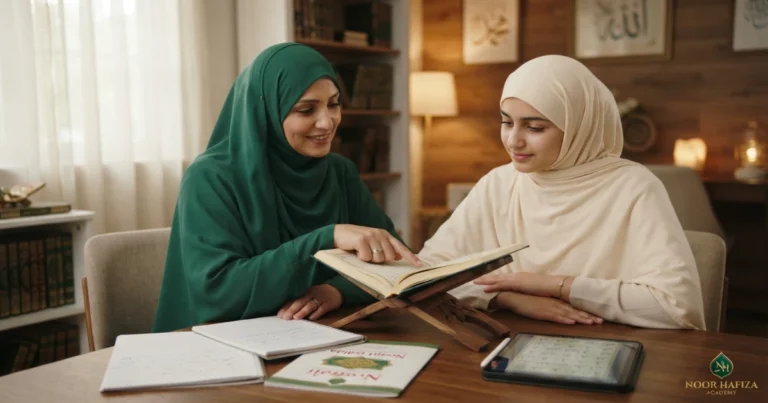
A qualified Quran teacher needs accurate recitation, but early-childhood teaching also requires patience, warmth, simple language, and the ability to keep the child involved. A teacher who is excellent with adults may not automatically be the right match for a four-year-old. Young children need visible demonstration, short turns, repetition, encouragement, and correction that does not create fear.
During a trial, observe the interaction rather than only the number of pages covered. Does the teacher wait for the child to answer? Does she reduce the instruction when the child looks confused? Does she praise genuine effort? Can she identify one important correction instead of reacting to every small movement? The teacher should guide the child toward participation, not merely demand silence.
Warm first contact
A young child should feel welcomed before being tested. The teacher uses the child’s name, explains one simple task, and allows a short settling period.
Clear pronunciation
The teacher models letter sounds accurately and slowly enough for the child to hear the difference, imitate it, and try again without confusion.
Age-aware instructions
Directions are short, concrete, and limited to one action at a time. The teacher does not overload a preschooler with long explanations or abstract rule names.
Patient correction
The teacher identifies one important mistake, demonstrates the better sound, and invites repetition without embarrassment, irritation, or constant negative language.
Interactive pacing
The lesson changes between listening, pointing, repeating, reading, and encouragement so the child is actively involved instead of watching a long lecture.
Parent communication
The parent receives one clear practice target and understands whether the goal is comfort, recognition, pronunciation, fluency, memorization, or revision.

What should happen during an age-appropriate Quran lesson?
A young child’s class should not be a smaller copy of an adult lesson. It needs a predictable rhythm, one clear objective, active participation, and an ending that leaves the child willing to return. The teacher should know whether the day’s goal is familiarity, recognition, pronunciation, reading, memorization, or revision.
Welcome and settle
The teacher greets the child, confirms the correct material, and begins with one familiar sound, dua, or review item. A predictable opening reduces anxiety and helps the child transition into learning.
Review one small target
The learner repeats the previous letter, sound, word, line, or short surah. The teacher checks whether the skill was retained rather than rushing immediately into new material.
Teach one manageable skill
For a preschool learner, this may be one letter or sound. For a school-age beginner, it may be a joining pattern, vowel rule, short line, or simple Tajweed habit.
Model, listen, and correct
The teacher demonstrates first, then listens to the child’s complete attempt. Correction is immediate but limited, specific, and followed by another chance to succeed.
Check an independent attempt
The teacher reduces prompts and asks the child to recognize, read, or repeat the same skill in a slightly different example. This shows whether learning is beginning to transfer.
End with a tiny home task
The revision target should be small enough to complete calmly: repeat three sounds, point to four letters, read two lines twice, or review one short memorized passage.
For ages three to five, the complete cycle may last only five to fifteen minutes. For ages six to eight, the same structure can support a twenty- to thirty-minute lesson with more reading and revision. Older children may work longer, but the principle remains the same: one focused skill should be taught, practiced, checked, and carried into a clear home target.
How long and how often should children take Quran classes?
Lesson length should follow attention and retention rather than parental ambition. A child who finishes ten calm minutes with one successful correction may learn more than a child who spends forty minutes resisting the screen. Start with a conservative duration, observe the child for several lessons, and increase only when attention, participation, and willingness remain healthy.
| Age or stage | Practical starting length | Possible weekly pattern | Main objective |
|---|---|---|---|
| Ages 2–3 | Informal moments rather than formal classes | Frequent home exposure | Listening, love, short duas, sounds, and positive association. |
| Ages 3–4 | About 5–10 minutes | One to three gentle sessions | Comfort with the teacher, imitation, one letter or sound, and simple response. |
| Ages 4–6 | About 10–20 minutes | Two to four lessons | Qaida foundations, pronunciation, recognition, and short revision. |
| Ages 6–8 | About 20–30 minutes | Two to five lessons | Reading development, accuracy, basic Tajweed habits, and selected memorization. |
| Ages 8–12+ | About 25–45 minutes | Based on reading, Tajweed, or Hifz goals | Fluency, detailed correction, stronger revision, and growing independence. |
The time of day matters as much as the number of minutes. A four-year-old may participate well in the morning but struggle immediately before bedtime. A school-age child may need food, rest, and movement after school before joining class. The best schedule is not merely an available slot; it is a recurring time when the child can actually learn.
What should parents prepare before the first Quran class?
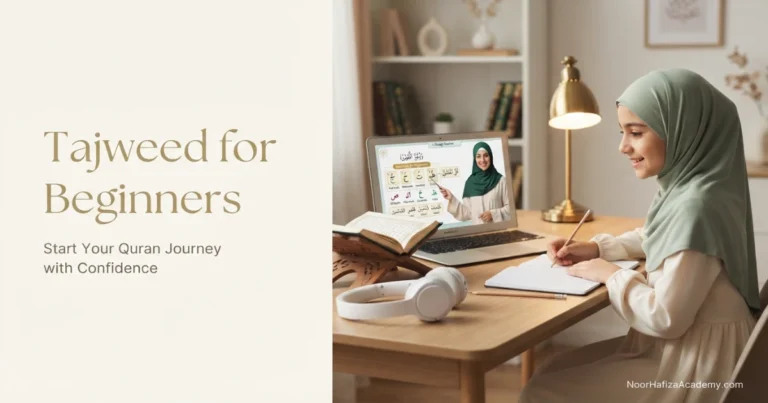
A calm first lesson begins before the call opens. The child should know where to sit, which book will be used, who the teacher is, and how long the lesson will last. Avoid presenting the trial as a difficult test. Explain simply that the teacher will listen, teach one small thing, and help the child practice.
A simple readiness setup
- A stable phone, tablet, laptop, or desktop
- Clear audio and a camera angle that supports interaction
- The assigned Quran, Qaida, or beginner material
- A comfortable chair and a surface at the child’s height
- A quiet supervised area with minimal visual distraction
- A parent nearby for technology and reassurance
A calm pre-class routine
- Tell the child the teacher’s name and what will happen
- Open the call link and test sound before the start time
- Place the book, notebook, pencil, and water within reach
- Complete bathroom and snack needs before class
- Allow a few minutes of movement before sitting
- Promise a short realistic lesson rather than threatening a long one

How involved should parents be when children start young?
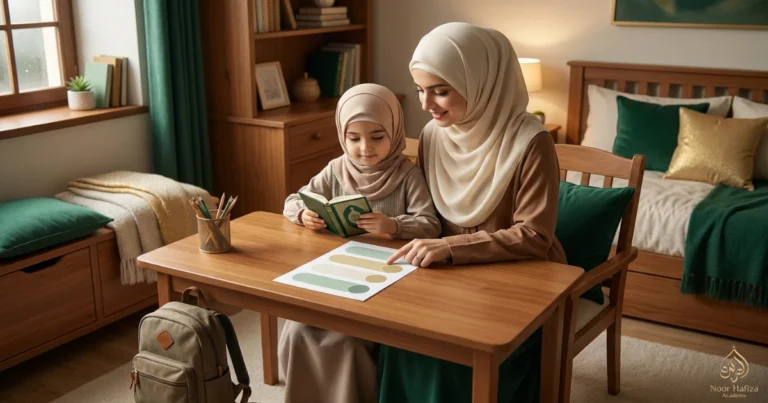
Parents create the emotional and practical conditions for early Quran learning. The goal is to support the routine without turning every lesson into a performance. A young child may need help opening the link, locating the page, staying near the desk, and understanding what the teacher asked. The parent should then step back enough for the teacher to hear the child’s genuine response.
Prepare without creating fear
Keep the device and material ready, explain that the lesson will be short, and avoid testing the child repeatedly in the final minutes before class.
Support without supplying answers
Help with technology, page location, or gentle redirection, but allow the teacher to hear real mistakes. Whispering every answer prevents an honest readiness assessment.
Praise effort and repeat one small target
Ask what the child practiced, celebrate a genuine attempt, and repeat the exact assigned sound, letter, line, or dua for a few calm minutes on several days.
As the child becomes more independent, reduce your involvement gradually. The long-term objective is not a parent who manages every answer; it is a learner who can greet the teacher, open the material, listen to correction, practice the assigned target, and return to class with increasing confidence.
How can parents keep an early Quran start safe and positive?
Physical and digital safety matter, but emotional safety is equally important. A child should know the teacher’s identity, learn in a supervised area, and use an approved class platform. The child should also be free from humiliation, frightening threats, or comparison with siblings. Correction is necessary; shame is not.
It means correction is specific, calm, age-appropriate, and followed by another chance to succeed. Children can learn discipline without associating the Quran with fear or repeated personal criticism.
Digital and family safeguards
- Confirm the teacher through the academy
- Keep young learners in a shared or supervised area
- Use the agreed platform and parent-approved device
- Keep scheduling and communication visible to parents
- Remove private documents and unrelated tabs from view
- Give the child a clear route to report discomfort
Emotionally healthy teaching
- Correct the skill without labeling the child
- Avoid comparing siblings, cousins, or classmates
- Use goals the child can realistically complete
- Pause when tiredness becomes distress
- Discuss repeated resistance with the teacher
- Change the plan when the current method is not working
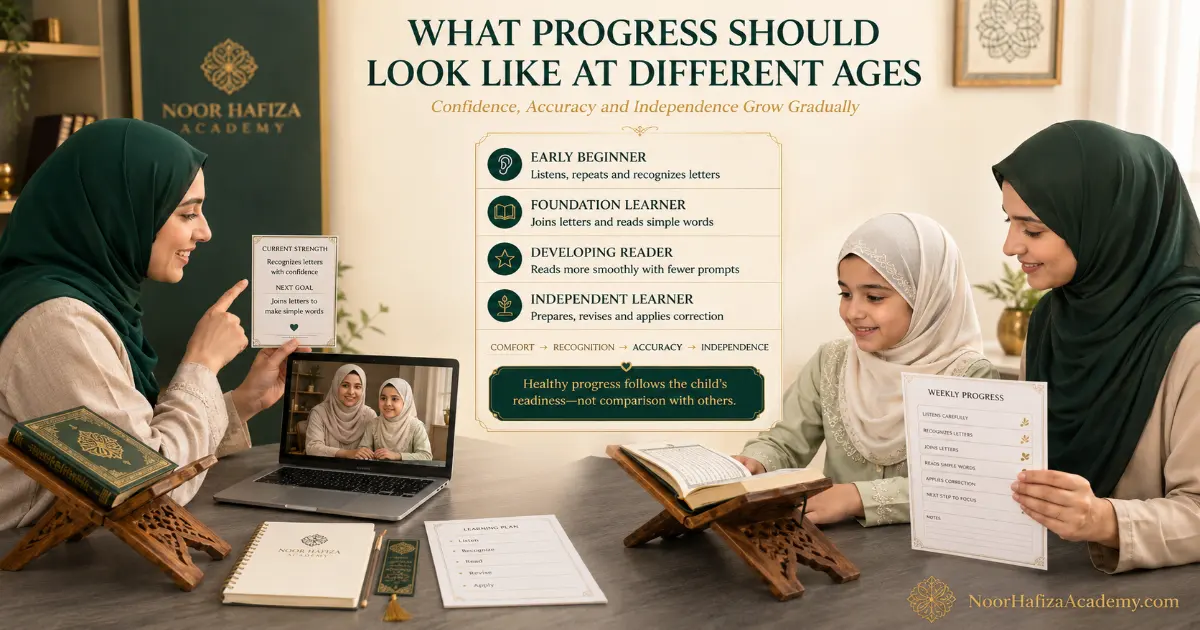
How should parents measure early Quran learning progress?
The youngest learners should not be judged mainly by pages completed. Early progress may appear as willingness to join the call, recognition of the teacher, improved listening, clearer imitation, recognition of a few letters, and the ability to return after correction. These small gains build the foundation for later reading.
Useful progress indicators
- Joins class with less resistance
- Looks toward the correct letter or line
- Repeats a sound more accurately
- Recognizes previously practiced letters
- Remembers a short dua or surah more reliably
- Accepts correction and tries again
- Completes a tiny revision task with less help
Questions parents can ask the teacher
- Is the child ready for more structure?
- Which skill improved this week?
- Which mistake should we focus on at home?
- Is the current lesson length suitable?
- Should we repeat the same material longer?
- Is the child learning or only memorizing order?
- What is the next realistic milestone?
What should happen during the first 90 days?
The first three months should establish a healthy relationship with the teacher and a sustainable routine. Parents should not expect a preschool beginner to read fluently or memorize large portions immediately. The early objective is to confirm readiness, create consistency, strengthen one foundation at a time, and see whether the child can retain learning between lessons.
Comfort and accurate placement
The teacher observes attention, language, recognition, imitation, and response to correction. The family tests the lesson time, device, duration, and parent involvement.
Build the lesson routine
The child becomes familiar with greeting, review, one new target, repetition, and a small home task. Predictability should reduce resistance and confusion.
Strengthen recognition and response
The teacher checks whether practiced sounds, letters, words, or memorized passages are retained and whether the child can respond with fewer prompts.
Review readiness for the next step
The family and teacher assess progress, confidence, lesson length, revision, and whether the child should continue, increase structure, or remain at the current pace.
The child should recognize the routine, feel comfortable with the teacher, understand the current objective, and show at least one clear improvement in attention, recognition, pronunciation, reading, memorization, or independent participation. Direction matters more than volume.
What if your child is distracted, resistant, shy, or progressing slowly?
Difficulty during the first lessons does not automatically mean the child is too young or incapable. It may reveal an unsuitable time, excessive duration, a weak teacher match, unclear instructions, tiredness, hunger, screen fatigue, or expectations that are too advanced. Identify the specific barrier before abandoning the idea or increasing pressure.
The child will not remain seated
Shorten the lesson, allow movement before class, remove nearby toys, and focus on active tasks such as pointing and repeating. Readiness does not require adult stillness.
The child becomes silent with the teacher
Allow several meetings for trust to grow. The teacher can begin with choices, familiar duas, imitation, and simple praise before expecting independent reading.
The child forgets letters repeatedly
Reduce the number of new items, increase spaced repetition, and check whether the child recognizes the letter outside memorized order. Slow recognition is not solved by adding more pages.
Correction causes frustration
Ask the teacher to prioritize one recurring mistake, model it clearly, and praise the improved attempt. Correcting every detail at once can overwhelm an early learner.
The child was ready at first but now resists
Review timing, fatigue, lesson length, teacher rapport, and home pressure. Resistance may come from the routine around the class rather than the Quran content itself.
An older beginner feels embarrassed
Use private one-to-one teaching, avoid comparisons, explain that foundations are normal at every age, and set milestones that allow the learner to see progress quickly.
Starting early vs. waiting for readiness vs. beginning later
Parents sometimes feel they must choose between starting as early as possible and waiting until the child is much older. A better approach separates Quran connection from formal instruction. Loving exposure can begin from infancy, while structured lessons begin when the child can benefit from them. Older beginners can then start without shame if formal study did not happen earlier.
| Starting approach | Main advantage | Main risk | Best parent strategy |
|---|---|---|---|
| Gentle exposure before age four | Builds familiarity, listening, love, and routine | Turning informal exposure into long forced study. | Keep it brief, warm, repetitive, and free from page targets. |
| Structured classes around ages four to six | Can establish Qaida and pronunciation foundations early | Using lessons that are too long or teacher-led without interaction. | Begin with a readiness trial, short duration, and one small objective. |
| Beginning around ages six to eight | Stronger attention, language, visual tracking, and routine | Parents may rush because they believe the child started late. | Use an honest level check and build foundations without skipping. |
| Beginning at age nine or later | Older learners often understand explanations and revise independently | Embarrassment, comparison, or placement above the true level. | Protect dignity, use private teaching, and celebrate measurable progress. |
The most harmful approach is not simply starting early or late. It is using pressure, unsuitable placement, inconsistent attendance, or teaching that ignores the child’s emotional and developmental needs. A good beginning can happen at many ages when the plan is honest and sustainable.
A parent checklist before booking the first Quran class
A website can describe a program, but the trial lesson reveals whether the teacher and structure are appropriate for your child’s age. Use the first interaction to evaluate readiness, comfort, pronunciation, teaching clarity, and the family routine—not only fees and available time.
Ask how readiness is checked
The academy should consider attention, language, previous exposure, current skill, emotional comfort, and the family’s realistic schedule.
Observe the female teacher
Notice patience, pronunciation, instructions, correction style, warmth, and whether the teacher adjusts when the child looks confused.
Confirm lesson length
Do not accept a long default lesson merely because it is available. Ask what duration suits this child and how it can be adjusted.
Understand the first goal
The academy should explain whether the initial objective is comfort, letters, sounds, Qaida, reading, Tajweed, memorization, or revision.
Clarify parent involvement
Ask where the parent should sit, how to support attention, what not to correct during class, and how home revision will be assigned.
Review policies and communication
Confirm teacher availability, timing, missed lessons, rescheduling, fees, safety expectations, feedback routes, and cancellation terms.
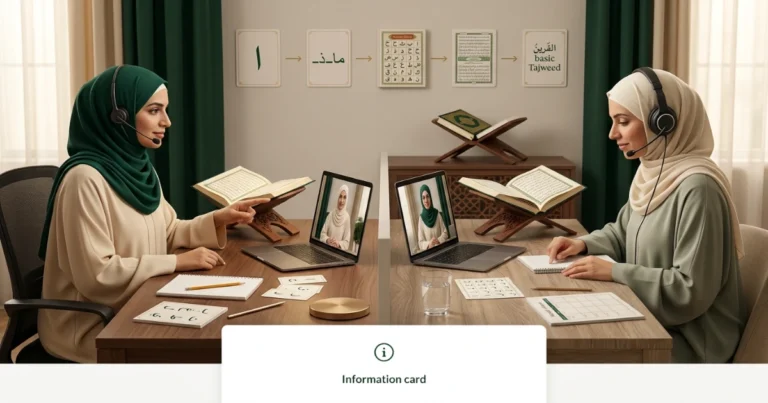
Noor Hafiza Academy offers live online learning for children with female Quran teachers. Families can review the dedicated Quran classes for kids program, explore Noorani Qaida online, understand how online Quran classes work, or arrange a trial to identify the child’s readiness, level, and suitable lesson length.
FAQs about the best age to start Quran classes for kids
What is the best age to start Quran classes for kids?
Can a three-year-old start Quran classes?
Is age four too early for Noorani Qaida?
Is age seven too late to begin Quran classes?
Is ten or twelve too late to learn Quran reading?
How long should a Quran lesson be for a four-year-old?
Should children memorize before learning to read?
What if my child refuses to sit for an online Quran class?
Do parents need to sit with a young child?
Can parents request a female Quran teacher for their child?
Find the right starting age, level, and lesson length with a free trial class
Share your child’s age, previous Quran exposure, attention needs, current ability, time zone, and preferred schedule. Noor Hafiza Academy will help you identify a suitable starting pathway with a female Quran teacher.