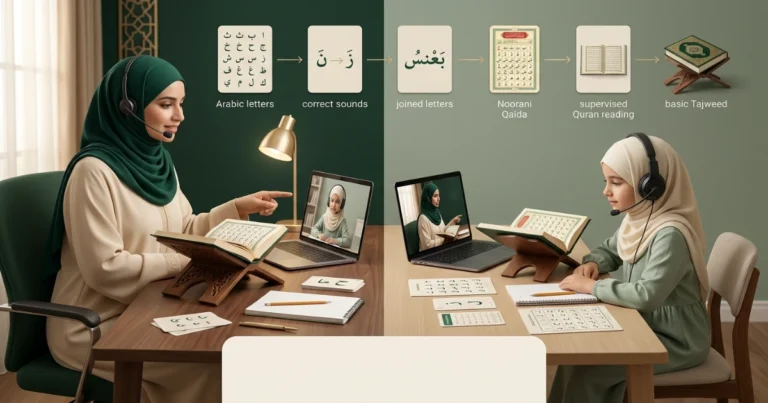
How Much Do Online Quran Classes Cost in the USA?

How much do online Quran classes cost in the USA? Published prices vary widely because families are not always comparing the same lesson length, weekly frequency, teacher experience, course type, or support. This guide explains realistic monthly ranges, what changes the fee, which costs may be hidden, and how to decide whether a plan offers genuine value.
How much do online Quran classes cost in the USA per month?
Based on publicly posted online Quran academy pricing reviewed in July 2026, entry-level plans may begin around $20 to $50 per month, commonly for 30-minute lessons offered one or two times per week. Plans with three or four 30-minute lessons per week often appear around $48 to $112 per month. Five weekly lessons or higher-frequency plans may cost roughly $80 to $140 per month, while specialized programs using 45- or 60-minute sessions—such as intensive Hifz, advanced Tajweed, Ijazah, Tafseer, or Arabic—can reach approximately $100 to $200 or more per month. These figures are market examples, not a universal tariff. The final fee depends on the number and length of lessons, whether teaching is private or group-based, the teacher’s qualifications, the learner’s goal, family discounts, and what the academy includes.
What is the average cost of online Quran classes in the USA?
There is no official national price for online Quran education. Academies set their own monthly tuition according to lesson time, teacher availability, course complexity, operating costs, and how much individual support is included. This is why a parent may see one website advertising $20 per month and another offering a plan near $100 or more. Those numbers may look directly comparable, but the underlying service can be very different.
A useful way to understand the market is to separate plans by frequency and duration. Lower-priced plans usually provide fewer minutes of live teacher time. Mid-range plans often offer two to four individual lessons each week. Higher-priced plans may include daily or near-daily instruction, longer sessions, advanced teachers, specialized memorization support, structured progress reporting, or priority scheduling in USA time zones.
Light monthly plan
Often one or two short lessons per week. Suitable for gentle beginnings, limited schedules, or families testing consistency.
Steady weekly learning
Frequently includes two to four 30-minute lessons weekly, depending on the provider and current offer.
Four to six weekly lessons
More teacher contact, faster correction cycles, and a stronger fit for fluency or structured memorization.
Longer or advanced sessions
May include 45–60 minute classes, Hifz, Ijazah, advanced Tajweed, Tafseer, Arabic, or intensive plans.
Seven factors that change online Quran class prices
Monthly tuition is usually the result of several decisions combined. A low headline fee does not automatically mean poor quality, and a high fee does not guarantee excellent teaching. Parents need to understand what they are paying for.
Lessons per week
Frequency is one of the strongest cost drivers. Moving from two lessons to five lessons weekly can more than double total teacher time.
Lesson duration
A 60-minute lesson uses twice the live teaching time of a 30-minute session, even when both plans list the same number of classes.
One-to-one or group class
Private lessons usually cost more because the teacher listens to one learner, follows one pace, and uses the full session for that student.
Course complexity
Noorani Qaida, Quran reading, Tajweed, Hifz, Ijazah, Tafseer, and Arabic require different preparation, tracking, and teacher expertise.
Teacher qualification
Advanced Tajweed, Ijazah, Hifz supervision, bilingual teaching, and extensive child-teaching experience may affect the price.
Schedule and time zone
High-demand evening or weekend times in Eastern, Central, Mountain, and Pacific time zones may have limited teacher availability.
Support and policies
Progress reports, curriculum materials, makeup classes, customer support, teacher replacement, and family coordination add value beyond live minutes.
How much do online Quran classes cost in the USA by weekly lesson frequency?
Frequency should match the learner’s goal and home revision capacity. One or two weekly lessons may support a gentle introduction, but progress can feel slow when the child forgets corrections between classes. Three or four weekly lessons create more regular contact. Five or six weekly sessions may suit Hifz or intensive fluency, provided the student can sustain the routine.
| Weekly pattern | Common lesson length | Broad monthly market range | Usually suitable for |
|---|---|---|---|
| 1 lesson per week | About 30 minutes | Approximately $25–$49 | Very light introduction, maintenance, or a learner with significant home support. |
| 2 lessons per week | About 30 minutes | Approximately $20–$75 | Beginners, young children, or families building a manageable routine. |
| 3 lessons per week | About 30 minutes | Approximately $30–$85 | Steady Qaida, Quran reading, Tajweed foundations, and regular correction. |
| 4 lessons per week | About 30 minutes | Approximately $55–$112 | Faster reading progress, consistent Tajweed practice, or early Hifz structure. |
| 5 lessons per week | About 30 minutes | Approximately $80–$140 | Hifz, intensive fluency, daily correction, or families seeking faster continuity. |
| Specialized 45–60 minute plan | 45–60 minutes | Approximately $75–$200+ | Advanced Tajweed, Ijazah, Tafseer, Arabic, adult study, or intensive memorization. |
The ranges overlap because academies use different teacher locations, promotions, class lengths, and package structures. A $50 plan with twelve 30-minute lessons is not equivalent to a $50 plan with eight 45-minute lessons. Calculate total monthly minutes before comparing.

Does the Quran course type change the monthly price?
Yes. A beginner learning Arabic letters may need short, highly guided lessons. A fluent reader studying advanced Tajweed may require a teacher with deeper technical knowledge. A Hifz student needs live listening plus a system for new memorization, recent revision, and older revision. The course name alone does not determine price, but it changes how much teacher time and expertise may be needed.
Noorani Qaida
Often fits standard 20–30 minute plans. Young beginners may need frequent short sessions rather than one long weekly lesson. Explore Noorani Qaida online.
Quran Reading
Usually priced within standard individual plans. Frequency matters because regular listening helps correct fluency and recurring errors. See online Quran reading classes.
Tajweed
Basic Tajweed may fit standard plans, while advanced rule application or Ijazah preparation can require longer sessions and specialized teachers. Visit online Tajweed classes.
Hifz Quran
Often costs more when the student needs five weekly lessons, longer listening time, detailed revision tracking, and consistent retention checks. Learn about Hifz Quran online.
Islamic Studies
May be included as a separate class, combined lesson, or add-on. Ask whether materials and age-based curriculum are part of the quoted fee. Explore Islamic Studies online.
Arabic, Tafseer, or Ijazah
Specialized study may use 45–60 minute sessions and teachers with advanced subject preparation, so published monthly fees may be higher.
Are one-to-one Quran classes more expensive than group classes?
Private classes generally cost more per student because the teacher’s full attention is reserved for one learner. The teacher can listen to every line, stop at a recurring mistake, adjust the pace, and use the complete session for that child. Group classes divide teacher time across several learners, which can reduce the individual fee but may also reduce personal recitation time.
| Feature | One-to-one class | Group class | Cost implication |
|---|---|---|---|
| Teacher attention | Fully individual | Shared among students | Private classes usually carry a higher per-student fee. |
| Reading time | Most of the lesson can be used for the learner | Each student waits for turns | A shorter private class may deliver more active reading than a longer group class. |
| Learning pace | Matched to the child | Matched to group level | Personalization can justify a higher price when the fit is strong. |
| Social learning | Private and focused | Peer interaction | Groups may be economical for families who value shared learning. |
| Scheduling | Often more flexible | Fixed shared time | Flexible private scheduling may be included in the premium. |
How do 30-, 45-, and 60-minute lessons affect the cost?
Lesson duration should be chosen by age, level, and objective—not simply by selecting the longest package. Young children may learn more effectively in a focused 20- or 30-minute class than in a 60-minute session that exceeds their attention. Older learners, Hifz students, advanced Tajweed learners, and adults may need longer classes to combine new instruction, supervised reading, correction, and revision.
Thirty-minute lessons
Common for children, beginners, Qaida, reading, and regular Tajweed. Usually the most affordable standardized format.
Forty-five-minute lessons
Useful when a learner needs more recitation time, explanation, or memorization review without committing to a full hour.
Sixty-minute lessons
Often used for advanced study, adults, Ijazah, Arabic, Tafseer, or intensive Hifz, and therefore normally costs more.
Short early-childhood lessons
Some young learners benefit from 15–20 focused minutes. Ask whether the academy can customize duration and pricing.
How much do online Quran classes cost in the USA for two or more children?
A family with two or three children should not assume that the first advertised price will simply multiply without adjustment. Many academies offer sibling or family discounts, but the structure varies. Some reduce the fee for each additional learner. Others offer a percentage discount, a bundled number of monthly sessions, or a shared family package.
Percentage sibling discount
A provider may reduce tuition by around 10% to 20% for multiple family members. Confirm whether the discount applies to every child or only additional enrollments.
Reduced additional-child rate
The first student pays the normal fee while siblings receive a lower price. Ask whether the reduction continues when a child changes frequency.
Family session bundle
A monthly package may include a larger shared pool of lessons. Check whether each child still receives private instruction and individual progress tracking.
Annual or term discount
Some academies discount longer commitments. Read refund and pause terms carefully before paying several months in advance.

What should be included in an online Quran class fee?
A monthly fee should be explained clearly. Families should know whether they are paying only for scheduled live lessons or also receiving placement, materials, progress communication, rescheduling support, and teacher coordination. The cheapest plan can become expensive when important support is missing or when unused classes cannot be recovered.
Commonly included features
- Live lessons with an assigned Quran teacher
- Initial level assessment or trial class
- A defined course pathway and lesson material
- Short home revision targets
- Parent communication or progress updates
- Technical and scheduling support
Costs that require clarification
- Registration or enrollment fee
- Books, printed materials, or shipping
- Payment-processing or currency charges
- Makeup classes after student absence
- Teacher changes or premium time slots
- Certificates, exams, or specialized assessment
Does a free trial make an online Quran plan better value?
A free trial is valuable when it allows the family to test the actual teaching process before paying. The child should meet a teacher, complete a short level check, experience at least one correction, and receive a clear starting recommendation. A trial that is only a sales conversation does not provide the same evidence.
Confirm whether the trial is truly free
Ask whether a card is required, whether billing begins automatically, and whether the trial uses the teacher likely to continue with the child.
Read the missed-class policy
Some academies provide makeup classes with advance notice. Others treat reserved teacher time as used when the student is absent.
Understand holidays and pauses
Confirm whether academy holidays are included, whether travel pauses are allowed, and how much notice is required before the next billing cycle.
Check cancellation and refund terms
Monthly flexibility can be valuable. Longer commitments may reduce price but should have clear written conditions.
Ask how teacher changes work
A family should know the route for requesting another teacher if schedule, communication, or child-teacher fit remains unsuitable.
Confirm the exact recurring charge
Separate temporary first-month promotions from the normal monthly fee you will pay after the offer ends.
How can parents decide whether Quran classes are worth the cost?
Value is not measured by the number of pages covered or the lowest fee found. A plan offers value when the teacher hears the child accurately, corrects recurring mistakes, uses lesson time efficiently, communicates useful targets, and helps the learner progress without an unsustainable family routine.
Calculate real live teaching time
Multiply lessons by minutes and confirm whether all sessions are private. This prevents a misleading comparison between packages with different durations.
Use the trial to judge teaching quality
Observe recitation, child-friendly explanation, correction, patience, attention, and the learner’s willingness to respond.
Review support, policies, and progress
Ask what happens after missed lessons, how parents receive feedback, and how the academy responds when the schedule or teacher match needs adjustment.
How to build a realistic Quran class budget for your family
Start with the learning goal rather than the cheapest package. A child beginning Qaida may need two or three short weekly lessons. A Hifz student may need five days of listening and structured revision. Choosing too little teacher contact can slow progress; choosing an intensive plan the family cannot maintain can lead to missed classes and wasted tuition.
Define the learning goal
Beginner Qaida, reading fluency, Tajweed, Hifz, Islamic Studies, or advanced study each needs a different level of teacher time.
Choose sustainable frequency
Consider school, homework, sleep, sports, work shifts, time zone, and the time available for home revision.
Estimate the annual cost
Multiply the normal monthly rate by twelve and include possible books, payment fees, or periods when classes continue during travel.
Review value after one month
Check attendance, teacher fit, progress, revision, and whether the selected frequency remains appropriate.

Are online Quran classes cheaper than local tutors or mosque programs?
The answer depends on the format. A subsidized mosque group may cost less than private online tuition, especially when community donations support the program. A private in-person tutor in the USA may charge a higher hourly rate and may add travel time or transportation costs. Online classes remove the commute and can provide access to more teachers and recurring time slots.
| Option | Typical strength | Possible cost advantage | Cost question to ask |
|---|---|---|---|
| Online one-to-one academy | Individual correction and flexible scheduling | No commute and access to global teacher supply | How many private minutes and what support are included? |
| Local mosque group | Community environment and peer learning | May be subsidized or lower-cost | How much individual recitation time does each learner receive? |
| Private in-person tutor | Face-to-face individual attention | No platform dependence | Are travel time, mileage, or minimum booking hours added? |
| Recorded course or app | Low price and self-paced access | Very low monthly fee or one-time purchase | Who listens and corrects the learner’s actual recitation? |
When can a very cheap Quran class become more expensive?
A low fee can be a genuine affordable offer, but parents should investigate how the provider sustains the service. Poor audio, repeated teacher changes, inaccurate correction, oversized groups, hidden fees, or missed lessons without support can reduce value. The family may later pay another teacher to rebuild weak foundations.
The lesson length is unclear
A monthly price is advertised without stating whether classes are 15, 20, 30, 45, or 60 minutes.
The class is called private but is shared
Parents discover later that several students join the same teacher during the scheduled period.
Promotional pricing hides the normal rate
The first month is heavily discounted, but the recurring charge is not explained before enrollment.
No makeup or cancellation clarity
Families lose paid sessions because attendance, holiday, and rescheduling terms were never confirmed.
Teachers change repeatedly
The child spends paid lesson time rebuilding rapport and repeating assessments instead of following a stable plan.
There is no measurable progress system
The learner moves through pages but repeated mistakes are not tracked, corrected, or communicated to parents.
How Noor Hafiza Academy approaches pricing and placement
Noor Hafiza Academy provides live online Quran learning with female Quran teachers for children, girls, women, and beginners. Because the appropriate plan depends on age, current level, course, lesson duration, weekly frequency, time zone, and teacher availability, families should confirm the current fee directly after discussing their needs.
A free trial or level check helps prevent families from paying for the wrong course or an unsuitable schedule. The teacher can listen to the learner, identify the starting point, recommend a practical lesson length, and explain the likely weekly pattern. Parents can then compare the complete plan rather than choosing from price alone.
Share the student’s age, existing Quran level, preferred course, country or USA time zone, number of weekly lessons, and suitable schedule. Ask what the monthly fee includes and which policies apply.
Questions to ask before paying for online Quran classes
Exact monthly charge
- Normal recurring price
- Temporary promotion end date
- Registration or processing fees
- Accepted payment currency
Teaching time
- Classes per week and month
- Minutes per lesson
- Private or group format
- Expected teacher attendance
Teacher and course
- Female teacher availability
- Relevant course qualification
- Child-teaching experience
- Teacher replacement process
Missed classes
- Advance-notice requirement
- Makeup-class eligibility
- Teacher absence process
- Holiday treatment
Progress support
- Level assessment
- Revision targets
- Parent feedback
- Milestone review
Family terms
- Sibling discounts
- Pause and cancellation rules
- Refund terms
- Annual payment conditions
Families can explore online Quran classes in the USA, review the complete parent guide to Quran classes for kids, understand how online Quran classes work, or learn how to choose an online Quran teacher before comparing plans.
FAQs about online Quran class costs in the USA
How much do online Quran classes cost in the USA?
How much do online Quran classes cost for kids?
Are private online Quran classes more expensive?
How much do online Hifz classes cost in the USA?
Do female Quran teachers cost more?
Do online Quran academies offer sibling discounts?
Are Quran learning materials included in the monthly fee?
What happens if my child misses an online Quran class?
Is the cheapest online Quran class the best value?
How can I get Noor Hafiza Academy’s current pricing?
Find a suitable learning plan and confirm the current monthly fee
Share the learner’s age, current Quran level, preferred course, USA time zone, desired lesson frequency, and available schedule. Noor Hafiza Academy will help identify an appropriate pathway and explain current teacher availability, pricing, and terms.