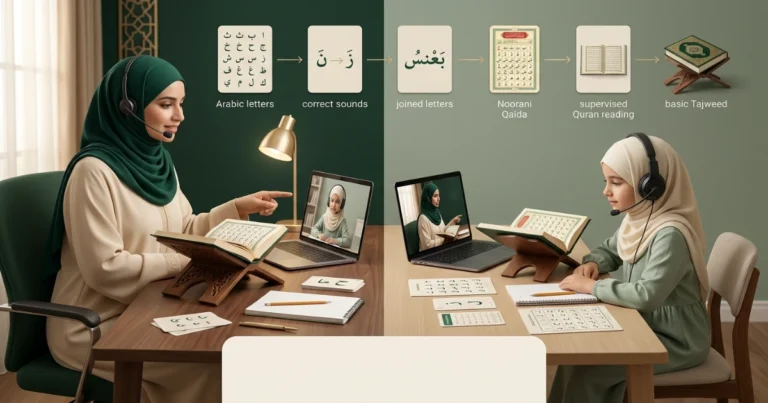
What Is Noorani Qaida and Why Is It the First Step in Quran Reading?
What is Noorani Qaida? It is a structured beginner reading primer used to teach the Arabic letters, their sounds, joined forms, short vowels, long vowels, sukoon, tanween, shaddah, and other essential reading patterns before a learner begins reading directly from the Quran. It does not replace the Quran, and completing it does not mean a learner has mastered Tajweed. Its purpose is to create the decoding and pronunciation foundation that makes Quran reading more accurate, manageable, and confident.
What is Noorani Qaida?
Noorani Qaida is a beginner-level method for learning how to read Quranic Arabic. It normally starts with individual Arabic letters and their sounds, then introduces connected letter shapes, short vowels, tanween, sukoon, shaddah, madd and increasingly complex reading combinations. The lessons are arranged so the learner develops one decoding skill at a time. This is why Noorani Qaida is commonly treated as the first step in Quran reading: it separates foundational reading skills from the visual and linguistic complexity of a full Quran page. A qualified teacher can use the Qaida to correct pronunciation early, prevent guessing, and decide when the learner is ready to move into direct Quran reading.
What exactly is Noorani Qaida?
Noorani Qaida is not simply an alphabet chart and it is not a collection of Quran verses arranged for memorization. It is a graded reading primer. Its lessons are designed to help a learner connect three things: what an Arabic symbol looks like, how that symbol sounds, and how the sound changes when the symbol is joined with vowels or other letters. Different printed and digital editions may organize the exercises differently, but the core purpose remains the same: to move a complete beginner from recognition toward accurate decoding.
A learner who opens the Quran without this foundation may see dense lines of connected Arabic script, multiple reading signs, and unfamiliar word shapes at the same time. Even when the teacher points to a word, the student may not know where one letter ends and the next begins. Noorani Qaida reduces that complexity. It introduces letters and signs in controlled exercises so the learner can focus on one new feature without being overwhelmed by everything else on the page.
The word “Qaida” is commonly used for a foundational rule or primer. In practical teaching, Noorani Qaida functions as a bridge between not knowing Arabic script and being able to attempt Quran words with teacher guidance. It is especially useful for children, adult beginners, returning learners, and students who once completed a primer but still guess, confuse letter shapes, or struggle with consistent vowel sounds.
The goal is not to finish pages quickly or memorize the sequence of exercises. The goal is to recognize, sound, blend, and read unfamiliar examples accurately enough that the skill transfers into the Quran.
Why is Noorani Qaida the first step in Quran reading?
Quran reading requires several skills at the same time. The learner must identify letters, notice their joined forms, interpret the marks above and below them, control the length of sounds, recognize doubled consonants, pause correctly, and listen to the teacher’s pronunciation. Trying to build every skill directly from a full Quran page can make the first stage unnecessarily difficult.
It reduces visual overload
Short exercises isolate one skill, helping the learner see exactly what changed instead of facing an entire verse filled with unfamiliar signs.
It prevents alphabet guessing
Repeated recognition exercises train the learner to identify the actual symbol rather than depend on position, color, or memorized sequence.
It builds sound-symbol links
The learner connects each shape with a sound and later applies that connection when letters appear inside words.
It allows early correction
A teacher can identify weak articulation, confused letters, or inconsistent vowels before those habits spread into Quran reading.
It introduces complexity gradually
Joined forms, sukoon, tanween, shaddah, and madd are added in stages instead of appearing all at once.
It creates independent decoding
The learner is trained to read unfamiliar combinations rather than repeat only the exact examples already heard from the teacher.
It supports confidence
Small, visible achievements help beginners experience progress without being judged against fluent readers.
It prepares for Quran page layout
Once the core signs are familiar, the learner can focus more attention on fluent reading and correction inside the Mushaf.
It gives the teacher a diagnostic tool
The lesson sequence shows whether difficulty comes from recognition, pronunciation, blending, attention, or retention.
What does Noorani Qaida teach step by step?
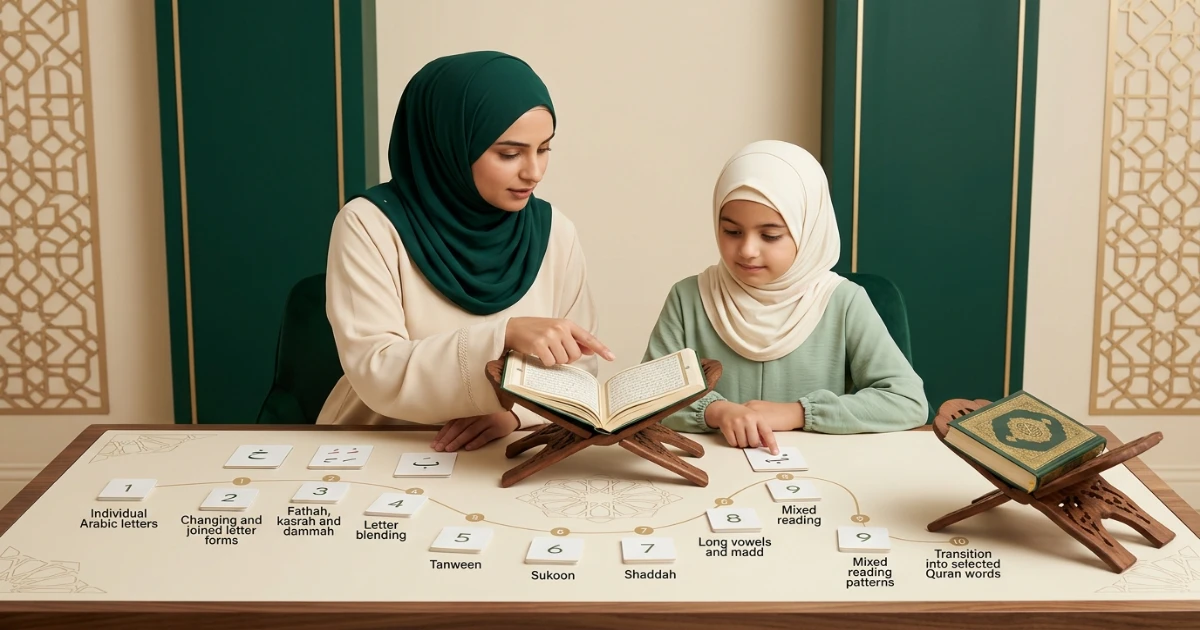
The exact page order differs among editions, but a well-taught Qaida normally covers the following skill groups. The teacher should not rush simply because a learner can repeat familiar examples. Advancement should be based on whether the learner can recognize and read new combinations with decreasing support.
Individual Arabic letters
The learner identifies each letter by shape and produces its basic sound. The teacher pays attention to letters that look similar or come from nearby articulation areas.
Changing and joined letter forms
Arabic letters may look different at the beginning, middle, and end of a word. The learner practices recognizing the same letter across these positions.
Short vowels
Fathah, kasrah, and dammah change the sound attached to a letter. The learner practices producing each vowel briefly and consistently.
Letter blending
Two- and three-part combinations teach the learner to move from separate sounds into connected reading without inserting extra vowels.
Tanween patterns
The learner becomes familiar with doubled vowel marks and their nasal ending sound while keeping the base letter clear.
Sukoon
A letter with sukoon is read without a following vowel. This stage is important for controlled blending and avoiding added sounds.
Shaddah
The learner understands that a doubled consonant requires a stronger, repeated articulation rather than a simple single sound.
Long vowels and madd
Basic lengthening patterns help the learner distinguish short sounds from sounds that need to be extended for the correct duration.
Mixed reading patterns
Previously learned signs appear together so the student must choose the correct reading process rather than rely on a single-page rule.
Transition into Quran words
The teacher begins applying the same recognition and pronunciation skills to selected Quran words and short passages before full-page reading.
Does Noorani Qaida teach Tajweed?
Noorani Qaida can introduce important pronunciation and reading foundations that support later Tajweed, but completing a Qaida should not be described as complete Tajweed mastery. Tajweed includes a wider body of recitation principles, sound qualities, articulation, rule application, stopping, starting, and consistent reading inside actual Quran passages. The Qaida prepares the learner to understand and apply some of these elements more effectively.
The difference matters for parents and adult beginners. A learner may finish every printed exercise yet still confuse articulation points, stretch short vowels, shorten long vowels, or read too quickly when moving into the Quran. This does not always mean the Qaida failed. It may mean the exercises were completed without enough listening, correction, transfer practice, or independent reading.
Articulation awareness
The teacher helps the learner hear and produce letters that may sound similar to an untrained ear but come from different articulation areas.
Vowel control
Short vowels remain short, while long-vowel patterns receive the correct basic extension instead of random stretching.
Sign recognition
The learner notices sukoon, tanween, shaddah, and lengthening signs and changes the reading accordingly.
Listening and imitation
A live teacher provides a sound model, then reduces support so the learner can reproduce the reading independently.
Correction transfer
The same corrected sound is tested in another example so progress is not limited to one memorized word.
Quran application
Foundational rules are gradually applied to Quran words and verses under teacher supervision.
What Noorani Qaida does not automatically guarantee
Parents sometimes hear that a child has “finished Qaida” and assume the child can now read any Quran page fluently. Completion is useful, but it is only one signal. The learner may need transition lessons, repeated application, slower Quran reading, and continued correction. A strong program measures transferable skill, not only the last page completed.
It does not guarantee fluent Quran reading
Fluency develops through repeated reading inside the Quran, accurate correction, and growing familiarity with real word patterns.
It does not replace a live teacher
A book or app cannot always hear subtle pronunciation mistakes, added vowels, weak articulation, or inconsistent sound length.
It does not equal full Tajweed mastery
The primer introduces foundations, while complete rule application requires continued instruction and Quran practice.
It should not be memorized mechanically
A learner who remembers page order may appear successful but struggle when the same signs appear in unfamiliar combinations.
It does not require identical timing for everyone
Age, previous exposure, lesson frequency, pronunciation needs, attendance, and home practice all affect the pace.
It should not be rushed for a certificate
Finishing quickly has little value when the learner still guesses, confuses letters, or cannot apply the rules independently.
A practical Noorani Qaida to Quran reading roadmap
The most effective pathway is not “finish the book and suddenly begin the Quran.” A smoother transition includes assessment, controlled practice, review, and gradual application. The teacher may move back and forth between stages when a weakness appears.
Identify the real starting level
The teacher checks letter recognition, sound production, joined forms, vowel awareness, and whether the learner reads or merely remembers familiar pages.
Strengthen one foundation at a time
Lessons focus on accurate recognition and pronunciation before adding more complex signs and mixed combinations.
Read unfamiliar combinations independently
The learner practices joining sounds without guessing, inserting extra vowels, or relying on the teacher to read first every time.
Apply the same skills to Quran words
Selected words and short lines help the learner recognize that the signs and patterns learned in Qaida also appear in the Quran.
Begin controlled Quran reading
The student reads small portions with teacher correction, prioritizing accuracy and sound control before speed.
Add fluency and deeper Tajweed gradually
As decoding becomes easier, lessons can focus more on recurring Tajweed rules, stopping, starting, rhythm, and smoothness.
Who should learn through Noorani Qaida?
Noorani Qaida is often associated with young children, but it can be equally useful for adults. The deciding factor is not age; it is the learner’s actual reading foundation. An adult who does not recognize Arabic letters should not be pushed into Quran pages simply because of age. A child who already reads accurately may not need to restart every early exercise.
First exposure to Arabic script
Lessons should be short, visual, repetitive, and supported by a parent who helps with setup and a small practice routine.
Weak or uneven foundation
The teacher can identify missing skills without making the learner feel punished for returning to beginner material.
Starting from zero
A respectful, mature teaching style helps adults learn letters and sounds without childish language or embarrassment.
Restarting after a long gap
A focused review may rebuild forgotten letters, vowel patterns, and reading confidence before direct Quran practice.
The teacher should assess rather than assume. Some learners need the complete sequence. Others may begin from joined letters, sukoon, shaddah, or mixed reading. Personalized placement saves time while protecting the foundation.
Can Noorani Qaida be learned effectively online?
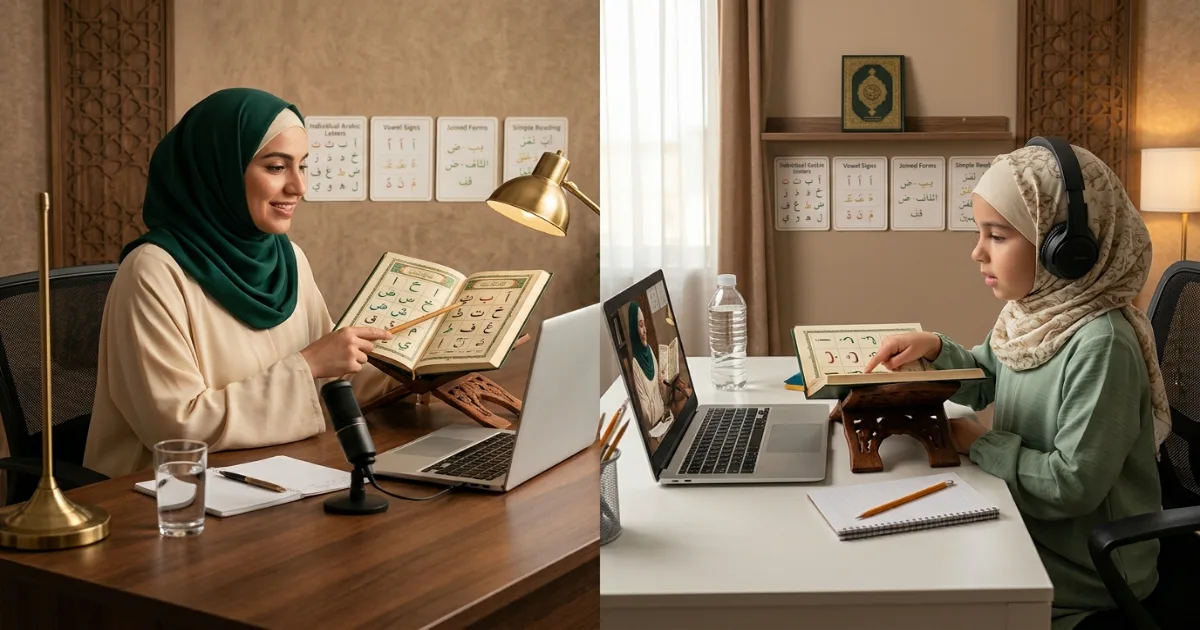
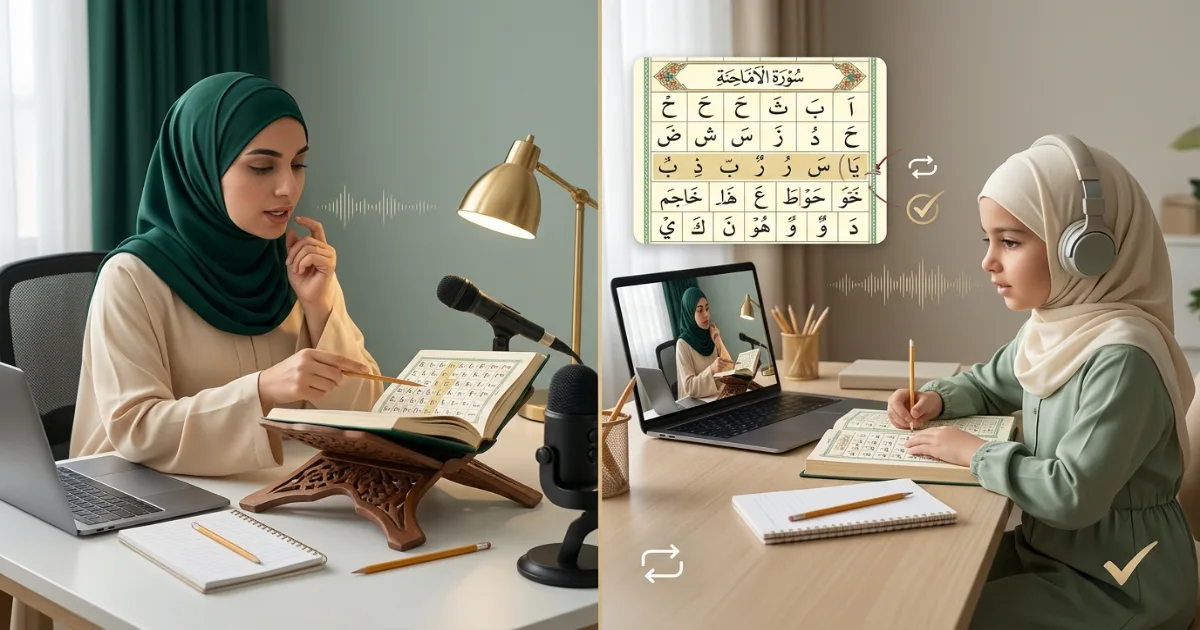
Yes, provided the class includes clear audio, visible lesson material, live listening, accurate modeling, and immediate correction. Online teaching is especially suitable for one-to-one Qaida work because the teacher can hear every attempt, control the pace, repeat difficult sounds, and keep the learner focused on one line at a time.
The technology does not need to be complicated. A stable device, clear microphone, suitable camera position, shared digital page or physical book, and a quiet learning space are usually more important than elaborate software. For young children, a parent should help open the class, place the book correctly, and remain nearby without answering every question for the child.
| Lesson stage | Teacher action | Learner action | What parents should notice |
|---|---|---|---|
| Review | Checks previous letters or patterns without giving every answer | Recognizes and reads independently | The teacher tests retention, not only repetition |
| Model | Demonstrates a new sound or sign clearly | Listens and watches carefully | The explanation is short and understandable |
| Practice | Guides several examples and reduces prompting | Reads increasingly unfamiliar combinations | The learner does real reading rather than only echoing |
| Correct | Identifies the exact error and models the better version | Repeats and tries again independently | Correction remains calm, specific, and useful |
| Assign | Gives a small revision target | Practices the agreed examples between lessons | Home practice is realistic and clearly explained |
How often should a beginner practice Noorani Qaida?
Consistency matters more than a long session once a week. Many beginners benefit from several short teacher contacts and brief home review because letter-sound links weaken when too much time passes between attempts. However, the correct schedule depends on age, attention, school or work responsibilities, pronunciation needs, and family routine.
Two lessons each week
Can work for adults or families with a busy routine when home practice is consistent and the learner retains skills well.
Three lessons each week
Provides regular correction and usually reduces the gap between learning a pattern and applying it again.
Four or five short lessons
May suit young beginners, learners with weak retention, or families seeking faster continuity without very long sessions.
Five to fifteen focused minutes
Review only the teacher’s assigned lines, prioritizing correct recognition and sound rather than racing through pages.

How long does it take to complete Noorani Qaida?
There is no responsible universal completion promise. Some learners already know part of the alphabet, attend frequently, and practice consistently. Others are starting from zero, need more pronunciation work, miss lessons, or require repeated review. Age alone does not determine speed. A motivated adult may progress quickly through recognition but need extra time for articulation. A young child may need short lessons but retain patterns very well through repetition.
Instead of asking only, “How many months will the book take?” ask whether the learner can demonstrate the following milestones. These are more meaningful than page count.
Letter recognition
The learner identifies letters in mixed order rather than only reciting the alphabet sequence.
Joined-form recognition
The same letter can be recognized when its shape changes inside a word.
Vowel accuracy
Short vowels are produced consistently without stretching or changing them.
Controlled blending
The learner combines letters without guessing, dropping sounds, or adding extra vowels.
Reading-sign awareness
Sukoon, tanween, shaddah, and long-vowel patterns change the reading correctly.
Transfer to Quran text
The learner can apply the same skills to selected Quran words with decreasing teacher support.
What should a good Noorani Qaida teacher do?
A strong teacher does more than point to letters and ask the learner to repeat. She listens for the reason behind the mistake. Is the learner confusing the shape? Forgetting the vowel? Producing the wrong articulation? Reading from memory? Losing attention? Each problem requires a different response.
Strong teaching evidence
- Assesses the actual starting point
- Models sounds clearly and at an imitable pace
- Checks recognition in mixed order
- Explains one rule at a time
- Corrects the precise error respectfully
- Tests whether the skill transfers to a new example
Warning signs
- Rushes pages without checking independence
- Accepts repeated guessing or unclear sounds
- Uses only “wrong” or “again” without modeling
- Requires memorization of page order
- Moves to Quran reading before the foundation is stable
- Gives parents no useful progress guidance
The learner should read independently, receive one clear correction, try again, and leave with a realistic starting recommendation and practice target.
How parents and adult learners can support progress
The teacher leads instruction, but the learning environment affects retention. Parents should support young children without turning every practice into a test. Adult beginners should protect a short, repeatable practice time instead of waiting for a perfect long session.
Make the lesson easy to begin
Open the correct page, test the device, reduce background noise, and keep the learner’s book, pencil, and headphones ready.
Notice the assigned skill
Parents should understand whether the current target is recognition, vowel control, blending, or pronunciation instead of asking only how many pages were covered.
Practice the teacher’s exact examples
Short, accurate repetition is more useful than reading ahead incorrectly or introducing a rule the teacher has not yet taught.
Praise effort and accurate improvement
Avoid comparing children or adults with fluent family members. Notice a clearer sound, faster recognition, or more independent attempt.
Common Noorani Qaida mistakes that slow Quran reading progress
Memorizing the page instead of reading
Mix the order, cover nearby examples, and ask the learner to identify unfamiliar combinations.
Learning letter names but not usable sounds
The learner must connect the visual letter with the sound needed in actual reading.
Adding vowels after consonants
Sukoon and blending practice should prevent extra sounds that change the word pattern.
Stretching every sound
Short vowels should remain short; only the appropriate long-vowel or madd patterns receive extension.
Moving forward with unstable recognition
New pages should not hide persistent confusion between similar letters or changing joined forms.
Practicing without correction
Repeated incorrect practice can strengthen the exact habit the teacher is trying to remove.
Using lessons that are too long
A focused short lesson may produce better attention and sound quality than a long session filled with fatigue.
Judging progress only by speed
Accuracy, independent recognition, transfer, and confidence are stronger measures during the foundation stage.
How Noor Hafiza Academy teaches Noorani Qaida online
Noor Hafiza Academy offers live online Noorani Qaida learning with female Quran teachers for children, girls, women, sisters, and adult beginners. The learner’s starting point should be determined through a live assessment rather than assumed from age or previous book completion. A teacher can then recommend a suitable page, lesson length, weekly frequency, and home-review target.
The teaching approach focuses on recognition, clear pronunciation, repeated guided practice, independent attempts, respectful correction, and gradual transition into Quran reading. Parents can discuss the child’s age, previous learning, attention, language needs, time zone, and schedule. Adult beginners can request a private, respectful learning pathway that begins from their real level without embarrassment.
Families can explore Noorani Qaida online, read the complete guide on how to learn Quran online for beginners, review Quran learning from scratch for adults, or continue to online Quran reading classes when the foundation is ready.
Noorani Qaida readiness and progress checklist
Recognition
- Letters identified in mixed order
- Joined forms recognized
- Similar shapes distinguished
- No dependence on page sequence
Pronunciation
- Teacher models each difficult sound
- Short vowels remain controlled
- Major letter confusions are improving
- Corrections transfer to new examples
Blending
- Letters combine without guessing
- No unnecessary added vowels
- Sukoon is recognized
- Reading pace remains controlled
Reading signs
- Tanween patterns understood
- Shaddah applied correctly
- Long vowels distinguished
- Mixed patterns read carefully
Learning routine
- Classes occur consistently
- Practice is short and focused
- Correct page is prepared
- Parents support without answering
Quran transition
- Selected Quran words are attempted
- Skills transfer beyond memorized pages
- Teacher correction remains active
- Accuracy comes before speed
FAQs about Noorani Qaida
What is Noorani Qaida?
Why is Noorani Qaida the first step in Quran reading?
Is Noorani Qaida only for children?
Does Noorani Qaida teach complete Tajweed?
Can I learn Noorani Qaida online?
How long does Noorani Qaida take to complete?
Should my child memorize Noorani Qaida pages?
When is a learner ready to move from Qaida to the Quran?
Do parents need to sit in Noorani Qaida classes?
Can I request a female Noorani Qaida teacher?
Build the foundation before moving into Quran reading
Share the learner’s age, previous experience, current Arabic-letter recognition, country or time zone, and preferred schedule. Noor Hafiza Academy can arrange a live beginner assessment with a female Quran teacher and recommend a suitable Noorani Qaida starting point.