When Is a Child Ready to Move from Noorani Qaida to the Quran?

A child ready to move from Noorani Qaida to Quran reading can use the foundation outside the familiar Qaida page. The child should recognize letters in joined forms, read short vowels correctly, notice sukoon and shaddah, distinguish basic short and long sounds, blend unfamiliar combinations, and attempt selected Quran words before the teacher supplies the answer. Finishing the final page, memorizing examples, or reading quickly does not prove readiness by itself. A short live assessment should test recognition, decoding, retention, pronunciation, and transfer.
When is a child ready to move from Noorani Qaida to the Quran?
A child is usually ready when they can read unfamiliar Qaida combinations and selected Quran words with reasonable independence. The child does not need to be fast or mistake-free. Readiness means the child can identify joined letters, short vowels, tanween, sukoon, shaddah, and basic long-vowel patterns; blend without inventing extra sounds; attempt before copying; and apply a correction to another example. When these skills remain unstable, targeted Qaida review or bridge lessons are more useful than forcing a full Quran page. When the child can transfer the foundation, begin with short Quran portions and continue correcting one skill at a time.
Readiness is not the last Qaida page—it is independent skill transfer
Parents understandably look for a clear finishing point. Noorani Qaida has pages, lessons, and a final section, so reaching the end can feel like graduation. Yet a child may complete the book through repetition, teacher prompting, or memory without being able to read an unfamiliar combination. Another child may move slowly through the book but understand the system deeply enough to begin selected Quran words before every page is finished.
The decision should therefore focus on what the child can do today. Can the child identify a letter after its shape changes? Can they notice the difference between a short vowel and a long sound? Can they treat sukoon and shaddah correctly? Can they blend without pausing after every symbol? Can they try first, accept correction, and reproduce the correction elsewhere? These are stronger indicators than speed, confidence, age, or the number of completed pages.
Moving too early can turn Quran reading into imitation. The child may repeat after the teacher, memorize the sound of a line, and appear to progress while remaining unable to decode independently. Keeping a child in Qaida for too long can create another problem: the foundation becomes detached from its purpose. The best transition happens when Qaida patterns are immediately connected to real Quran words in small, manageable portions.
A child is ready when the reading skill remains available after the page, example, and teacher prompt have changed.
Ten signs a child may be ready for Quran reading
No single sign should decide the transition. A teacher should look for a pattern across recognition, decoding, pronunciation, attention, memory, and response to correction. A child can still be slow and ready; speed normally grows after the child begins reading real Quran text consistently.
Letters are recognized in mixed order
The child identifies letters without depending on the memorized alphabet sequence or the position of a familiar Qaida page.
Joined forms are familiar
The child notices how a letter changes at the beginning, middle, and end of a word instead of treating each shape as a new letter.
Short vowels stay short
Fathah, kasrah, and dammah are read clearly without unnecessary stretching, added vowels, or English-style letter names.
Sukoon is noticed
The child understands that a sakin letter joins with the preceding sound and does not add a fresh vowel after it.
Shaddah receives two-part attention
The child can hear and produce the doubled consonant pattern instead of reading the marked letter as an ordinary single sound.
Basic long sounds are distinguished
The child can separate short vowels from common long-vowel patterns and follow the teacher’s measured model.
Unfamiliar examples are attempted
The child is willing to decode a new combination before asking the teacher to read it first.
Blending is becoming continuous
The child can connect letters into a word without restarting after each symbol or guessing from the first sound.
Correction transfers
After one mistake is corrected, the child applies the same rule to a different example rather than only repeating the teacher.
Short focus is sustainable
The child can remain engaged long enough to read a few words or part of a line without the lesson becoming a memory test.

A child can read slowly and still be ready for the Quran
Parents sometimes delay the transition because the child does not read quickly. Speed is useful, but it is not the first readiness requirement. A slow child who studies every sign and produces a careful attempt may be better prepared than a fast child who recognizes the page by memory. Quran reading itself provides the repeated exposure that develops visual familiarity and flow.
The teacher should separate decoding speed from decoding accuracy. Slow pauses may be normal when the child is combining several rules for the first time. The concern is not the pause itself; the concern is what happens during the pause. Is the child examining the signs and building the word, or waiting for the teacher to provide the sound? Is the child able to continue after the first letter, or do they restart repeatedly? Does the attempt become more accurate after correction?
Slow but ready
- Looks carefully at each sign
- Produces a genuine independent attempt
- Improves after one correction
- Recognizes the same rule elsewhere
- Maintains accuracy across a short phrase
Fast but not yet ready
- Recites from page memory
- Skips signs inside unfamiliar words
- Guesses from the first letter
- Cannot explain or repeat the corrected pattern
- Needs the teacher to begin every example
How a teacher should assess a child before the transition
A useful assessment should not feel like a harsh exam. It can be brief, encouraging, and child-appropriate while still producing clear evidence. The teacher begins with familiar material to reduce anxiety, then introduces mixed and unfamiliar examples. The child should receive enough thinking time to attempt before the teacher models the answer.
Start with comfortable Qaida material
Ask the child to read a familiar section independently. This checks confidence, posture, attention, and the ordinary reading routine.
Mix letters and joined forms
Present letters outside their familiar sequence and include beginning, middle, and ending shapes to test real recognition.
Test signs in short combinations
Use examples containing short vowels, tanween, sukoon, shaddah, and basic long sounds without introducing advanced rules unnecessarily.
Give an unfamiliar blending task
Allow the child to build the sound without copying. Observe whether they examine the entire combination or guess from one familiar feature.
Correct one high-value mistake
Model the correct sound, explain briefly, let the child retry, and avoid correcting several unrelated issues at the same time.
Check transfer in another example
Present a new word with the same pattern. This step separates understanding from simple repetition.
Introduce selected Quran words
Choose short words or part of a verse containing patterns already learned. Do not begin with a full difficult page simply to test confidence.
Recommend one of three routes
Place the child in continued Qaida, bridge lessons, or direct Quran reading with correction. Explain the reason to the parent in specific skill language.
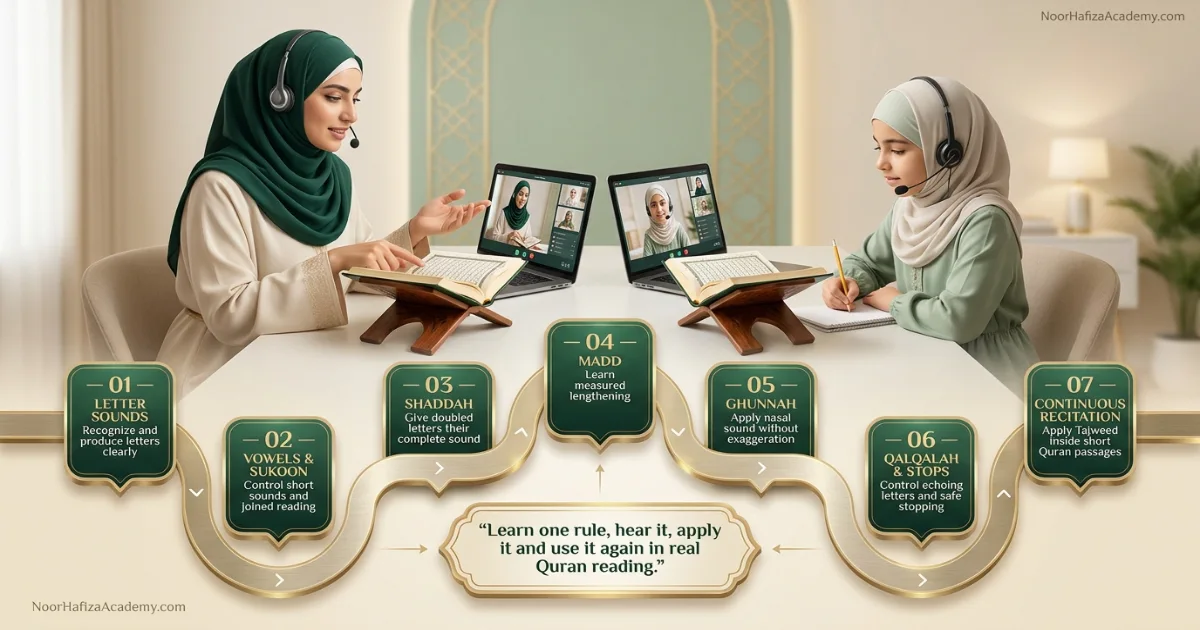
Qaida-to-Quran readiness checklist for parents and teachers
Use the checklist as a conversation guide rather than a pass-or-fail score. A child may be strong in six areas and still need targeted work in one foundation that affects many words. The teacher should identify which weakness blocks Quran reading and which weakness can continue improving during direct Quran practice.
| Skill | Ready signal | Wait or review signal | Next action |
|---|---|---|---|
| Letter recognition | Identifies letters in mixed order and joined positions. | Depends on alphabet order or confuses shapes repeatedly. | Use mixed-letter drills and joined-form review. |
| Short vowels | Reads each short vowel briefly and consistently. | Adds extra sounds or stretches every vowel. | Contrast short and long examples orally and visually. |
| Sukoon | Joins the sakin letter without adding a vowel. | Reads sukoon like a normal vowelled letter. | Practice two- and three-part combinations slowly. |
| Shaddah | Produces the doubled consonant pattern with control. | Ignores the mark or treats it as a single sound. | Use listen-repeat-apply practice with new words. |
| Basic madd | Distinguishes basic long sounds from short vowels. | Length varies randomly or every sound is stretched. | Use measured teacher modeling and paired examples. |
| Blending | Connects unfamiliar combinations with limited prompting. | Stops after every letter or guesses the whole word. | Return to controlled blending before long lines. |
| Independence | Attempts before hearing the teacher. | Waits for a model and only repeats. | Increase thinking time and reduce immediate prompting. |
| Correction transfer | Uses the corrected pattern in another example. | Repeats one word correctly but loses the rule immediately. | Use spaced retrieval and a second transfer example. |
Signs the child may need more Qaida or bridge work
Needing more foundation work is not failure. A short targeted review can prevent months of frustration later. The important point is to name the exact skill rather than tell the child that they are “bad at reading.”
Page memory is replacing decoding
The child reads familiar pages smoothly but cannot handle the same signs when their order changes.
The teacher begins every word
The child waits for the first sound and follows by imitation instead of examining the written pattern independently.
Joined forms cause repeated confusion
Letters known in isolation are not recognized after they connect to neighboring letters.
Vowels are added or removed
The child inserts familiar sounds, ignores visible signs, or changes the ending according to expectation.
Sukoon and shaddah remain unstable
These marks appear frequently enough that weakness can interrupt nearly every Quran line.
Correction does not survive the next word
The child can copy the model once but cannot identify the same pattern in another example.
Long portions cause guessing
The child becomes overwhelmed by a full line and begins rushing instead of using the reading method.
The lesson produces fear of attempting
Constant interruption or pressure may make the child wait for help even when the foundation is partly available.
Why some children need bridge lessons instead of a full restart
The choice is not always “finish Qaida” or “start the Quran.” Many children benefit from a transition period that uses both. The teacher chooses one weak Qaida rule, reviews it briefly, and then finds the same pattern inside a selected Quran word. This gives the child a reason for the rule and builds confidence without pretending the weakness has disappeared.
Bridge lessons are especially useful after a long break, a teacher change, inconsistent previous instruction, or a Qaida course completed mainly through repetition. They are also helpful when the child can read simple words but becomes overloaded by a full Quran line. The teacher can reduce the portion to two words, one phrase, or part of a verse while keeping the Mushaf visible and respected.
Review the weak pattern
Use a short Qaida exercise focused only on the letter, sign, or blending issue that blocks reading.
Find it in Quran text
Show the same pattern inside one or two selected Quran words so the child sees the practical connection.
Return and retest
After a short gap, present another example and check whether the child can apply the skill without prompting.
How the first weeks of Quran reading should progress
Starting the Quran does not mean the child should immediately read a full page. The first month should protect the foundation while gradually increasing authentic reading. Portion size depends on age, confidence, lesson frequency, and accuracy.
Selected words and short phrases
Begin with Quran words containing familiar signs. Let the child identify what is known before introducing any new detail.
Partial lines with controlled correction
Read a small portion, correct the highest-value mistake, and allow a complete retry before moving forward.
Mixed Qaida review when necessary
Return to a targeted exercise only when a recurring rule blocks progress; avoid restarting the entire book without evidence.
Longer continuous reading
Increase from words to phrases and lines after the child shows stable recognition and less teacher dependence.
Stopping and restarting
Introduce practical pause points gradually so the child learns that Quran reading includes how to stop and begin, not only how to decode letters.
Recurring Tajweed application
Add rules through words the child is already reading. Avoid turning every line into a long theory lecture.
Monthly progress review
Compare independence, accuracy, recurring mistakes, attention, revision, and the next milestone rather than counting pages alone.
Common parent mistakes during the Qaida-to-Quran transition
Parents usually want to encourage progress, but certain shortcuts can create pressure or hide the child’s real level. A calmer approach gives the teacher better evidence and helps the child remain willing to attempt.
Celebrating pages more than skills
Page completion feels concrete, but parents should also ask which signs are stable, which mistakes recur, and what the child can read independently.
Giving the answer too quickly
Immediate prompting prevents the child from developing a decoding process. Allow quiet thinking time before helping.
Comparing siblings
Children differ in age, attention, language exposure, memory, confidence, and lesson history. Comparison can make careful reading feel like failure.
Requesting speed before accuracy
Pressure to finish a line may encourage skipped signs and guessing. Fluency should grow from repeated accurate reading.
Practicing with a different method
Home support should match the teacher’s current correction and terminology. Conflicting instructions can confuse a young learner.
Restarting the entire Qaida without assessment
A full restart may be unnecessary when the child needs only a few targeted rules and transfer practice.
Does age determine when a child should start reading the Quran?
Age can affect lesson length, explanation style, attention, and the amount of repetition a child needs, but it does not create a universal transition age. One seven-year-old may decode independently after steady instruction, while an older child may need review after a long break. A younger learner may show strong recognition but need very small Quran portions because attention is still developing.
Keep portions very small
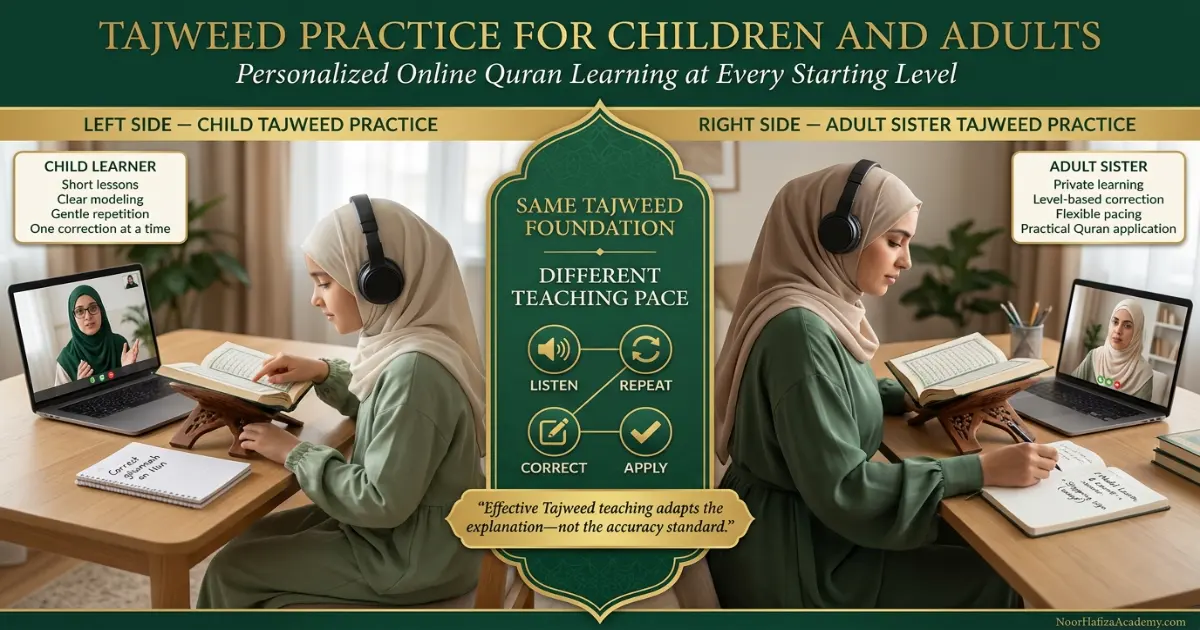
Use short lessons, clear modeling, repetition, and praise for careful attempts. Quran transition may begin with individual words rather than lines.
Build independent decoding
Encourage the child to inspect the word before receiving help and use specific home revision that lasts only a few minutes.
Explain the reason for review
Older children often respond better when the teacher identifies the exact weak skill instead of returning them to beginner material without explanation.
Assess before restarting
After a break, test retained skills first. Use targeted review when most foundations remain available.
A short home routine that supports the transition
Long practice is not automatically better. Ten focused minutes with the correct method can be more useful than repeating a full page inaccurately. Parents do not need to become the Quran teacher; their role is to protect consistency and follow the teacher’s current target.
Review one previously corrected pattern
Ask the child to read one example from memory, then look at the text and check whether the same reading method appears.
Practice a small assigned Quran portion
Use the exact words or line given by the teacher. Do not expand the assignment merely to increase page count.
Repeat after one specific correction
Let the child make a full second attempt so improvement becomes visible and confidence remains connected to real skill.
End before attention collapses
A short successful practice routine is easier to repeat tomorrow than a long session ending in frustration.
What a good teacher should do after the child begins Quran reading
The transition requires more than opening the Mushaf at the first page. The teacher should select an appropriate portion, listen to the child’s independent attempt, prioritize corrections, and keep a clear record of recurring patterns. A child who has just left Qaida should not be interrupted after every sound; too much correction can break the reading process and make the child wait passively.
Listen before modeling
The teacher gives enough time for a genuine attempt and uses the mistake as evidence of the current skill.
Correct with priority
The teacher focuses first on errors that change the reading or reveal an unstable foundation.
Test transfer
The teacher checks the same rule in another word so the lesson produces independent learning.
Should a child know all Tajweed rules before starting the Quran?
No. Noorani Qaida should support correct letter sounds, short and long sound control, sukoon, shaddah, and early reading discipline. These are important Tajweed foundations, but complete Tajweed understanding normally develops during continued Quran reading. The child needs enough accuracy to enter the text productively, not a complete theoretical syllabus before opening the Mushaf.
A good teacher introduces rules in context. When a recurring pattern appears, the teacher models it, names it when age-appropriate, and helps the child apply it. The goal is gradual consistency. Parents should not interpret every remaining Tajweed correction as proof that the child moved too early; the question is whether the child can decode and improve through guided Quran practice.
How Noor Hafiza Academy supports children moving from Qaida to Quran
Noor Hafiza Academy offers live online Quran learning for children, girls, women, sisters, and beginners with female Quran teachers. A child’s previous learning, current reading, age, language needs, time zone, and preferred schedule can be discussed before regular classes begin. A trial or level assessment can help identify whether the child should continue Noorani Qaida, use targeted bridge lessons, or begin direct Quran reading.
For a child beginning the Quran, lesson portions can be adjusted according to attention, confidence, and accuracy. Parents can ask how progress will be reported, which revision is expected at home, how missed classes are handled, and how communication remains parent-visible. Current teacher availability, schedules, lesson frequency, fees, materials, and enrollment terms should be confirmed directly with the academy.
A live assessment can test unfamiliar examples, selected Quran words, correction transfer, and the most suitable next step.
The clearest answer for parents
Move the child from Noorani Qaida into Quran reading when the foundation works beyond the memorized Qaida page. The child should recognize joined letters and common signs, make independent attempts, blend unfamiliar combinations, respond to correction, and apply the corrected pattern again. Slow reading is acceptable. Continuing mistakes are expected. Complete Tajweed mastery is not required.
Delay the transition when the child still relies mainly on imitation, page memory, guessing, or immediate prompting. In that case, identify the exact weak skill and use targeted Qaida or bridge lessons. The aim is not to keep the child away from the Quran; it is to help the child enter Quran reading with a method that can grow into accuracy, fluency, confidence, and lifelong independent recitation.
Moving a child from Noorani Qaida to Quran FAQs
Does finishing Noorani Qaida mean my child is ready for the Quran?
Can my child start Quran reading before finishing every Qaida page?
How fast should a child read before moving to the Quran?
What are the strongest signs that my child is ready?
What if my child finished Qaida but struggles with Quran words?
Should my child restart Noorani Qaida after a long break?
Does my child need to know all Tajweed rules first?
How long should bridge lessons last?
What should parents do during the transition?
Can I request a female teacher for my child?
Is your child ready to move from Noorani Qaida to the Quran?
Share the child’s age, previous Qaida experience, current reading ability, time zone, and preferred schedule. A live assessment can identify whether the next step should be continued Qaida, bridge lessons, or direct Quran reading.