
Free Trial Quran Class Checklist: What Parents Should Evaluate

A free trial Quran class is one of the most useful opportunities parents have before enrolling a child, but only when the trial is evaluated carefully. A pleasant conversation and a smiling child are encouraging, yet they do not show the full quality of the program. Parents should observe whether the teacher assesses the child’s real level, listens to independent reading, identifies important errors, explains corrections clearly, adjusts to age and attention, uses respectful communication, protects privacy, and proposes a realistic learning plan. This checklist helps families move beyond first impressions and decide whether the teacher, course, schedule, technology, and academy system are suitable for the child.
What should parents evaluate in a free trial Quran class?
Parents should evaluate six areas: the child’s comfort and participation, the teacher’s Quran accuracy and communication, the quality of the level assessment, the lesson structure and correction method, the academy’s safety and technology arrangements, and the clarity of the proposed learning plan. During the trial, the child should read or respond independently instead of only repeating after the teacher. The teacher should identify the learner’s current level, explain one or two important corrections, allow a complete retry, and show how future lessons would address the child’s needs. Afterward, parents should receive specific feedback about strengths, weaknesses, recommended course, lesson length, frequency, home practice, progress review, schedule, fees, and policies. A good trial provides evidence and direction—not pressure to enroll immediately.
A free trial Quran class should be more than a friendly introduction
Many parents enter a trial hoping to answer one broad question: “Is this a good teacher?” That question is important, but it is too general. A teacher may be kind yet unable to diagnose the child’s reading. Another may have strong recitation but communicate poorly with young learners. A child may appear quiet because she is shy, confused, tired, or unfamiliar with online classes. A useful trial separates these factors.
The trial should give both sides information. The teacher needs to understand the child’s age, current course, previous Quran learning, reading level, memorization, recurring difficulties, attention, school schedule, and family goal. The parent needs to see how the teacher listens, explains, corrects, encourages, manages time, and responds when the child makes a mistake.
It is a structured observation period used to understand level, teacher fit, lesson design, technology, communication, and whether the proposed program is realistic for the family.
Parents should also avoid judging the trial only by how much content was completed. A careful assessment may cover fewer lines because the teacher is listening closely. A fast lesson may appear impressive while missing important pronunciation, decoding, or Hifz weaknesses. The goal is not to finish a page; it is to understand how future learning should begin.
How parents should prepare for a free Quran trial class
Preparation reduces confusion and allows the teacher to evaluate the learner rather than spend most of the session solving avoidable problems. Parents should share accurate information before class and prepare a calm learning space.
Share the learner profile
Provide age, current Quran level, previous books or courses, memorized Surahs, first language, learning concerns, and main goal.
Choose a realistic time
Avoid a slot when the child is hungry, exhausted after school, rushing to another activity, or close to bedtime.
Prepare the device
Test internet, microphone, camera, charging, headphones, and the lesson link before the teacher is waiting.
Prepare the material
Keep the child’s Qaida, Mushaf, Hifz portion, notebook, pencil, and previous teacher notes available.
Reduce distractions
Turn off television and notifications, move toys away, and tell siblings not to answer or interrupt.
Set the child’s expectation
Explain that the teacher will listen and help. Do not tell the child that she must impress the teacher or avoid every mistake.

What the child’s response can tell parents during the trial
Parents should observe the child without interpreting every quiet moment as failure or every smile as proof of a perfect match. A child may need several minutes to adjust to a new teacher. Look for patterns across the lesson.
Does the child feel safe enough to attempt?
Healthy comfort does not require constant smiling. The child should be able to answer, make mistakes, listen to correction, and try again without visible fear.
Does the child understand the teacher’s language?
Instructions should match age and language level. Repeated blank responses may show confusion rather than poor motivation.
Is the child doing the learning work?
The learner should read, identify, recall, or explain. A trial in which the teacher speaks almost continuously gives weak evidence.
How long does active focus last?
Observe when attention begins to fall. This helps determine lesson length, activity changes, and whether the selected time is suitable.
Can the child accept a correction and retry?
The teacher should create enough emotional safety for the child to attempt the sound or passage again instead of shutting down.
How does the child describe the lesson afterward?
Ask what felt easy, hard, helpful, or confusing. Avoid asking only, “Did you like the teacher?”
How to evaluate a Quran teacher during a free trial
The teacher’s own recitation matters, but parents also need to evaluate teaching skill. Strong teaching is visible in the way the teacher gathers evidence, prioritizes errors, gives explanations, adapts to the learner, and checks whether a correction was understood.
The teacher begins with an independent attempt
She allows the child to read or recite before supplying the answer, so the assessment reflects the learner’s real skill.
The teacher identifies the cause of difficulty
She distinguishes letter recognition, joining, Makharij, vowel timing, fluency, memory, attention, and prompt dependence instead of saying only “needs improvement.”
The teacher chooses the most important correction
She does not overwhelm a beginner by interrupting for every small issue while ignoring the main reading foundation.
The correction is clear and age appropriate
A child receives a simple model or physical cue; an older learner may receive a more detailed explanation when useful.
The child receives a complete second attempt
The teacher does not speak over the learner or accept repetition without checking whether the child can reproduce the correction alone.
The skill is tested in another example
A fresh word, line, or starting point shows whether the learner understood the correction or only copied one example.

What a Quran trial assessment should examine
The assessment should match the course. A complete beginner does not need to be tested like an advanced Tajweed learner. A memorization student needs different evidence from a child beginning Noorani Qaida.
| Learner type | What the teacher should check | Useful evidence | Weak trial sign |
|---|---|---|---|
| Complete beginner | Letter recognition, direction, matching, short vowels, and ability to follow instruction | A few known and unknown letters or sounds | Assuming the first Qaida page without checking prior knowledge |
| Qaida learner | Joined forms, vowels, sukoon, shaddah, madd foundation, and blending | Familiar and unfamiliar lines | Judging only by the last page completed |
| Quran reader | Accuracy, decoding, phrase flow, stopping, repeated errors, and independence | One familiar and one unfamiliar passage | Teacher models every line before the child reads |
| Tajweed student | Makharij, Sifat, short and long sounds, ghunnah, qalqalah, and rule application | Connected recitation plus target words | Testing rule names without listening to application |
| Hifz student | New memorization, recent revision, older revision, joins, prompts, and random starts | Sabaq, sabqi, and manzil samples | Testing only the newest memorized lines |
| Islamic Studies learner | Age, prior knowledge, comprehension, discussion, and practical application | Short questions and age-appropriate conversation | A long one-way lecture with no learner response |
What a well-structured free Quran trial should include
The exact length may vary, but a useful trial usually contains a clear sequence. Parents should understand what each part is doing.
Welcome and learner history
The teacher confirms age, previous learning, current material, goals, and any concerns without using most of the trial for general conversation.
Independent sample
The child reads, identifies, recites, or answers before the teacher gives a model. This creates a reliable starting point.
Focused teaching sample
The teacher selects one priority, explains it, models it, and lets the learner retry.
Transfer check
The child applies the same skill to another word, line, passage, or memorization point.
Age-appropriate engagement
The teacher varies the task or gives a brief reset when needed without turning the lesson into entertainment unrelated to Quran learning.
Parent feedback
The teacher explains the current level, strengths, first priority, recommended course, and realistic next step.

How should a teacher correct a child during the trial?
Correction should be accurate, specific, calm, and proportionate. A teacher should not ignore serious reading errors to keep the child happy, but she should also avoid making the trial feel like a list of failures. The child needs enough success to show learning potential.
- The teacher identifies the exact issue instead of saying only “wrong.”
- She models the sound, word, or passage clearly and at a usable speed.
- She gives the learner thinking time before supplying the answer.
- She prioritizes letter identity, added sounds, missed shaddah, unstable vowels, or weak recall before minor refinements.
- She allows a full retry without speaking at the same time.
- She recognizes genuine improvement specifically.
- She avoids sarcasm, comparison, shame, fear, or exaggerated praise.
- She adjusts the explanation when the first method does not work.
“This letter needs a different tongue position. Listen once, watch the difference, and then try the complete word.” It gives the child a reason, a model, and an independent retry.
How to judge whether the Quran teacher is a good fit for the child
Teacher fit does not mean the child never finds the lesson difficult. A good fit means the teacher can communicate clearly, maintain respectful standards, respond to the child’s age and confidence, and help the learner make progress.
Communication fit
The child understands the teacher’s vocabulary, tone, pace, and instructions without the parent translating every sentence.
Age fit
The teacher uses lesson segments, explanations, and expectations suitable for the child’s attention and maturity.
Course fit
The teacher’s experience matches the need: Qaida, Quran reading, Tajweed, Hifz, revision, or Islamic Studies.
Personality fit
The child can respond to the teacher’s level of warmth, firmness, energy, and structure without fear or constant negotiation.
Learning fit
The teacher can adjust explanations, repetition, visual cues, listening, and independent practice according to the learner.
Family fit
The schedule, lesson frequency, parent communication, policies, and home-practice expectations are realistic for the household.
What parents should check about online Quran class safety
Safety and privacy should be discussed before enrollment, not assumed from a website or teacher profile. Parents should know who teaches, how the child joins, who can communicate with the learner, whether classes are recorded, and how concerns are handled.
Online safety checklist
- Confirm the teacher’s identity and the academy’s teacher-selection process.
- Ask whether a parent can remain nearby or observe a child’s trial.
- Use parent-visible contact channels for scheduling and feedback.
- Confirm whether lessons are recorded and how any recordings are stored or used.
- Ask who has access to the class link, account, and child’s information.
- Keep younger children in an appropriate shared family space.
- Confirm the complaint, teacher-change, and safeguarding process.
- Review camera, microphone, messaging, and privacy expectations.
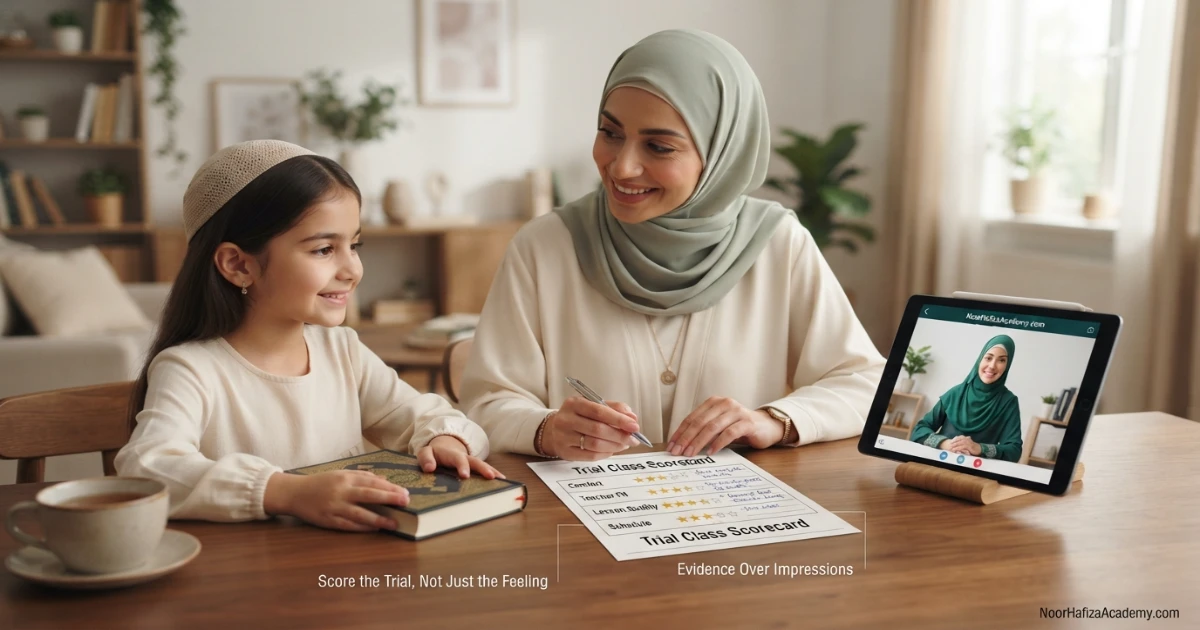
Use the trial to test the online learning setup
A qualified teacher cannot correct what she cannot hear. The trial should reveal whether the family’s technology and learning space are suitable.
| Area | Good evidence | Problem sign | Possible adjustment |
|---|---|---|---|
| Internet | Audio and video remain stable through recitation | Repeated freezing, delay, or dropped calls | Move closer to router, reduce other use, or improve connection |
| Microphone | Teacher hears letters, breath, and timing clearly | Distortion, echo, or very low volume | Use headphones or an external microphone |
| Screen | Child can see teacher, page, and shared material | Phone screen is too small or child leans constantly | Use a tablet, laptop, or suitable stand |
| Camera | Stable angle supports attention and mouth-position explanation | Device moves or camera shows only part of the child | Use a stable stand and fixed desk position |
| Environment | Quiet, respectful, well-lit, and materials ready | Television, siblings, visitors, or missing books interrupt | Create a protected class routine |
What parents should and should not do during the trial
Parents should help the trial run smoothly without hiding the child’s real level. The teacher needs to see what the learner can do independently.
Parents should
- Prepare the device and materials.
- Share accurate learning history.
- Remain nearby when appropriate.
- Observe patterns quietly.
- Note questions for the feedback period.
- Help with technical problems.
Parents should avoid
- Answering before the child responds.
- Whispering every next word.
- Correcting over the teacher.
- Threatening consequences during class.
- Comparing the child with siblings.
- Explaining away every mistake.
What useful parent feedback should include
A trial becomes valuable when the teacher or academy can explain what was observed. Generic statements such as “She did well” or “She needs Tajweed” are not enough.
Where should the learner begin?
The feedback should identify the correct Qaida stage, reading level, Tajweed priority, Hifz revision need, or Islamic Studies level.
What can the child already do?
Useful strengths may include letter recognition, memorized Surahs, listening, confidence, blending, or ability to accept correction.
What should be corrected first?
The teacher should name a specific foundation or recurring issue instead of listing every observed weakness.
Which program is suitable?
The recommendation should explain whether the child needs Qaida, reading, Tajweed, Hifz, revision, Islamic Studies, or a combination.
What lesson length and frequency fit?
The recommendation should reflect age, attention, goal, school schedule, and realistic home practice.
How will improvement be measured?
Ask when parents will receive the next review and what evidence will show that the plan is working.
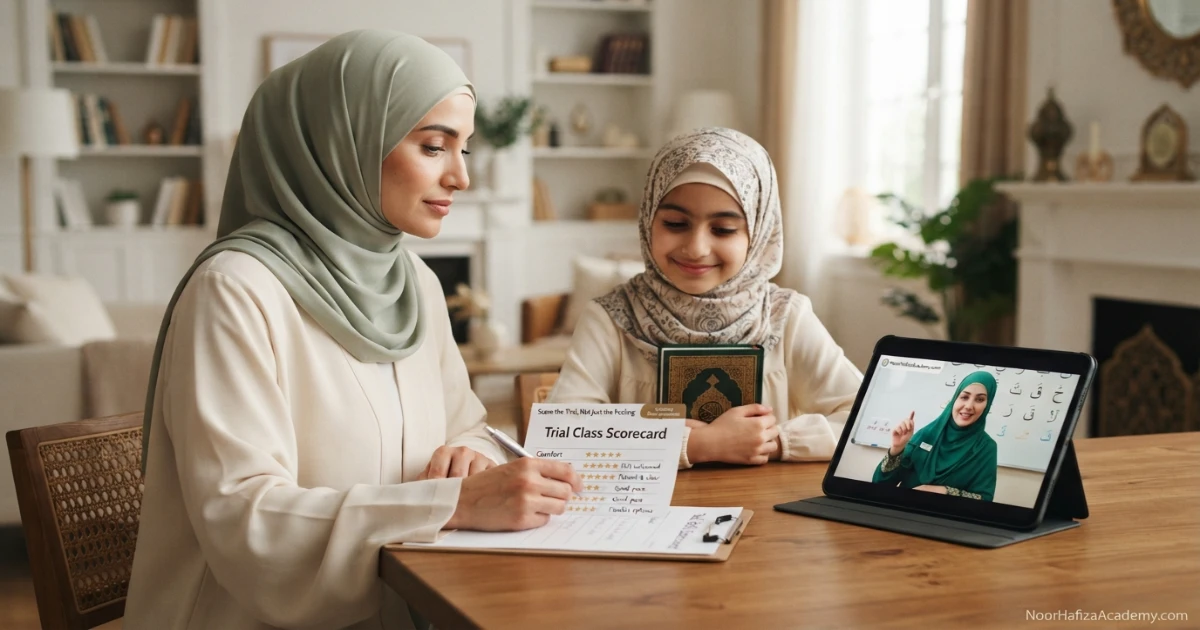
A simple free trial Quran class scorecard for parents
Use a five-point score only after writing a short note. The number is less important than the evidence behind it.
| Evaluation area | Score 1–5 | Evidence to record | Decision question |
|---|---|---|---|
| Child comfort | ___ | Did the child attempt, ask, listen, and retry? | Can confidence grow with this teacher? |
| Teacher communication | ___ | Were instructions clear and age appropriate? | Can the child understand without constant translation? |
| Quran accuracy | ___ | Did the teacher model and identify errors accurately? | Is correction trustworthy and useful? |
| Assessment quality | ___ | Was the child tested independently at the right level? | Does the proposed starting point make sense? |
| Lesson structure | ___ | Was there assessment, teaching, retry, transfer, and feedback? | Will regular lessons use time productively? |
| Teacher fit | ___ | Did tone, pace, firmness, and warmth suit the child? | Is this a relationship the child can learn within? |
| Technology | ___ | Could both sides hear, see, and respond reliably? | Can the family sustain this setup? |
| Safety and communication | ___ | Were privacy, parent contact, and policies clear? | Does the family trust the system? |
| Learning plan | ___ | Was the level, course, schedule, practice, and review explained? | Is there a realistic path forward? |
Questions parents should ask after the free trial
Use these questions to turn the trial into a clear decision
- What level did you identify, and what evidence led to that placement?
- What is the child’s strongest current Quran skill?
- What is the first weakness that regular classes should address?
- Which course do you recommend, and why?
- How long should each lesson be for this child?
- How many classes per week are realistic for the goal?
- What home practice will be expected from the child and parent?
- How will you track Qaida, reading, Tajweed, or Hifz progress?
- When will the first parent progress review happen?
- What happens if the teacher and child are not a good match?
- What are the missed-class, rescheduling, holiday, and payment policies?
- How are parent communication, privacy, and child safety managed?
Warning signs during a free trial Quran class
No real level assessment
The teacher recommends a course without hearing the child read, recite, identify, or respond independently.
The teacher talks almost all the time
The child mainly watches or repeats, leaving little evidence of actual reading, memory, understanding, or independence.
Correction is vague or harsh
The teacher says “wrong” repeatedly, embarrasses the child, or cannot explain what should change.
Unrealistic promises
The family is promised fluency, Tajweed mastery, or major Hifz completion within a fixed period without a proper assessment.
Pressure to enroll immediately
The academy avoids questions, creates artificial urgency, or discourages the parent from reviewing the trial calmly.
Unclear teacher identity or policies
Parents cannot confirm who will teach, how communication works, or what safety and privacy procedures apply.
Oversized homework after one trial
The assignment does not match age, level, school schedule, or the amount of guidance the child received.
No measurable next step
The feedback remains general and provides no starting level, first priority, course plan, or review method.
How trial evaluation changes for younger children, school-age learners, and teens
| Age or stage | Parents should watch | Teacher should demonstrate | Common mistake |
|---|---|---|---|
| Ages 4–6 | Comfort, simple response, short attention, ability to imitate and identify | Very short tasks, clear modeling, praise, and gentle redirection | Expecting a long formal assessment |
| Ages 7–9 | Independent attempts, decoding, correction response, and task switching | Clear goals, varied short segments, and a complete retry | Parent supplying every answer |
| Ages 10–12 | Understanding, confidence, responsibility, and honest effort | Respectful feedback, measurable targets, and learner involvement | Using a childish tone or no accountability |
| Teens | Privacy comfort, motivation, current gaps, and ownership | Dignified communication, clear diagnosis, and collaborative goals | Discussing the learner as if absent |
What parents should look for in a Qaida, Tajweed, Hifz, or reading trial
Noorani Qaida trial
The teacher should assess more than the last completed page. She should check letter recognition, joined forms, short vowels, tanween, sukoon, shaddah, long-vowel foundations, and independent blending according to the child’s stage. A child may need to return to one missing foundation without restarting the entire book.
Quran reading trial
The teacher should hear familiar and unfamiliar text. Familiar Surahs may sound fluent because they are memorized. An unfamiliar line reveals decoding, stopping, phrase flow, and prompt dependence. The teacher should distinguish reading difficulty from Tajweed refinement.
Tajweed trial
The teacher should listen to connected recitation and identify a few priority issues, such as Makharij, vowel timing, ghunnah, qalqalah, heaviness, lightness, or stopping. She should show one correction method and test transfer rather than presenting a long rule lecture.
Hifz trial
A Hifz assessment should include new memorization, recent revision, and older revision where applicable. The teacher should note first-word prompts, verse joins, repeated substitutions, similar passages, random starts, and whether new memorization has exceeded revision strength.
Islamic Studies trial
The teacher should use age-appropriate questions, discussion, stories, or examples to assess understanding. Parents should observe whether the lesson encourages practical reflection rather than only memorizing isolated facts.
How parents should decide after the free Quran trial
Do not decide only from the child’s first yes or no. A child may reject a suitable teacher because the class interrupted play, or prefer a weak lesson because nothing challenging happened. Combine the child’s experience with objective evidence.
Write observations immediately
Record the child’s comfort, focus, independent reading, teacher communication, correction, technology, and feedback before details are forgotten.
Ask the child specific questions
Ask what felt helpful, difficult, confusing, or comfortable rather than requesting only a like-or-dislike verdict.
Review the proposed learning plan
Confirm that the level, course, lesson length, frequency, home practice, and progress review match the child and family.
Clarify policies before payment
Ask about fees, rescheduling, absences, teacher changes, holidays, privacy, parent communication, and cancellation.
Compare evidence, not sales language
When trying more than one program, compare the same criteria instead of choosing the most polished presentation.
Set an early review date
After enrollment, review the first four to eight weeks using attendance, accuracy, independence, retention, focus, and family stress.

Free online Quran trial classes with female Quran teachers
Noor Hafiza Academy offers live online Quran learning for children, girls, women, sisters, adults, and beginners with female Quran teachers. A trial or level discussion can help identify whether the learner needs Noorani Qaida, Quran reading, Tajweed, Hifz, revision, Islamic Studies, or a combined plan.
Families can share the learner’s age, current level, previous course, memorized Surahs, time zone, preferred schedule, learning concerns, and main goal. During a suitable trial, the teacher can listen to an independent sample, identify a priority, demonstrate the teaching approach, and discuss a realistic next step. Current teacher availability, trial length, programs, schedules, fees, privacy practices, policies, and enrollment terms should be confirmed directly.
Share accurate background information, prepare the learning setup, allow independent attempts, observe quietly, and ask for specific feedback before deciding.
FAQs about evaluating a free trial Quran class
What should happen in a free Quran trial class?
How long should a free Quran trial class be?
Should parents stay during the trial?
How can I tell whether the Quran teacher is qualified?
What if my child is shy during the trial?
Should a trial include Quran reading from an unfamiliar passage?
What should parents ask after the trial?
What are red flags in a Quran trial class?
Should I choose the teacher my child likes most?
Can I try more than one Quran teacher?
Does a free trial guarantee the same regular teacher?
How soon should parents review progress after enrollment?
Use a free trial to find the teacher, course, and schedule your child can grow with
Share the learner’s age, current Quran level, previous learning, memorized Surahs, city and time zone, preferred days, attention needs, and main goal. Noor Hafiza Academy can discuss a suitable trial with a female Quran teacher.