
Sifaat al-Huruf: Characteristics of Arabic Letters
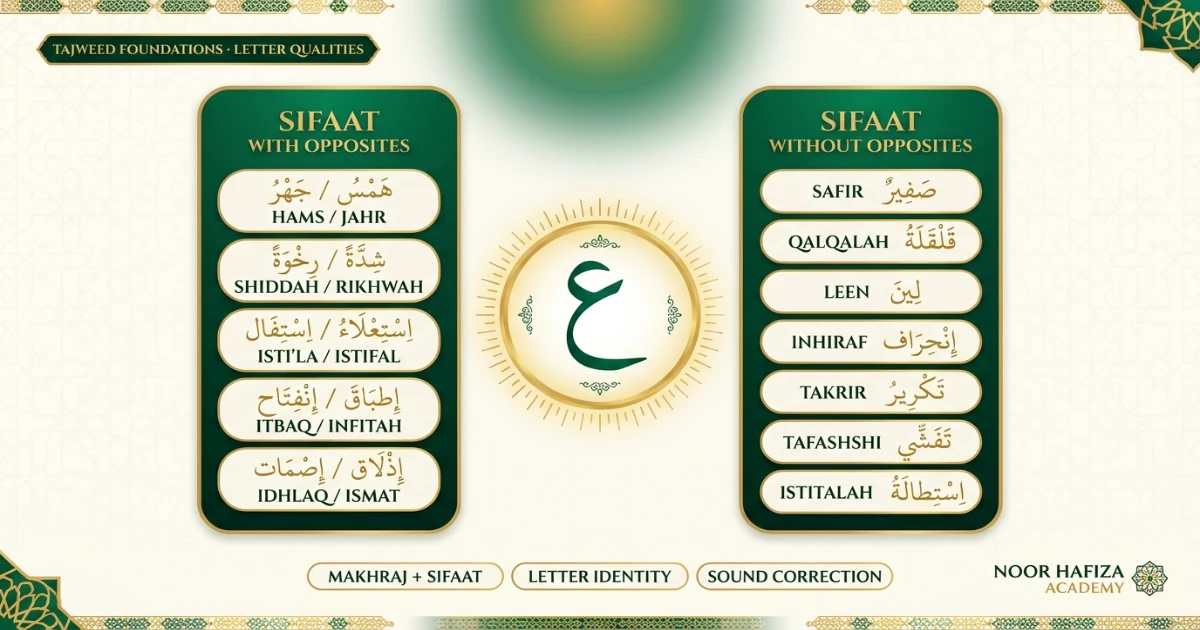
Sifaat al-Huruf are the characteristics or qualities of Arabic letters. If Makharij explain where a letter comes from, Sifaat explain how that letter behaves when it is pronounced. A learner may place the tongue in roughly the right location but still produce an inaccurate Quranic sound if the letter’s qualities are missing. Tajweed books commonly divide Sifaat into characteristics with opposites and characteristics without opposites. The exact way teachers count or group the qualities can vary slightly between curricula, especially when discussing intermediate qualities or additional applied characteristics, but the core letter groups are well established. This beginner guide focuses on the commonly taught permanent qualities, their Arabic names, letter groups, practical sound effect, and how to use them in Quran recitation without turning Tajweed into a list of definitions.
What are Sifaat al-Huruf in Tajweed?
Sifaat al-Huruf are the sound characteristics attached to Arabic letters. They describe qualities such as whether breath flows or is restrained, whether the voice is strong or soft, whether the back of the tongue rises, whether a sound is enclosed, whether a letter has an echo, whistle, spreading quality, or other distinctive behavior. Common Tajweed teaching divides them into qualities that have opposites—such as Hams/Jahr, Shiddah/Rikhwah, Isti’la/Istifal, Itbaq/Infitah, and Idhlaq/Ismat—and qualities without opposites, such as Safir, Qalqalah, Leen, Inhiraf, Takrir, Tafashshi, and Istitalah. Their purpose is practical: they help you pronounce each letter accurately and distinguish letters that may share or have nearby articulation points.
What is the difference between Makharij and Sifaat?
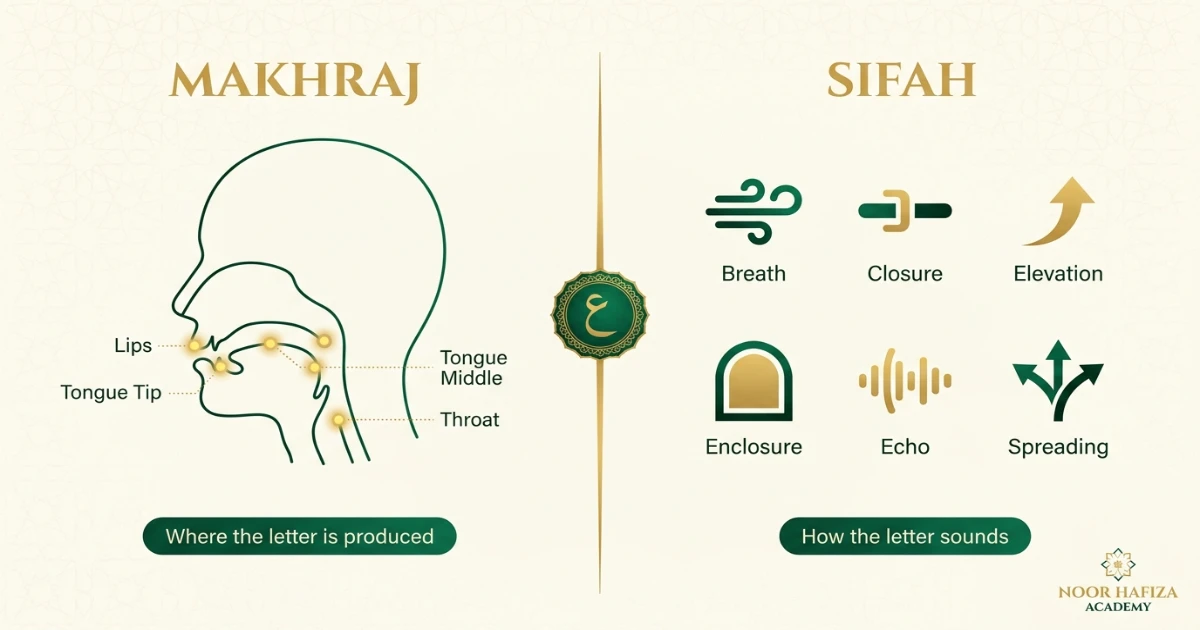
Makhraj is the articulation point—the physical place from which the letter emerges. Sifah is a characteristic that accompanies the letter as it is produced. Two letters may have nearby articulation points but remain distinct because their qualities are different.
For example, learning the tongue position alone is not enough for letters such as ص and س. Both need accurate articulation, but Sad carries heaviness while Seen is light. Likewise, Qalqalah changes the way a Sakin letter from قطب جد is released, without changing its Makhraj.
Correct Quran pronunciation needs both. If either one is weak, similar letters can begin to sound alike.
How are the characteristics of Arabic letters classified?
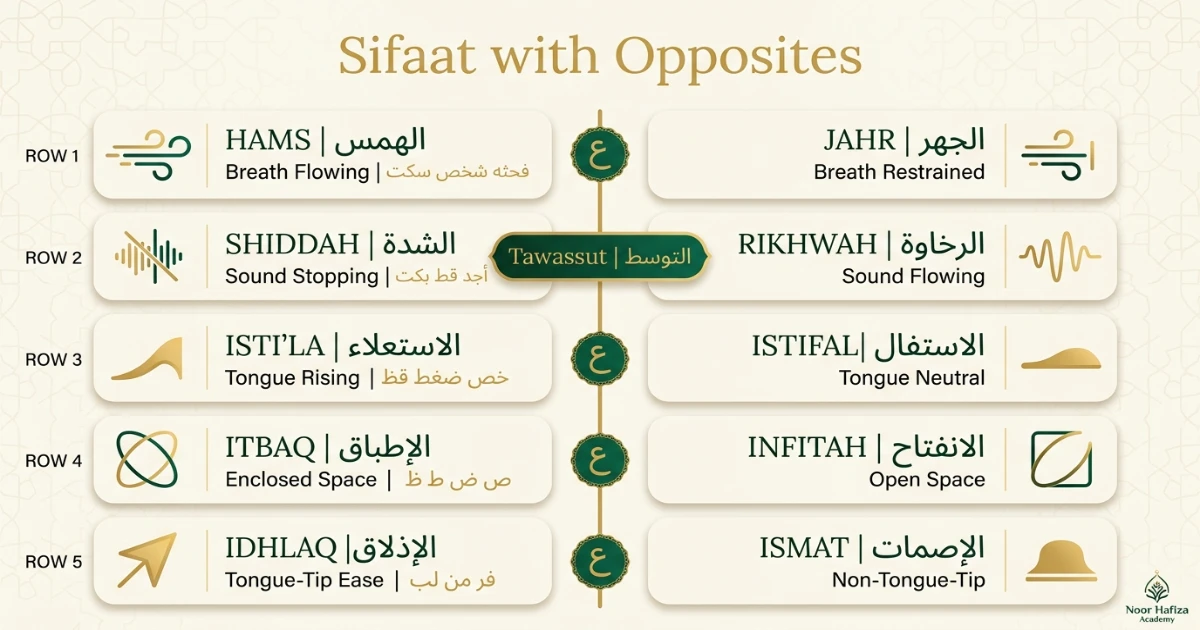
A common beginner framework separates permanent letter qualities into two categories. The first category contains qualities that are taught against an opposite quality. The second category contains qualities that do not have a direct opposite in the same classification.
Sifaat with opposites
These are learned in contrasting families: Hams/Jahr, Shiddah/Rikhwah with Tawassut between them, Isti’la/Istifal, Itbaq/Infitah, and Idhlaq/Ismat.
Sifaat without opposites
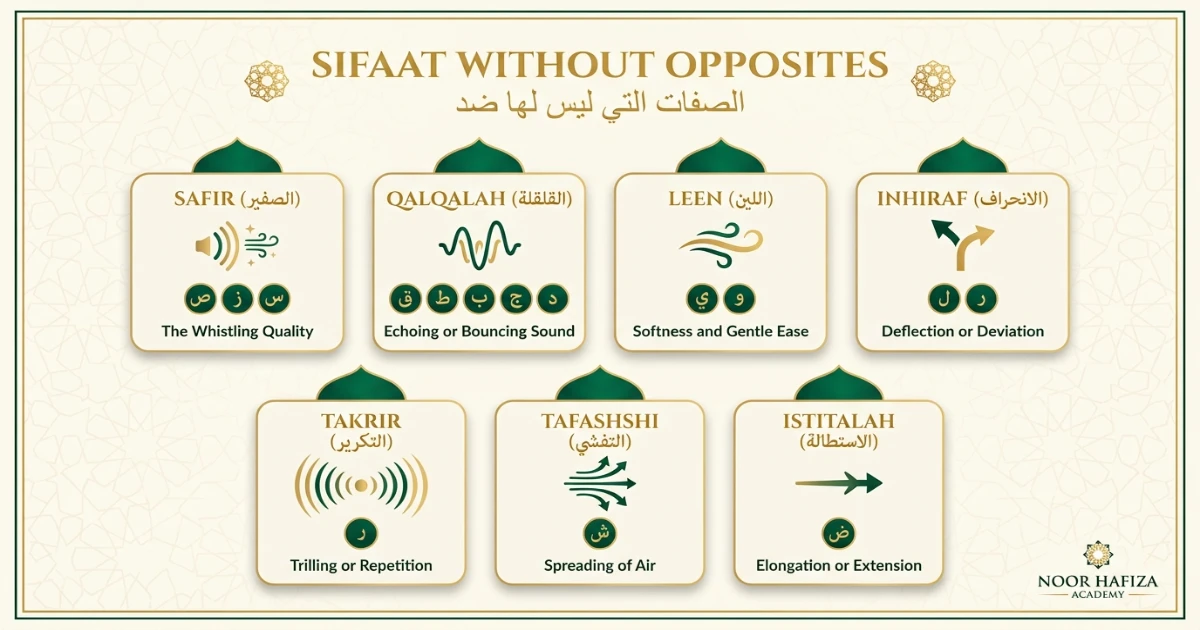
Commonly taught examples are Safir, Qalqalah, Leen, Inhiraf, Takrir, Tafashshi, and Istitalah.
Some Tajweed curricula count the total number of Sifaat differently or include additional applied characteristics such as Ghunnah in a separate discussion. That is a curriculum difference, not a reason to abandon the core letter groups. Follow the terminology used by your teacher while learning the same sound behavior.
Hams vs Jahr: does breath flow with the letter?
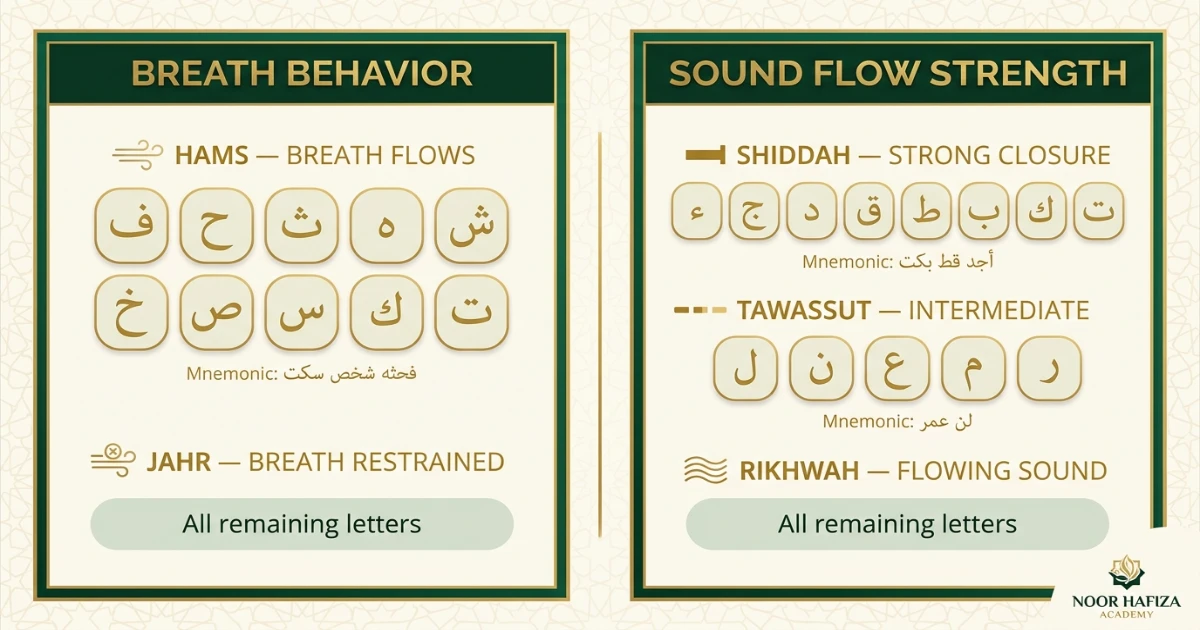
Hams is associated with the flow of breath during pronunciation because of relative weakness in reliance on the articulation point. The ten Hams letters are commonly memorized with:
The mnemonic is فحثه شخص سكت. Jahr is the opposite category and applies to the remaining letters; breath is more restrained because the articulation is more strongly engaged.
Hams does not mean “whisper the letter” and Jahr does not mean “shout.” The distinction is about airflow and the nature of the letter, not speaking volume.
How does the sound flow or stop?
Shiddah means strong closure: the sound is restrained at the articulation point. Its eight letters are commonly remembered as أجد قط بكت.
Tawassut is an intermediate state between full restraint and full flow. Its five letters are commonly remembered as لن عمر: ل ن ع م ر.
Rikhwah describes the flow of sound and applies to the letters not belonging to Shiddah or Tawassut. This three-way practical comparison is more useful than trying to memorize Rikhwah as one very long letter list.
Which letters raise the back of the tongue?
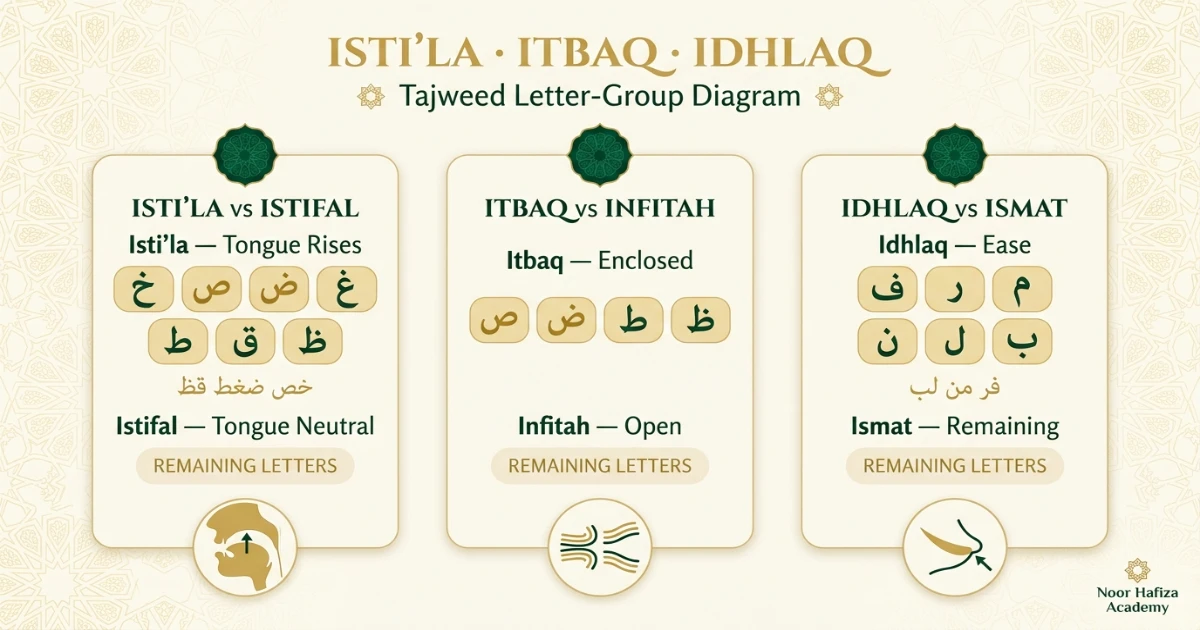
Isti’la means elevation. The back of the tongue rises, creating a heavy sound. The seven Isti’la letters are:
They are memorized as خص ضغط قظ. Istifal is the opposite quality and applies to the remaining letters, whose back of tongue does not rise in the Isti’la manner.
This pair connects directly to Tafkheem and Tarqeeq. The seven Isti’la letters remain heavy, although their degree of heaviness changes with the vowel.
Which letters have stronger enclosure?
Itbaq is a stronger enclosed quality in which the tongue and upper palate create a more compressed resonant space. Its four letters are:
These four are all already Isti’la letters, which is why they are especially strong in heaviness. Infitah is the opposite quality and applies to the rest of the alphabet.
What are Idhlaq and Ismat?
Idhlaq is traditionally associated with ease and quickness of articulation from the tongue tip or lips. Its six letters are memorized with فر من لب:
Ismat is the opposite category and applies to the other letters. For a beginner reciter, this pair is usually less immediately audible than Hams, Shiddah, Isti’la, or Qalqalah, but it is still part of the classical Sifaat framework.
Which Sifaat do not have direct opposites?
Whistling quality
Found in ص ز س. The air produces a noticeable whistle-like sound. It should be natural, not exaggerated.
Controlled bounce
Found in ق ط ب ج د when Sakin. The articulation releases with an echo-like bounce without adding a full vowel.
Ease and softness
Occurs with Sakin و or ي preceded by Fathah, producing a soft glide.
Deviation of sound
Associated with ل and ر, where the sound inclines from its path during articulation.
Repetition tendency
Associated with ر. The tongue tip naturally tends to repeat, but Tajweed requires controlling excessive rolling.
Spreading of air
Associated with ش. The sound spreads across the mouth during pronunciation.
Elongation along tongue side
Associated with ض, whose sound extends along the side of the tongue toward its articulation.
Can one Arabic letter have several Sifaat?
Yes. Every Arabic letter carries a combination of characteristics. A learner should not think that each letter belongs to only one Sifah. For example, ص is from Hams, Rikhwah, Isti’la, Itbaq, and also has Safir. ر is from Jahr, Tawassut, Istifal, Infitah, Idhlaq, and has the special qualities Inhiraf and Takrir.
This is why Sifaat study becomes powerful only when the qualities are combined around real letters. The combination explains why two letters that look or feel similar can still sound clearly different.
| Letter | Important qualities | Main beginner effect |
|---|---|---|
| ص | Hams, Rikhwah, Isti’la, Itbaq, Safir | Heavy, flowing, whistle-like Sad |
| ق | Jahr, Shiddah, Isti’la, Infitah, Qalqalah when Sakin | Strong deep Qaf; controlled bounce when Sakin |
| ر | Jahr, Tawassut, Istifal, Infitah, Idhlaq, Inhiraf, Takrir | Controlled Arabic Ra without over-rolling |
| ش | Hams, Rikhwah, Istifal, Infitah, Tafashshi | Light Sheen with spreading airflow |
Why should beginners study Sifaat al-Huruf?
Sifaat make pronunciation more precise. They are especially useful when a student can place the tongue correctly but the sound still feels wrong. A letter may need more breath, less breath, stronger closure, fuller resonance, a controlled bounce, or a spreading quality.
They also help diagnose substitutions. If Qaf keeps turning into Kaf, the student may need to revisit both Makhraj and Isti’la. If Sad sounds like Seen, the learner may be losing Isti’la and Itbaq. If Ra is over-rolled, Takrir is not being controlled.
Are Sifaat always present in the same way?
Classical Tajweed often distinguishes between necessary/permanent characteristics tied to the identity of a letter and contextual or applied qualities that become relevant in particular situations. The permanent Sifaat help define the letter itself. Other recitation effects—such as the degree of Tafkheem, Qalqalah when the letter is Sakin, or Ghunnah in specific rules—may become stronger or weaker according to context.
Different textbooks organize this terminology differently. For a beginner, the practical goal is to know which qualities belong to the letter and which effects depend on Sukoon, Shaddah, neighboring letters, or a specific Tajweed rule.
Common mistakes when learning Sifaat al-Huruf
Memorizing definitions without sound
A student can recite the mnemonic but cannot demonstrate the quality in a Quranic word.
Ignoring Makhraj
Sifaat cannot repair a letter produced from the wrong articulation point.
Exaggerating Hams
Hams is breath flow, not theatrical whispering.
Making Qalqalah into a vowel
The bounce should release the Sakin letter without inserting a full Fathah, Dammah, or Kasrah.
Making every heavy letter equally heavy
Isti’la remains, but the degree of heaviness changes with vowel and context.
Over-rolling Ra
Takrir describes a natural tendency that should be controlled, not multiplied.
Spreading heaviness to light letters
A heavy consonant should not automatically darken surrounding light consonants.
Trying to learn every classification at once
Start with audible qualities, then add the less obvious theoretical pairs.
What is the easiest order for learning Sifaat?
Know roughly where each letter comes from before fine-tuning its qualities.
Heavy/light contrast is highly audible and useful immediately.
Notice whether breath flows or is restrained.
Notice whether sound stops, sits between, or flows.
Qalqalah, Safir, Tafashshi, Takrir and others make individual letters easier to distinguish.
Use Sifaat as a correction tool rather than an abstract chart.
How to practise Sifaat al-Huruf at home
Choose one quality family at a time. Read the letter in isolation, then with Fathah, Dammah, Kasrah, and Sukoon where appropriate. After that, find the same letter in short Quran words. Recording yourself is useful because qualities such as Hams, Tafkheem, Safir, and excessive Takrir are easier to hear on playback.
| Practice block | Focus | Exercise | Goal |
|---|---|---|---|
| 1 | Hams/Jahr | Compare breathy vs restrained letters | Feel airflow difference |
| 2 | Shiddah/Rikhwah | Compare closed vs flowing sounds | Control sound release |
| 3 | Isti’la/Istifal | Compare ص/س, ط/ت, ق/ك | Protect heavy/light contrast |
| 4 | Unique qualities | Practise Safir, Qalqalah, Tafashshi, Takrir | Hear distinctive effects |
| 5 | Fresh Quran text | Mark one Sifah family in a short passage | Transfer theory to recitation |
Why teacher feedback is especially important for Sifaat
Sifaat are heard more than they are seen. A student may believe a letter is heavy enough, airy enough, or controlled enough while a teacher hears that Sad is becoming Seen, Qaf is becoming Kaf, or Ra is being rolled repeatedly.
A teacher can isolate the exact problem: Makhraj, airflow, sound strength, tongue elevation, or a special quality. This targeted correction is usually more efficient than repeating a word many times without knowing what part of the sound is wrong.
12-point Sifaat al-Huruf checklist
Use this while practising a small set of Arabic letters
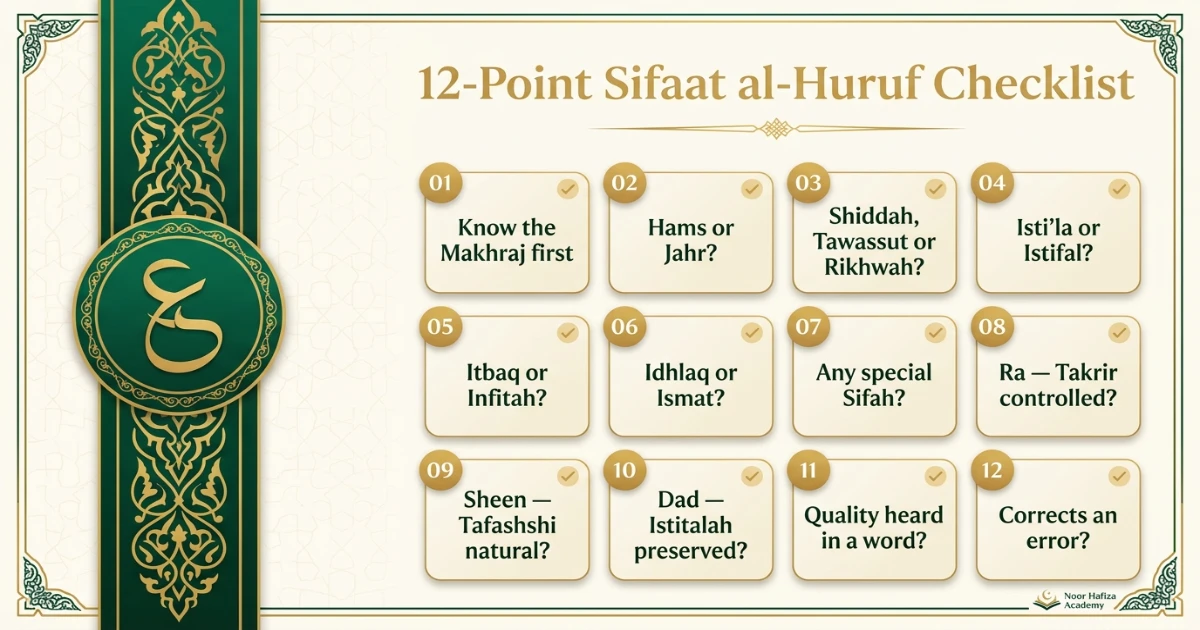
- Do I know the Makhraj before I focus on the Sifah?
- Is this letter from Hams or Jahr?
- Is it Shiddah, Tawassut, or Rikhwah?
- Is it Isti’la or Istifal?
- Is it Itbaq or Infitah?
- Is it from Idhlaq or Ismat?
- Does it have a special quality such as Qalqalah or Safir?
- If it is Ra, am I controlling Takrir?
- If it is Sheen, can I hear Tafashshi without exaggeration?
- If it is Dad, am I preserving Istitalah and the correct side-of-tongue Makhraj?
- Can I hear the quality inside a Quran word, not only in isolation?
- Can I use the Sifah to explain and correct a pronunciation error?
Learn Sifaat al-Huruf in online Tajweed lessons
Noor Hafiza Academy offers live online Quran learning for children, girls, women, adults, beginners, returning readers, teenagers, siblings, and homeschool families with female Quran teachers. Learners can ask about Noorani Qaida, Quran reading, Tajweed, Makharij, Sifaat, Hifz, and pronunciation correction according to their current level.
A Tajweed plan may include Makharij, Sifaat al-Huruf, Tafkheem and Tarqeeq, rules of Ra, Qalqalah, Ghunnah, Noon Sakinah and Tanween, Meem Sakinah, Madd, Waqf, and guided recitation. Current teacher qualifications, female-teacher availability, class length, trial arrangements, fees, schedules, privacy practices, safeguarding policies, and enrollment terms should be confirmed directly.
Share the learner’s age, Quran level, Tajweed background, main pronunciation difficulty, preferred schedule, and whether a female teacher is requested.
FAQs about Sifaat al-Huruf
What does Sifaat al-Huruf mean?
What is the difference between Makhraj and Sifah?
How many Sifaat are there in Tajweed?
What are the Hams letters?
What are the Shiddah letters?
What are the Tawassut letters?
What are the Isti’la letters?
What are the Itbaq letters?
What are the Qalqalah letters?
Which letters have Safir?
Which letters have Takrir, Tafashshi, and Istitalah?
How should beginners practise Sifaat?
Make every Quranic letter clearer by combining the right Makhraj with the right Sifaat
Share the learner’s age, Quran level, Tajweed background, main pronunciation difficulty, and preferred class schedule.