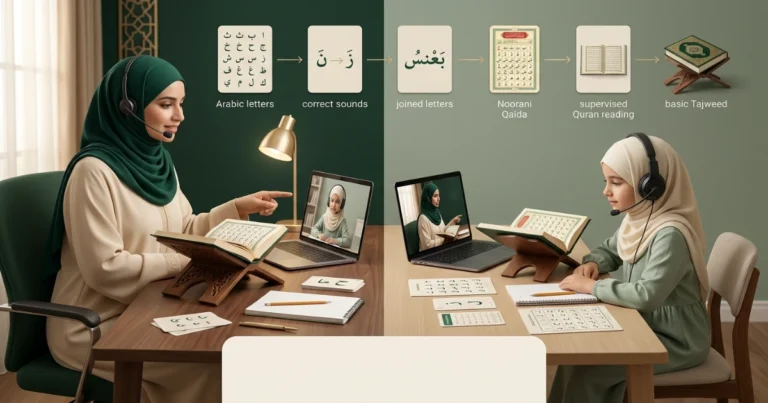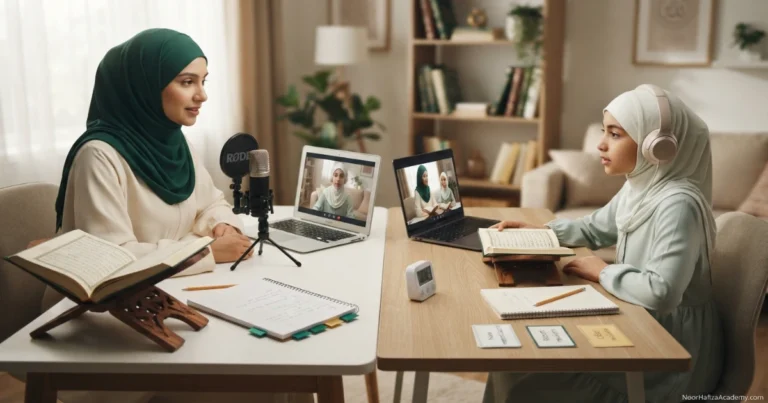
How to Choose an Online Quran Teacher for Your Child

Learning how to choose an online Quran teacher for your child requires more than selecting the first tutor with an open time slot. Parents should evaluate Quran accuracy, Tajweed knowledge, experience with children, correction style, patience, communication, safety, reliability, and the child’s response during a live trial. This guide gives you a practical system for comparing teachers and choosing with confidence.
How to choose an online Quran teacher for your child
To understand how to choose an online Quran teacher for your child, check six areas together: accurate Quran reading and Tajweed, experience teaching children at your child’s age and level, a calm and specific correction method, transparent safety and communication practices, reliable attendance and technology, and a positive teacher-child connection during a live trial. Do not decide from qualifications, price, nationality, or availability alone. A suitable teacher should listen to the child independently, identify the real starting level, explain one clear goal, correct without shaming, give a manageable revision task, and tell parents what improved and what needs work. The strongest choice is the teacher who combines sound Quran knowledge with the ability to help this particular child learn consistently and confidently.
Why choosing the right Quran teacher matters so much
When learning how to choose an online Quran teacher, remember that a child’s Quran teacher influences more than page completion. The teacher shapes how the learner hears Arabic sounds, responds to correction, approaches revision, and feels about returning to the Quran after a difficult lesson. Accurate instruction can strengthen foundations for years. Unclear modeling, repeated impatience, or an unsuitable pace can also create habits that become harder to repair later.
Online learning makes teacher choice especially important because the class is often one-to-one. The teacher’s attention is not divided among a large group, which creates a valuable opportunity for individual correction. It also means the teacher’s communication style, energy, organization, and reliability directly shape almost every lesson. A technically qualified tutor who cannot explain to children may produce less progress than a teacher who combines sound recitation with patient, structured instruction.
Parents sometimes choose by one visible factor: the teacher has a certificate, speaks a preferred language, charges an affordable fee, or offers the perfect time. Each factor can matter, but none proves suitability alone. The right decision comes from looking at the whole learning relationship: what the teacher knows, how she teaches, how your child responds, how safety is protected, and whether progress becomes visible over time.
A teacher may be knowledgeable and sincere yet still be a poor match for a particular age, personality, learning goal, or schedule. The purpose of a trial is not to label a teacher as “good” or “bad.” It is to decide whether her method and your child’s needs work well together.
How to choose an online Quran teacher: 12 qualities to check
The following qualities create a balanced evaluation. No teacher needs to perform theatrically or make every lesson entertaining, but a suitable teacher should demonstrate dependable Quran knowledge, teaching judgment, emotional steadiness, and professional communication.
Accurate Quran recitation
The teacher should model letters, vowels, articulation points, elongation, stops, and connected reading accurately enough for the child to imitate with confidence.
Relevant Tajweed knowledge
She should understand the rules appropriate to the student’s course and explain them practically rather than giving theory the child cannot apply.
Experience with children
Teaching a young beginner, an anxious reader, a teenager, and a Hifz student requires different language, pacing, and expectations.
Clear explanations
Instructions should be short, concrete, and easy to act on: listen, point, repeat, read this line, slow this sound, or try without help.
Specific correction
The teacher identifies the exact problem, models the better version, allows another attempt, and checks whether the correction transfers.
Patient repetition
Children often need to hear and repeat the same skill many times. Patience should remain calm without allowing the lesson to lose structure.
Age-aware lesson pacing
The teacher adjusts lesson length, task size, prompting, and activity changes to the child’s attention and current foundation.
Positive authority
A child-friendly teacher is warm but not passive. She sets expectations, protects learning time, and encourages effort without humiliation.
Active listening
She listens for patterns in the child’s mistakes rather than interrupting every word randomly or moving on without understanding the weakness.
Professional boundaries
Communication stays focused on lessons, scheduling, progress, and approved academy channels, with parents informed appropriately.
Reliable attendance
Regular punctual lessons help children build trust and routine. Occasional changes should be communicated clearly rather than becoming a pattern.
Useful parent feedback
Parents should know the current skill, recurring challenge, exact revision task, and next realistic milestone without needing to guess.
What qualifications should an online Quran teacher have?
Qualifications matter because a teacher must have a reliable foundation in the subject she teaches. Depending on the course, parents may ask about Quran reading proficiency, Tajweed study, memorization, teaching experience, language ability, and any formal training or certification relevant to the academy’s program. For Hifz, the teacher should understand how to balance new memorization with recent and older revision. For Noorani Qaida, she should be able to model foundational sounds clearly and prevent the child from memorizing letter order without true recognition.
However, a qualification is evidence of study—not automatic evidence of child-teaching skill. A teacher can know advanced Tajweed terminology but explain it in a way that overwhelms a seven-year-old. Another may have beautiful recitation but interrupt so frequently that the child cannot complete a phrase. Parents should therefore verify knowledge and observe application. Ask how the teacher assesses beginners, what she does when a child repeats the same error, and how she decides whether to move forward or review.
Knowledge check
Can the teacher model the child’s lesson accurately and explain the relevant rule or reading skill?
Demonstration check
Does she turn knowledge into a sound, example, gesture, or instruction the child can follow?
Correction check
Can she identify the exact mistake and guide an improved attempt without vague criticism?
Transfer check
Does she test whether the child can apply the correction in another word, line, or passage?
Level check
Does the teacher begin from demonstrated ability rather than assuming a level from age or a completed book?
Communication check
Can she explain the current goal and home revision clearly to both child and parent?

Choose a teacher for your child’s age, level, and goal
A teacher who works well with teenagers may not naturally suit a five-year-old beginner. A teacher skilled in early Qaida may not be the strongest choice for advanced Tajweed or intensive Hifz. Before comparing personalities, define what the child actually needs. Share age, previous learning, independent reading ability, confidence, attention span, preferred language, time zone, and the main goal with the academy.
Warm, brief, highly guided
Look for simple instructions, visual pointing, patient sound imitation, short tasks, and a teacher comfortable working with parent support nearby.
Foundation with structure
The teacher should build Qaida or early reading systematically while keeping correction clear, manageable, and encouraging.
Growing independence
Look for accurate correction, respectful accountability, clearer milestones, and gradual responsibility for preparation and revision.
Respect and purposeful goals
Teenagers often respond best to privacy, mature communication, meaningful targets, and a teacher who avoids childish language or comparison.
Level matching matters just as much as age. A young child may already read fluently; an older child may need to rebuild letter recognition. The teacher should respond to demonstrated skill rather than rushing an older beginner or holding back a younger capable learner. Read our detailed guide to the best age to start Quran classes for a fuller readiness framework.
How to evaluate an online Quran teacher during a free trial class
A live trial is central to how to choose an online Quran teacher because it shows what a profile, certificate list, or recorded introduction cannot. The goal is not to demand perfect chemistry in twenty minutes. It is to observe the teacher’s normal process: how she greets the child, checks the level, explains, listens, corrects, manages hesitation, and communicates the next step.
Watch how she builds initial comfort
The teacher should greet the child respectfully, use the learner’s name, confirm the material, and create a calm start without spending the entire lesson on casual conversation.
Notice whether she assesses independently
A useful trial allows the child to read, identify, or repeat without constant parental answers. The teacher needs genuine evidence before recommending a level.
Listen to the teacher’s own recitation
Her modeling should be clear, measured, and suitable for imitation. She should not rush sounds or rely only on verbal descriptions.
Observe one correction cycle
Look for a specific sequence: identify the mistake, demonstrate the correct version, ask the child to repeat, and check again with less prompting.
Assess the child’s emotional response
Does the child remain willing to try? A little nervousness is normal, but repeated shutdown, embarrassment, or confusion deserves attention.
Ask for the teacher’s recommendation
The teacher should explain the starting course, first priority, possible lesson length, revision expectation, and why that plan suits the observed level.
Ten questions to ask after the trial
- What did you identify as my child’s strongest current skill?
- Which mistake or foundation needs the most attention first?
- Which course and starting point do you recommend, and why?
- How will you correct pronunciation without overwhelming the child?
- What lesson length and weekly frequency seem realistic?
- What revision should happen between lessons?
- How will progress be recorded or communicated?
- What happens when the child is distracted, shy, or repeatedly stuck?
- Which platform and communication channel will be used?
- When should the family review whether the teacher match is working?

What does respectful and effective Quran correction look like?
Correction is central to Quran learning. A teacher who never corrects may protect short-term comfort while allowing errors to become habits. A teacher who corrects harshly or interrupts every second may damage concentration and confidence. The right approach is accurate, prioritized, and respectful.
Hear the whole attempt
When appropriate, the teacher allows the child to complete a sound, word, or phrase before responding. This reveals the pattern rather than only one isolated slip.
Name one clear issue
The teacher focuses on the most useful correction instead of listing every weakness at once. A child should know exactly what to change.
Model the improved version
The learner needs a sound to imitate, not only the words “again” or “wrong.” Modeling should be slow enough to hear clearly.
Allow another attempt
The child repeats while the correction is fresh. The teacher acknowledges improvement and guides another try when necessary.
Reduce the prompt
The teacher checks whether the student can produce the improved reading without copying every part directly.
Revisit the pattern later
A real correction is retained and applied. The teacher listens for the same issue in another example or the next lesson.
How to check whether an online Quran teacher is safe and professional
Safety should not be treated as a vague feeling. Parents need a transparent system: the teacher is connected through an identifiable academy or verified route, lesson times are known, communication channels are approved, and younger children learn in a supervised environment. Families should know whom to contact when schedules change or concerns arise.
Parents should know who teaches the child, when lessons occur, which platform is used, what the current target is, and how to contact the academy. Communication should remain focused on education, scheduling, revision, and progress.
Safety checks before enrollment
- Confirm the teacher through the academy or official contact route
- Use a parent-approved device and agreed video platform
- Keep the recurring schedule and contact method documented
- Supervise young children in a shared or accessible area
- Ask how feedback, complaints, and teacher changes are handled
- Protect passwords, private documents, and unnecessary personal details
Professional boundaries during classes
- Conversations remain relevant to learning and scheduling
- Parents are informed about changes in time or platform
- The teacher does not request unnecessary private information
- The child knows they can tell a parent about discomfort
- Recordings or screenshots follow the academy’s stated approach
- Questions and concerns receive a clear professional response
At Noor Hafiza Academy, children learn with female Quran teachers, and families can discuss the learner’s age, level, comfort, time zone, and goal before a regular schedule is confirmed. Parents can learn more about the academy’s teaching approach on the About Us page.
What should a Quran teacher communicate to parents?
Parents do not need a lengthy report after every class, but they should not be left with only “she did well.” Useful communication is specific enough to guide home support. The teacher should be able to identify the current learning objective, one observed improvement, one recurring difficulty, and one revision task.
Clarify level, goal, and routine
The teacher or academy should confirm the starting program, lesson material, class length, weekly timing, attendance process, and the first realistic milestone.
Share meaningful learning information
Parents should understand the skill being strengthened, repeated errors, revision expectations, and any issue affecting attention, confidence, or preparation.
Explain progress and the next step
After a reasonable period, the teacher should describe what has improved, what remains weak, whether the pace is suitable, and what milestone comes next.
Do schedule, punctuality, and technology matter when choosing?
Yes. An excellent teaching method cannot help consistently when classes are frequently missed, delayed, or disrupted by avoidable audio problems. Parents should distinguish occasional emergencies from a repeated pattern. A professional arrangement includes a clear recurring time, reasonable punctuality, a known rescheduling process, and communication when changes are necessary.
The teacher should also be comfortable with the selected video platform, able to position the camera and microphone clearly, and prepared with the correct material. Technology does not need to be elaborate. Clear sound is more important than decorative software. For pronunciation work, both teacher and student must hear each other without repeated echo, background television, or unstable device placement.
| Selection area | Strong evidence | Question to ask | Caution sign |
|---|---|---|---|
| Quran accuracy | Clear modeling and precise correction | How do you teach difficult sounds and Tajweed? | Vague or inconsistent pronunciation guidance |
| Child teaching | Short instructions and age-aware pacing | How do you teach a distracted or shy learner? | Adult-level explanations or constant scolding |
| Level placement | Live assessment before choosing a starting point | Why do you recommend this course and page? | Automatic placement based only on age |
| Correction | Specific model, repeat, and independent check | How do you prevent repeated mistakes? | Only saying “wrong” or never correcting |
| Safety | Approved platform and transparent parent contact | How are communication and concerns handled? | Unapproved private contact or unclear identity |
| Reliability | Regular timing and clear change policy | What happens if either side misses class? | Frequent unexplained changes or lateness |
| Progress | Specific feedback and measurable next steps | How will I know what is improving? | Only page counts or generic praise |
Warning signs that a Quran teacher may be the wrong fit
One awkward trial moment does not prove a teacher is unsuitable. New students can be shy, internet may briefly fail, and teacher-child rapport may need time. Look for repeated patterns rather than demanding perfection. The following signs deserve clarification or a change when they continue.
Harsh, shaming, or mocking correction
The child is embarrassed for mistakes, compared negatively, threatened, or made afraid to attempt reading.
No meaningful correction
The teacher allows recurring errors, praises everything, or moves through pages without listening carefully.
One pace for every child
The lesson ignores age, foundation, attention, school load, or retention and follows a fixed page target regardless of understanding.
Constant distraction
The teacher repeatedly checks another device, handles unrelated tasks, or appears disengaged during the child’s recitation.
Unclear professional boundaries
Communication moves into unapproved private channels or includes unnecessary personal requests without parent visibility.
Repeated unreliability
Classes regularly begin late, change without notice, or are missed without a clear process for communication and recovery.
No learning plan
Parents cannot identify the current goal, revision task, recurring challenge, or reason the child is moving forward.
The child remains persistently distressed
After reasonable adjustment, the learner continues to shut down, fear class, or feel unable to ask for help.
How to judge the teacher match after the first 30 days
Do not judge only from the first lesson, and do not wait indefinitely when serious concerns appear. A month of regular classes usually provides better evidence about routine, communication, correction, attention, and progress. The expected result is not dramatic fluency. It is a stable learning relationship with clear direction.
Level and comfort
The teacher confirms the starting point, learns how the child responds, and establishes a predictable class structure.
Correction and routine
The child begins to understand how to listen, attempt, receive correction, repeat, and complete a short revision target.
Retention and transfer
The teacher checks whether an earlier correction appears in a new word, line, recitation, or memorized passage.
Review the match
Parents and teacher assess comfort, accuracy, attendance, communication, revision, pace, and the next realistic milestone.
The child participates, accepts correction, understands the routine, and shows at least one observable skill improvement.
Consider lesson length, timing, revision load, communication language, or the level of parent support before changing teachers.
Change may be appropriate when safety, harshness, weak correction, repeated unreliability, or continued emotional shutdown remains unresolved.

When should parents request a different Quran teacher?
A teacher change should protect learning, not become a response to every difficult correction. Children need consistency and may resist normal effort. Before changing, identify the exact problem. Is the lesson too long? Is it scheduled when the child is tired? Is home revision unclear? Is the parent interrupting? Is the course level wrong? These issues may be solved without ending a promising teacher relationship.
A change becomes more reasonable when the concern is about safety, repeated harshness, inaccurate teaching, persistent lack of attention, poor professional boundaries, frequent unreliability, or a serious communication mismatch that remains after discussion. Describe the problem factually to the academy. Instead of saying “the teacher is not good,” explain that the child cannot understand the instruction language, the correction is too rapid, the schedule repeatedly changes, or the learner remains distressed despite several adjustments.
A suitable teacher will sometimes challenge the child, ask for another attempt, slow down rushed reading, or require revision. The question is whether correction is accurate, respectful, understandable, and connected to progress.
How to choose an online Quran teacher: final parent checklist
Subject knowledge
- Clear Quran recitation
- Relevant Tajweed understanding
- Course-specific competence
- Ability to model sounds accurately
Child teaching
- Age-appropriate explanations
- Patient but structured manner
- Specific respectful correction
- Experience with the child’s level
Teacher-child fit
- Child remains willing to participate
- Communication feels understandable
- Pace supports attention and retention
- Rapport improves across early lessons
Safety
- Verified teacher route
- Approved platform
- Parent visibility
- Professional boundaries
Reliability
- Clear recurring schedule
- Reasonable punctuality
- Known rescheduling process
- Stable audio and preparation
Progress system
- Honest starting assessment
- Clear lesson objective
- Specific home revision
- Regular milestone review
Noor Hafiza Academy offers live one-to-one Quran classes for kids with female Quran teachers. Families can also review how online Quran classes work, explore all Quran programs, or use a free trial to observe teacher-child interaction before confirming a regular plan.
FAQs about choosing an online Quran teacher for a child
What should I look for in an online Quran teacher for my child?
How can I verify that a Quran teacher is qualified?
Is a female Quran teacher better for children?
What should happen during a Quran teacher trial class?
How do I know whether the teacher is child-friendly?
Should I choose a teacher based on nationality or accent?
How long should I give a new Quran teacher before deciding?
When should I change my child’s Quran teacher?
How should a Quran teacher report progress?
Can I request a female Quran teacher at Noor Hafiza Academy?
Choose through a real teaching experience with a free trial class
Share your child’s age, current Quran level, main goal, country or time zone, and preferred schedule. Noor Hafiza Academy will help arrange a trial with a suitable female Quran teacher so you can observe communication, correction, comfort, and the recommended learning pathway.