
Noon Sakinah and Tanween Rules Made Simple

Noon Sakinah and Tanween rules are among the most important beginner Tajweed rules because they appear constantly in Quran recitation. The system becomes much easier when you stop trying to memorize long definitions and instead ask one practical question: what letter comes next? The next letter places the sound into one of four main rules—Izhar, Idgham, Iqlab, or Ikhfa. This guide explains each rule with its letters, Ghunnah guidance, simple Quran examples, common mistakes, special exceptions, a decision process, and a beginner-friendly practice plan based on the common Hafs ‘an ‘Asim recitation.
What are the four Noon Sakinah and Tanween rules?
The four main rules are Izhar, Idgham, Iqlab, and Ikhfa. If Noon Sakinah or Tanween is followed by one of the six throat letters ء ه ع ح غ خ, read the Noon sound clearly: this is Izhar. If the next letter is ي ر م ل و ن, merge into it: this is Idgham; ي ن م و are generally taught with Ghunnah, while ل ر are without Ghunnah. If the next letter is ب, change the Noon or Tanween sound into a concealed Meem-like sound with Ghunnah: this is Iqlab. If the next letter is one of the remaining fifteen letters ت ث ج د ذ ز س ش ص ض ط ظ ف ق ك, use Ikhfa—a hidden Noon sound with Ghunnah.
What are Noon Sakinah and Tanween?
Noon Sakinah is the Arabic letter Noon, ن, carrying a sukoon: نْ. It can appear in the middle or at the end of a word. The Noon itself is written and pronounced, but the way it sounds can change depending on the letter that follows.
Tanween is the doubled vowel sign that produces an extra “n” sound at the end of a noun in connected recitation. Its three common forms are fathatayn ــًــ, dammatayn ــٌــ, and kasratayn ــٍــ. Tanween is not written as a separate Noon letter, but when reading continuously it creates an “n” sound that follows the same four main rules as Noon Sakinah.
Noon Sakinah
Written as an actual Noon with sukoon. It may occur inside a word or at the end of a word.
Tanween
A doubled vowel at the end of a word that gives an “n” sound when the recitation continues.
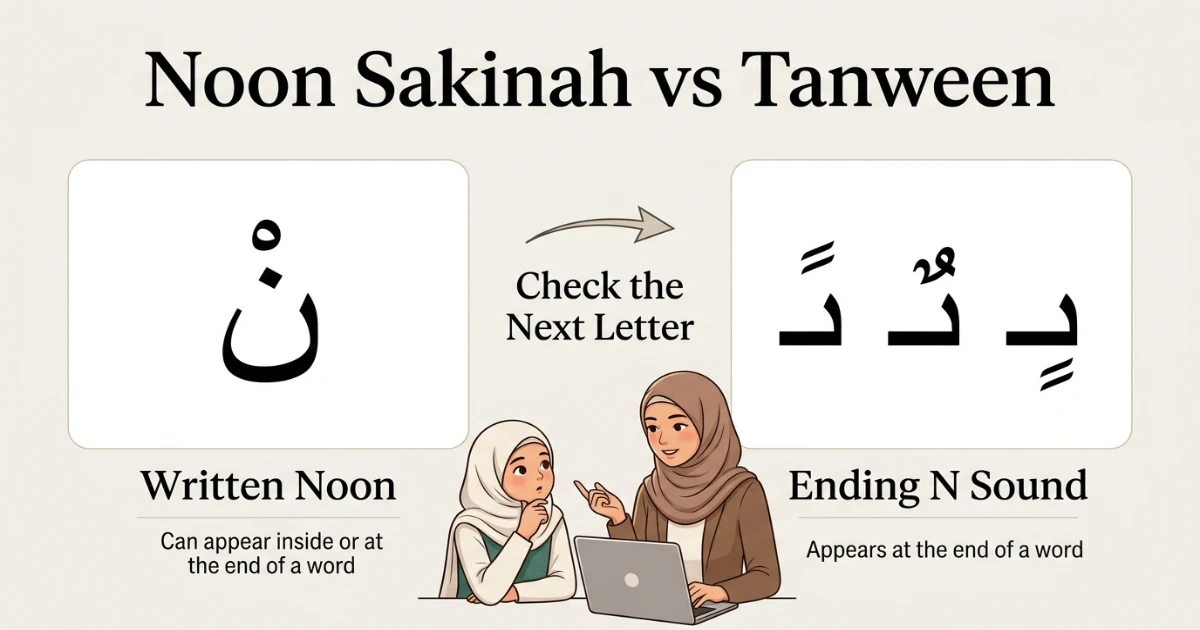
Do not ask, “Which rule do I remember?” Ask, “What is the next letter?” The next letter decides whether you use Izhar, Idgham, Iqlab, or Ikhfa.
The four Noon Sakinah and Tanween rules at a glance
| Rule | Letters | What happens? | Ghunnah? | Beginner clue |
|---|---|---|---|---|
| Izhar Halqi | ء ه ع ح غ خ | Pronounce the Noon or Tanween clearly | No extra Ghunnah treatment | Six throat letters |
| Idgham with Ghunnah | ي ن م و | Merge into the next letter | Yes, commonly two counts | YANMU: ينمو |
| Idgham without Ghunnah | ل ر | Merge directly into Lam or Raa | No | Lam and Raa |
| Iqlab | ب | Change to a hidden Meem-like sound | Yes, commonly two counts | Only Baa |
| Ikhfa Haqiqi | ت ث ج د ذ ز س ش ص ض ط ظ ف ق ك | Hide the Noon sound between clear pronunciation and merging | Yes, commonly two counts | The remaining 15 letters |
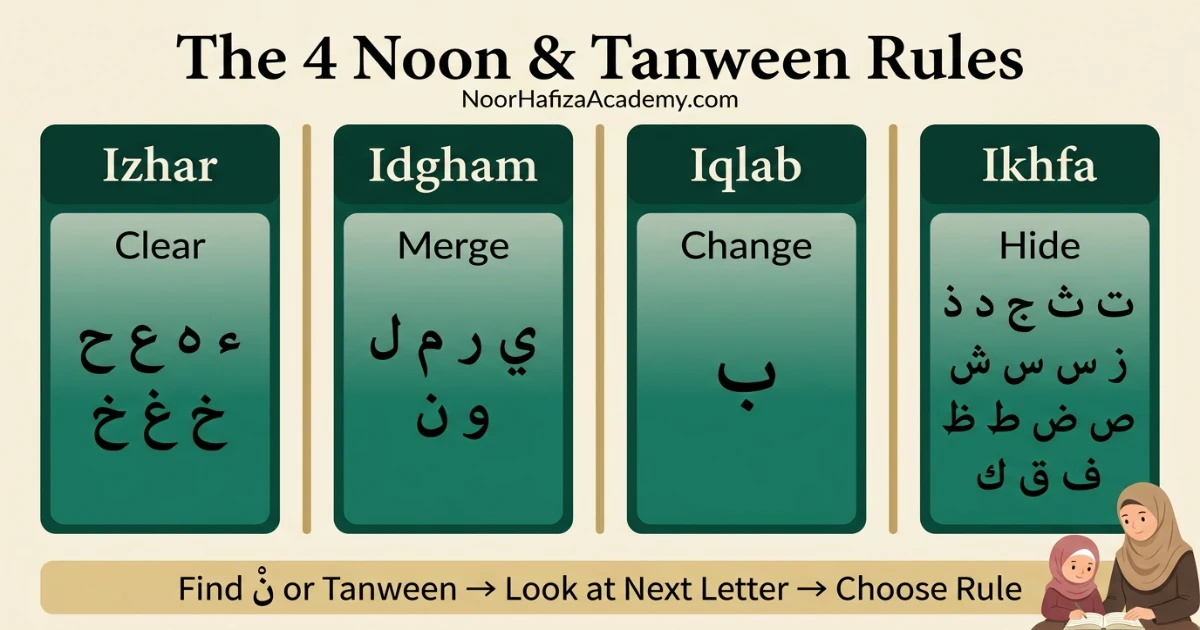
Izhar Halqi: pronounce the Noon sound clearly
Izhar means clarity or making something clear. Halqi refers to the throat. Izhar Halqi happens when Noon Sakinah or Tanween is followed by one of the six throat letters. The Noon sound remains clear and separate rather than being merged or hidden.
The six Izhar letters
When one of these six letters comes immediately after Noon Sakinah or Tanween, pronounce the “n” sound clearly without merging it into the next letter.
The reason these letters are grouped together is articulation. They come from different areas of the throat, while Noon is articulated with the tongue. Because the articulation points are sufficiently separated, the Noon sound remains distinct.
How Izhar should sound
The learner should hear a complete Noon sound before moving into the throat letter. However, “clear” does not mean “detached.” Do not insert a pause between the two words or letters. The recitation should remain connected and smooth.
Every Noon has a natural nasal quality, but Izhar should not be turned into a long two-count Ghunnah like Ikhfa or Idgham with Ghunnah. Keep the Noon clear and proportionate.
Idgham: merging Noon Sakinah or Tanween into the next letter
Idgham means merging or inserting one sound into another. When Noon Sakinah or Tanween is followed by one of six Idgham letters, the Noon sound merges into the next letter. These six letters are:
A common memory word is يرملون (Yarmaloon), which contains all six letters. But beginners must then divide these six letters into two groups: Idgham with Ghunnah and Idgham without Ghunnah.
Idgham with Ghunnah
Letters: ي ن م و. Merge the Noon or Tanween into the next letter while keeping the nasal Ghunnah, commonly taught for two counts.
Idgham without Ghunnah
Letters: ل ر. Merge the Noon or Tanween directly into Lam or Raa without carrying a Ghunnah through the merge.
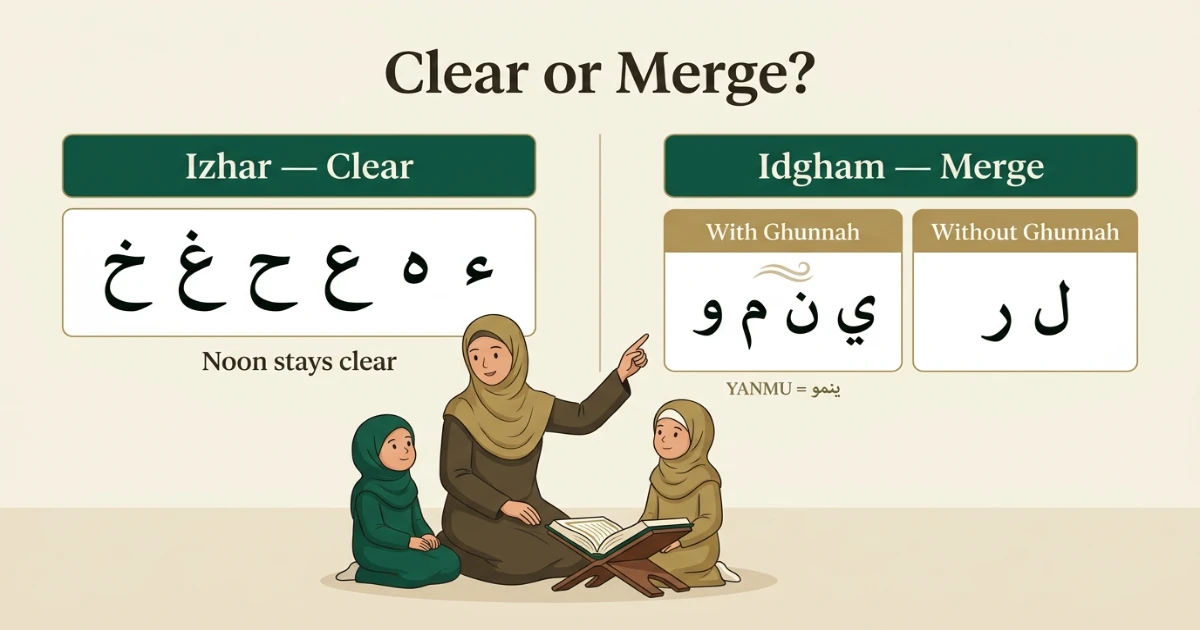
What does “merge” actually mean?
You should not pronounce a full, separate Noon and then start the Idgham letter. Instead, the Noon loses its independent articulation and blends into the next sound. In Idgham with Ghunnah, the nasal sound remains while the tongue prepares for the following letter. In Idgham without Ghunnah, the transition goes directly into Lam or Raa.
In the standard beginner treatment, Idgham of Noon Sakinah occurs when the Noon is at the end of one word and the Idgham letter begins the next word. If Noon Sakinah and one of the Idgham letters occur within the same word in certain well-known Quranic words, Idgham is not applied.
The famous same-word exceptions: Izhar Mutlaq
Students are often taught four famous Quranic words where Noon Sakinah is followed by a Yaa or Waw inside the same word, but the Noon is pronounced clearly rather than merged. These are commonly listed as:
This clear pronunciation is often called Izhar Mutlaq. The purpose of teaching these words early is to stop the beginner from applying Idgham mechanically whenever Yaa or Waw follows a Noon Sakinah.
Iqlab: change the Noon sound before Baa
Iqlab means changing or converting. This rule is very easy to identify because it has only one letter: Baa, ب. When Noon Sakinah or Tanween comes before Baa, the Noon sound changes into a concealed Meem-like sound accompanied by Ghunnah.
The only Iqlab letter
Do not pronounce a clear Noon before Baa. Prepare the lips lightly for the Baa while producing a hidden Meem-like nasal sound, commonly held for two counts.
In many printed Mushafs, a small Meem sign can appear over the Noon Sakinah or Tanween to signal Iqlab. This visual clue is useful, but students should still learn the rule from the next letter, because not every printed script uses signs in exactly the same style.
How should the lips behave in Iqlab?
The lips should prepare for the following Baa without making a heavy, fully pronounced Meem before it. If the lips close too strongly and the reader pronounces a complete Meem, the sound becomes heavier than the intended concealed transition. If the lips stay completely open, the Baa is difficult to enter naturally. This balance is one of the reasons live teacher correction is helpful.
Iqlab is a changed and concealed sound, not a normal standalone Meem. Keep the Ghunnah smooth and move directly into the Baa.
Ikhfa Haqiqi: hide the Noon sound with controlled Ghunnah
Ikhfa means hiding or concealment. In Ikhfa, the Noon sound is neither pronounced fully clearly like Izhar nor completely merged like Idgham. Instead, it is concealed while Ghunnah remains. Ikhfa applies before fifteen letters:
What happens in Ikhfa?
Do not place the tongue in the full Noon position. Keep the nasal Ghunnah while preparing the mouth for the articulation point of the next letter. The Ghunnah is commonly taught for two counts.
Ikhfa can feel harder than the other three rules because there is no single fixed mouth shape. The mouth prepares for whichever Ikhfa letter follows. For example, Ikhfa before Qaf feels different from Ikhfa before Taa because the next articulation point is different. The Ghunnah stays nasal, but the oral preparation changes.
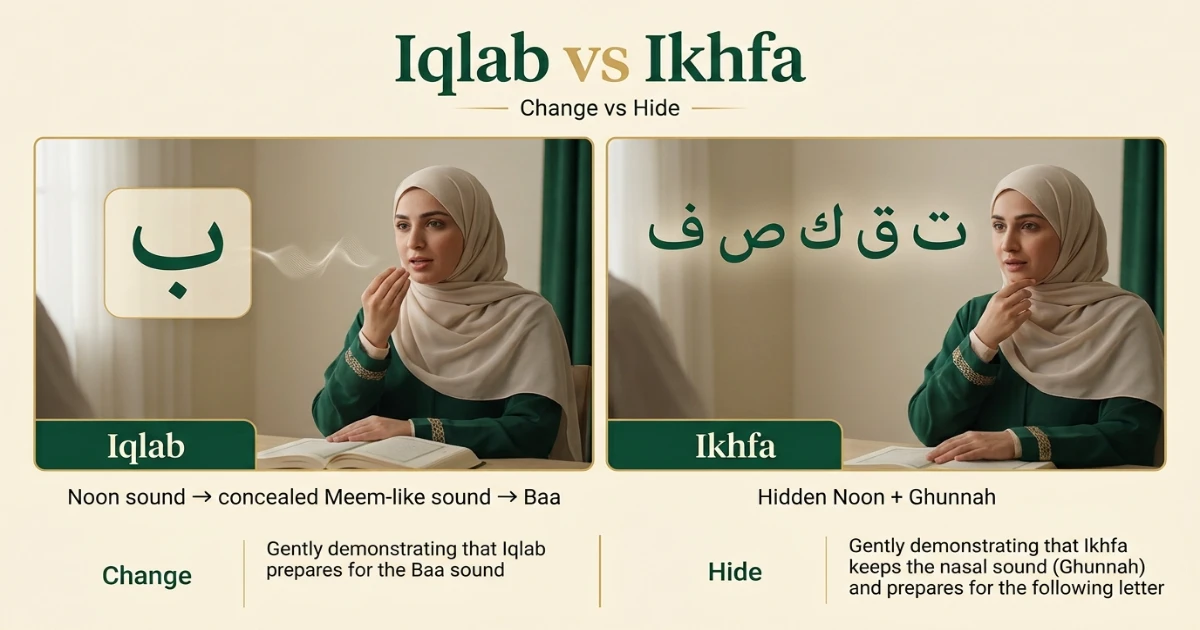
Why Ikhfa is called a middle state
Teachers often describe Ikhfa as being between Izhar and Idgham. You do not hear a fully articulated Noon, but the Noon has not disappeared completely either because the Ghunnah remains. This middle quality is what a beginner should listen for.
Which Noon Sakinah and Tanween rules use Ghunnah?
Ghunnah is the nasal sound that comes through the nasal passage. In the four-rule system, the rules are easiest to remember by asking whether the nasal sound remains strongly present.
Izhar
No extended Ghunnah treatment. Pronounce the Noon clearly and move into the throat letter.
Idgham
With ي ن م و, Ghunnah is retained. With ل ر, the merge is without Ghunnah.
Iqlab
Yes. A concealed Meem-like nasal sound is produced before Baa.
Ikhfa
Yes. The Noon is hidden while the nasal sound is maintained.
For beginner teaching, the Ghunnah in Idgham with Ghunnah, Iqlab, and Ikhfa is commonly trained for two counts. The exact sound quality depends on the following letter and rule, so “two counts” should not be reduced to simply holding the nose sound for the same shape every time.
For a deeper explanation, see our guide to Ghunnah in Tajweed: Meaning, Letters and Practice Tips.
A simple decision process for every Noon Sakinah or Tanween
Find Noon Sakinah or Tanween
Look for نْ or one of the tanween signs at the end of a word.
Look at the next letter
Ignore the rule name for a moment. Your only job is to identify the letter immediately after the Noon sound.
Is it one of the six throat letters?
If yes, use Izhar and pronounce the Noon clearly.
Is it one of يرملون?
If yes, use Idgham. Keep Ghunnah with ي ن م و and omit Ghunnah with ل ر.
Is it Baa?
If yes, use Iqlab: convert to a concealed Meem-like nasal sound before the Baa.
If none of those, use Ikhfa
The remaining fifteen letters belong to Ikhfa. Hide the Noon sound with controlled Ghunnah.
Learn the 6 Izhar letters, the 6 Idgham letters, and the single Iqlab letter. Everything left from the Arabic alphabet belongs to the 15-letter Ikhfa group.
Noon Sakinah and Tanween examples by rule
| Rule | Noon Sakinah example | Tanween example | What to listen for |
|---|---|---|---|
| Izhar | مِنْ هَادٍ | عَلِيمٌ حَكِيمٌ | A clear “n” before the throat letter |
| Idgham with Ghunnah | مَن يَقُولُ | خَيْرًا يَرَهُ | Merge plus nasal Ghunnah |
| Idgham without Ghunnah | مِن رَّبِّهِمْ | هُدًى لِّلْمُتَّقِينَ | Direct merge into Raa or Lam |
| Iqlab | مِنۢ بَعْدِ | سَمِيعٌۢ بَصِيرٌ | Concealed Meem-like Ghunnah before Baa |
| Ikhfa | مِنْ قَبْلُ | أَجْرًا كَبِيرًا | Hidden Noon with Ghunnah |
Do all three types of Tanween follow the same rules?
Yes. Fathatayn, dammatayn, and kasratayn all create an “n” sound in connected recitation, so each follows the same four-rule system based on the next letter. The visual vowel changes, but the decision process does not.
Fathatayn
Produces an “an” ending in connected recitation. Check the next letter for Izhar, Idgham, Iqlab, or Ikhfa.
Dammatayn
Produces an “un” ending in connected recitation. The next letter determines the Tajweed rule.
Kasratayn
Produces an “in” ending in connected recitation. Again, the following letter decides the rule.
The phrase in connected recitation matters. Tanween behavior can change when you stop on a word. For example, many words with fathatayn are stopped with an Alif-like ending rather than the “an” sound. That stopping behavior belongs to waqf and Madd topics rather than the Noon Sakinah/Tanween connection rule itself.
Common Noon Sakinah and Tanween mistakes beginners make
1. Pronouncing every Noon clearly
This removes Idgham, Iqlab, and Ikhfa. Always look at the next letter before deciding how much of the Noon sound remains.
2. Using Ghunnah in Idgham with Lam or Raa
Lam and Raa belong to Idgham without Ghunnah. The transition should merge directly into the next letter.
3. Making Iqlab a full Meem
The sound is Meem-like and concealed. Over-closing the lips can create an overly explicit Meem before Baa.
4. Touching the tongue to the Noon point in Ikhfa
If the tongue fully articulates Noon, the sound becomes too clear and moves toward Izhar.
5. Pausing between words to “show” the rule
These rules are designed for connected recitation. Do not insert artificial gaps between Tanween or Noon and the next letter.
6. Treating all Ghunnah the same
The nasal sound remains important, but the mouth prepares differently for Yaa, Meem, Waw, Baa, Qaf, Kaf, and other following letters.
7. Applying Idgham inside the famous exception words
Words such as الدنيا and بنيان preserve a clear Noon even though Yaa follows inside the same word.
8. Memorizing letters without reciting examples
Recognition is useful, but Tajweed is an oral skill. Students need repeated listening, imitation, and correction.
A seven-day Noon Sakinah and Tanween practice plan
The fastest way to make these rules usable is to learn one pattern at a time and then mix them. Avoid memorizing all twenty-eight letters in one sitting and expecting fluent recitation immediately.
Learn the difference between Noon Sakinah and Tanween
Find ten examples of نْ and ten examples of tanween. Do not apply rules yet; just identify the Noon sound.
Master the six Izhar letters
Practise ء ه ع ح غ خ. Keep the Noon clear and connected without turning it into a long Ghunnah.
Split Idgham into two groups
Practise ينمو with Ghunnah, then Lam and Raa without Ghunnah. Compare the difference by ear.
Focus only on Iqlab
Use several examples before Baa. Practise the light lip preparation and concealed Meem-like Ghunnah.
Learn Ikhfa by clusters
Do not rush all fifteen letters. Practise a few at a time and notice how the mouth prepares for each next articulation point.
Use mixed examples
Before reciting each phrase, name the rule based only on the next letter. Then recite without stopping between words.
Read naturally from a short surah
Stop naming the rule aloud. Mark your mistakes, record the recitation, and ask a teacher to correct the most repeated error.

How to teach Noon Sakinah and Tanween rules to children
Children usually learn these rules more easily through four clear actions rather than four long definitions. You can describe them as clear, merge, change, hide. Attach the Arabic names only after the child understands the sound.
Izhar
Clear it. Say the Noon sound clearly before the six throat letters.
Idgham
Merge it. Blend the Noon into the next Idgham letter.
Iqlab
Change it. Before Baa, change to the hidden Meem-like nasal sound.
Ikhfa
Hide it. Keep a nasal sound but do not pronounce a full Noon.
Use short cards with one trigger letter at a time. Show the child a phrase, ask “What comes next?”, and let her identify the action before reciting. This builds the habit of reading evidence from the Mushaf instead of guessing from memory.
For younger learners, avoid correcting pronunciation, Ghunnah timing, letter recognition, and fluency all at once. Choose one rule as the weekly target and let the teacher guide the home practice.
Listening practice: what each rule should sound like
When listening to a teacher or skilled reciter, compare the amount of Noon identity you hear. In Izhar, the Noon is obvious and complete. In Idgham, the Noon disappears into the following letter. In Iqlab, the sound changes toward a concealed Meem before Baa. In Ikhfa, you hear the nasal quality but not a fully articulated Noon.
Use one reciter or teacher at a time for training. Different recitation speeds can make the same two-count Ghunnah feel longer or shorter in seconds. The target is proportional timing and correct sound quality, not copying a fixed stopwatch duration.
A useful exercise is minimal contrast. Recite one Izhar example and one Ikhfa example back to back. Then compare Idgham with Ghunnah against Idgham without Ghunnah. Finally compare Iqlab against Ikhfa before Baa and Kaf. These pairs teach the ear what the labels actually mean.
Beginner checklist before moving to more advanced Tajweed
- I can recognize Noon Sakinah in the Mushaf.
- I can recognize fathatayn, dammatayn, and kasratayn.
- I know the six Izhar throat letters.
- I know the six Idgham letters in يرملون.
- I can separate Idgham with Ghunnah from Idgham without Ghunnah.
- I know that Baa alone triggers Iqlab.
- I know the fifteen Ikhfa letters or can identify them as the remaining group.
- I can explain why الدنيا does not use normal Idgham.
- I can keep Ghunnah smooth without breaking the flow of recitation.
- I can identify the rule by looking at the next letter rather than guessing.
Why these four rules are easier with a Tajweed teacher
A chart can teach you which letters belong to which rule, but it cannot hear whether your Noon is too clear in Ikhfa, whether your lips are closing too heavily in Iqlab, or whether you are carrying Ghunnah into Lam and Raa. Those are sound-quality problems, not memory problems.
A live Tajweed teacher can identify which error repeats most often and correct one point at a time. This is especially helpful for children and beginners because too many corrections at once can make recitation mechanical. A teacher can also keep Ghunnah length consistent with the recitation method being taught.
Noor Hafiza Academy offers live online Quran and Tajweed learning with female Quran teachers for children, girls, women, sisters, beginners, and learners improving Quran recitation.
FAQs about Noon Sakinah and Tanween rules
What are the four rules of Noon Sakinah and Tanween?
What are the six Izhar letters?
What are the six Idgham letters?
Which Idgham letters use Ghunnah?
How many Iqlab letters are there?
How many Ikhfa letters are there?
How long is Ghunnah in Ikhfa?
Does Izhar have Ghunnah?
What is the difference between Ikhfa and Iqlab?
Why is there no Idgham in the word الدنيا?
Do all types of Tanween follow the same four rules?
What is the easiest way to memorize the rules?
Can I learn Noon Sakinah and Tanween without a teacher?
What should I learn after Noon Sakinah and Tanween?
Learn to recognize the next letter, apply the right rule, and recite with confidence
Master Izhar, Idgham, Iqlab, and Ikhfa one sound at a time. Noor Hafiza Academy can help learners practise Noon Sakinah and Tanween rules live with a female Quran teacher and receive correction on Ghunnah, merging, concealment, and articulation.